
As they say, “the best meal is a free meal,” and so very true when it’s a über-quality kaiseki meal in Tokyo. Today we were treated a complimentary meal at Unkai located in ANA Intercontinental Tokyo.

Overlooking the manicured perfection of a traditional garden and pond designed to highlight each season’s beauty, Unkai 雲海, meaning “sea of clouds”, showcases regional specialties and the essence of Japanese cuisine with carefully selected fresh seasonal ingredients.

The entrance of the restaurant features a familiar feature of traditional teahouses. A stone lantern is placed close to a stone basin near the entrance where visitors wash their hands before entering the tearoom. Here, these elements are modernised with wrought iron lantern and glass basin shaped like the traditional stone one.

As we walked towards our private room, the corridor showcased traditional Japanese hanging dolls. Hanging decoration of Hinamatsuri (Doll Festival) is a custom originated in Edo period which is now mainly performed around Izu Inatori area. The decorations, while reflecting the general good wishes for children, also have symbolic meanings. For example, monkeys supposedly have the ability to ward off calamities; mandarin ducks reflect love between spouses; and pillows represent children who sleep well and grow healthy.

There are so many fun decorative elements to spot along the way, like these rabbits under the full moon. Instead of the “man in the moon” found in Western folklore, Japanese tradition associates the moon with a rabbit pounding mochi.

For an unforgettable experience, private tatami dining rooms offer refined surrounds in which to savour their famous Kaiseki degustation meal.
「恵」懐石料理 “Kei” Kaiseki Course
小さな春 Appetisers “Little Spring”

The appetiser course is also known as 八寸 Hassun and consisted of 9 different small dishes, like little bursts of springtime. Among all the little bites, I loved the firefly squid 蛍島賊 from Toyama Bay and simmered herring 春告魚 the best. Both have great flavours and summoned the coming of spring.


- 白魚唐揚げ 桜塩 Deep-fried icefish
- うるいと近江蒟白和え “Urui” mountain vegetable and konjac with mushed tofu
- 北海道百合根の卵の花 はなびら百合根 Mushed lily bulb


- 蛍島賊落の基味噌和え Firefly squid with butterbur sprouts miso
- 筍土佐煮 木の芽 Bamboo shoots
- 鯛の子旨煮 鍵族 Stewed sea bream roe and bracken


- 田岸と春子椎茸麻よごし Japanese parsley and shiitake mushroom with sesame paste
- 鶏松風 Minced chicken
- 春告魚山椒煮 天豆 桜人参 Simmered herring with Japanese pepper, broad bean, carrot
春の淡味 Soup “Flavour of Spring”

The next course is traditionally known as 蓋物 Futamono, or lidded course, and is served in a beautifully decorated lacquerware with lid. It is commonly a soup or simmered dish.

潮仕立て Shio shitate (lit. “tide tailoring”) is a clear soup dish that condenses the umami of seafood with a broth made of seafood boiled in kelp and flavoured with only salt and soy sauce. This soup consisted of a fish ball stuffed with a whole clam known as 蛤の摘み取り真丈. 真丈(しんじょ)Shinjo is a style in Japanese cuisine that blended yamaimo (Japanese yam), egg white and fish into a fish ball.

Other ingredients in this luxurious and delicious soup include 鶯豆腐 green pea tofu, 根三つ葉 mitsuba with roots, 生姜 ginger to balance the fishiness (although there was none), and 山独活 (ウド) udo which is a special Japanese wild vegetable known as mountain asparagus.
春の色 Sashimi “Colours of Spring”

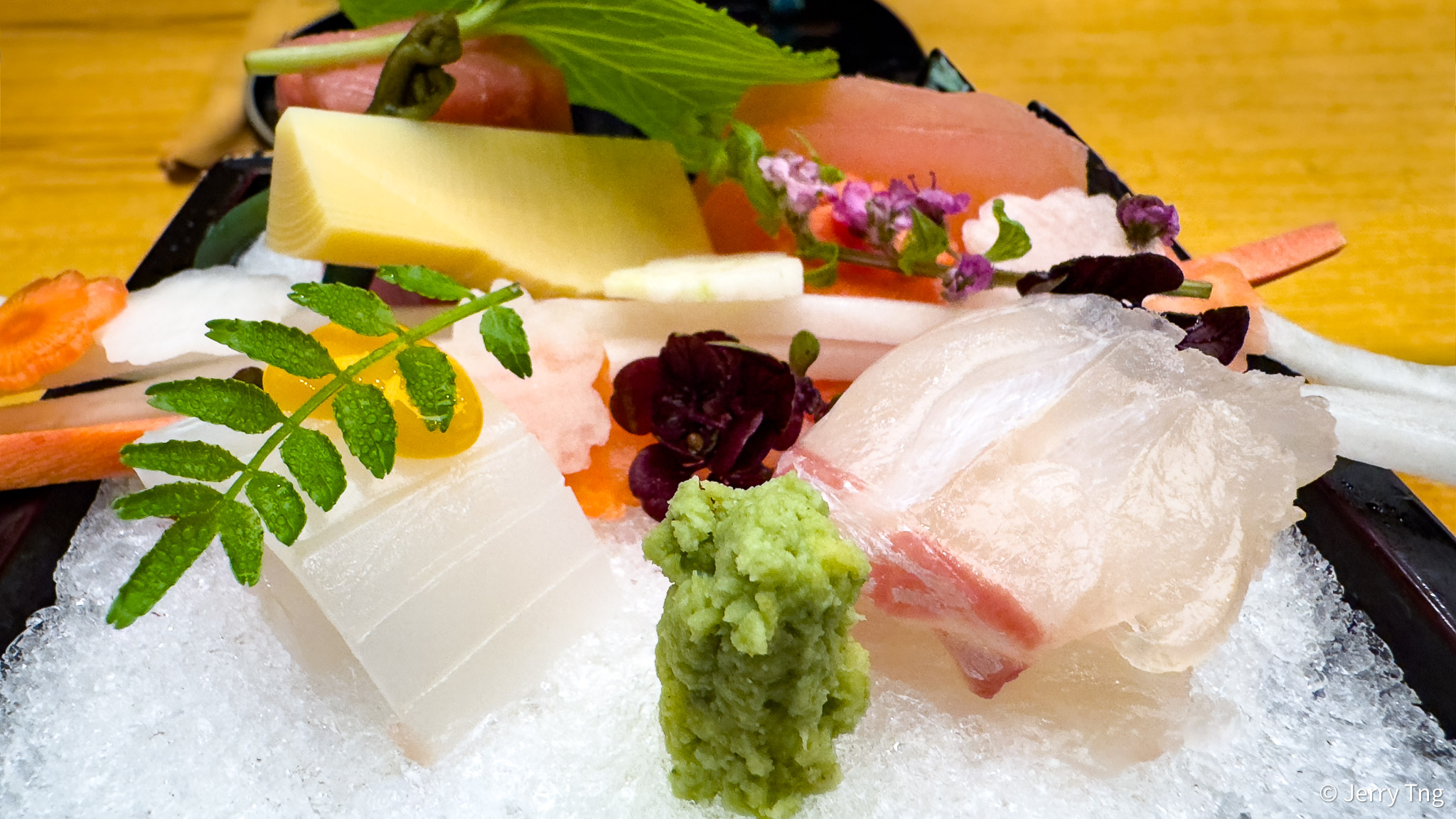
Aptly named the “Colours of Spring”, this is the お造り Otsukuri course of the kaiseki. The sashimi course features 桜鯛 “Sakura” sea bream that heralds the start of spring, 近海本鮪 wild-caught “true” tuna, 障泥鳥賊 bigfin reef squid and 勝浦まかじき Katsuura-caught marlin with 芽物いろいろ various sprouts that included bamboo sprouts. Even the condiments to eat the sashimi with are special – 有東木の山葵 wasabi from Yutogi that has the best fresh wasabi, and 土佐醤油 soy sauce from Tosa.

This is the first time I had marlin sashimi. It is a really light fish, almost tasteless and very lean. I was really surprised how translucent the flesh was.
春の香り Grilled dish “Scent of Spring”

This course is named the “Scent of Spring” because of the wonderful smoky fragrance from the grilled course, or 焼物 Yakimono.

First bite is grilled bamboo shoot 早堀り竹の子. Takenoko 竹の子, which literally translates to “bamboo’s child”, refers to the edible young bamboo shoots, a popular spring vegetable in Japanese cuisine, known for their crisp texture and mild, slightly sweet taste. The bamboo shoot has been lightly brushed with miso, making a lovely sweet and salty treat.

The second bite is grilled Hokkaido scallop 帆立磯辺. The style copies that of isobemaki 磯辺巻き that is made by grilling mochi and pouring soy sauce while it’s hot and then wrapping in nori seaweed. Here instead of mochi, a whole scallop is used, grilled over charcoal and brushed with soy sauce, and then wrapped in nori before serving. Just look at the thickness of the scallop, delicious!

The final bite of this course is the grilled sakura trout with miso, leaf buds vinegar sauce 噴火湾桜鱒諸味噌漬け 木の芽酢掛け. The sakura trout is line caught in Uchiura Bay in Hokkaido and is the favourite among sport fishing enthusiasts. The fish changes in its body colour to pink as it matures, just like the beautiful cherry blossoms in spring. The tender, buttery fish pairs very well with Moromi miso and salsa made from Japanese prickly-ash 木の芽.
春の旨味 Simmered dish “Taste of Spring”

Next up, 煮物 Takiawase course of simmered Japanese wagyu beef 黒毛和牛 with burdock 牛蒡, butterbur 蕗, and Yuzu citrus pepper 柚子胡椒 in a shallow claypot filled with smokey scorched rice おこげ (okoge).

Japanese butterbur 蕗 is recommended for use in simmered, dressed and stir-fried dishes that make the most of its crunch, flavourful aroma and light green colour. The simmered dish is complete by topping with crispy sakura shrimps 桜海老 and soft egg 朧たまごとじ (oboro tamago). Very satisfying dish.
春の温もり Rice “Warmth of Spring”

Not the traditional 御飯 Gohan course, it features 道明寺桜餅 doumyōji sakuramochi or cherry blossom rice cake, a famous produce from Kyoto. The rice cake is smooched with 銀餡 Gin-an, a transparent sauce made from thickening dashi with kudzu powder.

Domyoji Sakuramochi is a Japanese dessert that originated from Domyoji Temple 道明寺 in Fujiidera City 藤井寺市, Osaka. The dessert version has a red bean paste filling, but this variation is only glutinous rice. The aroma transferred from the cherry blossom leaves and the slight saltiness go well together.

唐墨 Karasumi, which literally means Chinese inkslab because of apperance, is cured mullet roe aka Wuyuzi 烏魚子 in Taiwan or bottarga in Italy. It is sliced and added on the rice cake, and provides a lot of flavours and umami to the slightly sweet mochi. Served with the pickled 桜の花 cherry blossoms for a variety of taste and a slice of poached 尼鯛 Akaamadai (tilefish).

And like all rice dish in Japan, there’s always miso soup, in this instance red miso soup or 赤出汁 akadashi, and pickles or 香の物 konomono.
花冷え Dessert “Cold Flowers”
The theme of the dessert course is 桜色の醍醐 sakura colours of Daigoji Temple. Here’s how the sakura blossoms looked like in the temple that is said to be the place where Hideyoshi Toyotomi went cherry blossom viewing in the past. It is still the vantage point where you can see the beautiful cherry blossom scenery in Kyoto.

五倍茶のあいすくりーむ matcha ice cream
あんみつ Anmitsu is a traditional Japanese cold dessert made up of a refreshing mix of agar jelly (kanten), sweet red bean paste (anko), and fresh fruits, often topped with black sugar syrup (kuromitsu). Served with a scoop of thick matcha ice cream.

かき氷 Kakigōri is a Japanese shaved ice dessert flavored with syrup and a sweetener, often condensed milk. We call them ice kacang in Singapore.

Similarly, they also feature fruits and sweetened red beans in the ice shaving, except that the Japanese version used fresh seasonal fruits and red bean paste, while Singapore versions used canned cocktail fruits and whole red beans. But in both versions, I love the condensed milk that has been liberally drizzled on the ice.

There’s a seasonal choice made from strawberries. Looking like a strawberry ripple ice cream, it was also delicious and refreshing.

What can I say, it was a really good meal. The ambiance was conducive for business talks and relationship building as the drinks kept pouring. The service was attentive and yet discreet. I do not find the waitress at all intrusive, and yet they appeared at the right moment. Recommend all to give it a try.
Unkai Japanese Restaurant 日本料理「雲海」
1 Chome-12-33 Akasaka, Minato City, Tokyo 107-0052, Japan
Tel : +81 (03) 3505 1185 (Reservations)
Visited Mar 2025
0 comments on “Unkai 雲海 @ Tokyo”