
It is quite difficult to find a good high-end sushi-ya that can accommodate 10 pax. Luckily we found this place in Ginza.


In Ginza, sushi restaurants like this are everywhere given that it’s an entertainment district and its close proximity to the old Tsukiji Market.

Sushi Tomi is the new kind on the block as they only opened in Aug 2023, and I have to give them the credit to open at Ground Zero. The Kanji for the restaurant says “冨味”, literally “rich taste”; this is the first time I see the character tomi 富 written without the dash on top. Hopefully they are not missing a dot elsewhere.

The sushi served is the traditional Edo-mae nigiri. Sitting at the counter you can watch the itamae 板前 performs his magic in transforming each seasonal ingredients into delicious sushi.

This evening we were seated in the tatami room seats. It is a private room, so it is perfect for business gatherings. Advantage? You can be as noisy as you want to be without disturbing anyone else. The downside, you cannot see the action at the itamae.
Omakase Dinner
鰆ともずくと菜の花のお吸い物 Spanish mackerel, seaweed and rapeseed soup

The meal kicked off with a clear soup with sawara 鰆 or Japanese Spanish mackerel and a stalk of rapeseed. The kelp is lurking somewhere underneath. Reminded me of my mom’s Teochew fish soup without the sour plum. At its peak level of fat, it was soft, almost flaky texture and great umami flavours.
マハタ、ホッキ貝、ボタン海老のお刺身 Grouper, surf clam, and button shrimp sashimi

Next up, a selection of three types of sashimi served with freshly grated wasabi and 竹炭の塩 bamboo charcoal salt. This is the first time I had mahata マハタor grouper as a sashimi. It is quite a tough fish to be eaten raw, so they have aged the fish a bit to tenderise it. Couldn’t say I enjoyed it.
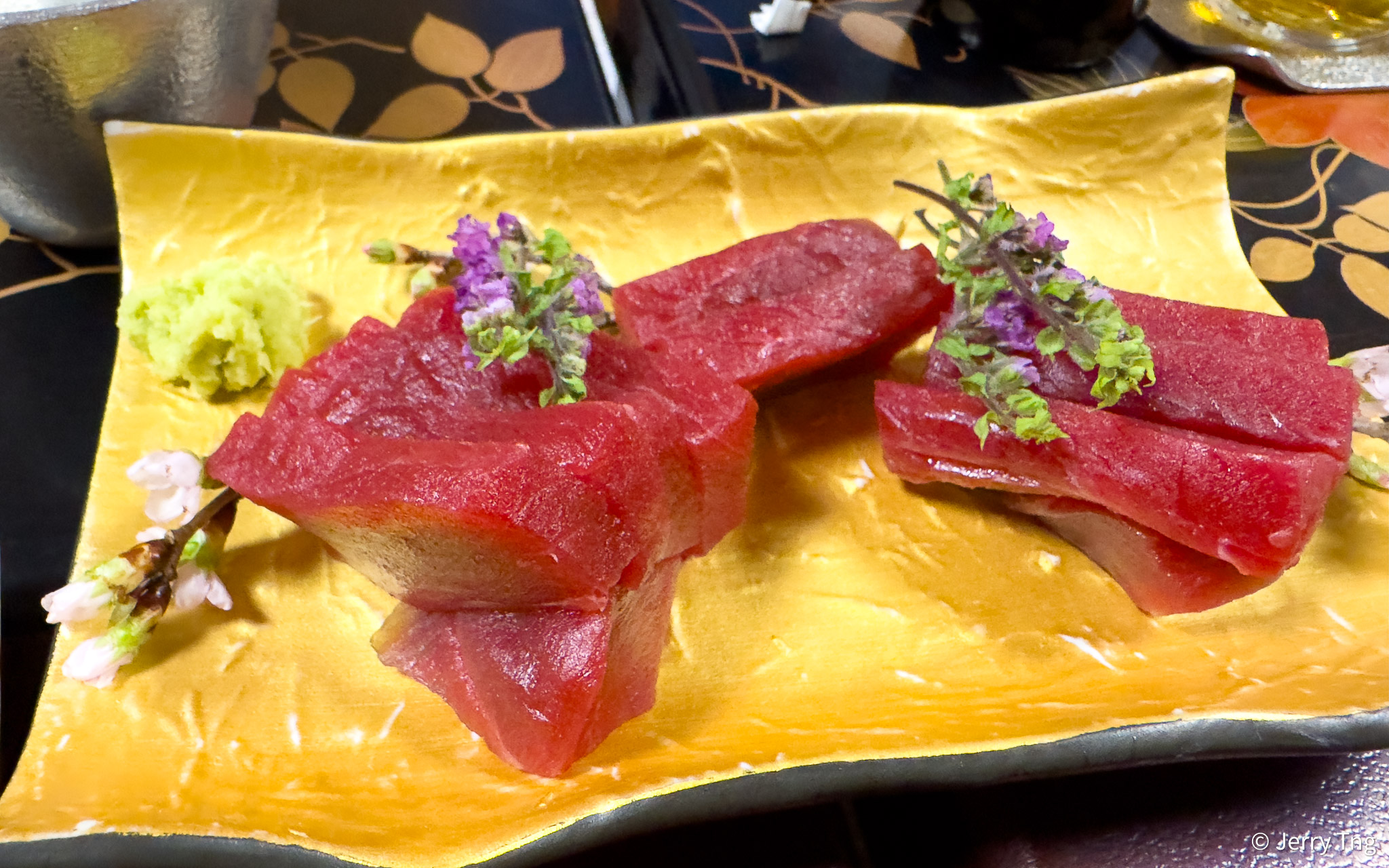
本 マグロ Bluefin tuna

This is actually their best work in the restaurant, marinated bluefin tuna aka akami zuké 本鮪の漬. During the Edo period virtually all maguro was marinated in a shoyunikiri in order to preserve it. Doing so not only preserved the fish, but it also kept it visually appealing as otherwise the tuna’s flesh would have turned dark when exposed to air. Visually, zuké has a bold, bright red appearance, and texturally it is incredibly smooth thanks to the marinade.
たけのこ焼き Grilled bamboo shoot

Takenoko or bamboo shoots are in season. And what way to enjoy it then to simply grilled it with a slight brush of shoyu.

By this time, we already had our second bottle of sake or Japanese rice wine, which is the best accompaniment with sushi. I am not so much a sake lover as it gives me a proper hangover the next day.
中トロ、スミイカ、金目鯛昆布〆 Medium fatty tuna, squid, and red sea bream marinated in kelp

Nobody says no to chutoro 中トロ or medium fatty tuna belly. It simply melted-in-mouth. This was not the best cut as there were sinews in the laterals, but it was still tasty.
The squid, most specifically, is sumiika すみいか or Japanese spineless cuttlefish. The sumiika season continues all the way into spring, when specimens are quite large and fat. Because it was so fresh, it was served raw.
Kinmedai 金目鯛 or Splendid Alfonso is best in the winter or early spring. This particular shiromi is generally served with some of its skin still on. The skin is lightly seared “aburi” style to tenderise it and release umami flavours from the oils. And the it is smeared with 昆布 kelp soy sauce for that additional flavour.

Gari or pickled ginger is a good palate cleanser; it neutralises the lingering flavours and aromas of the previous pieces of sushi and prepares the palate for the next bite. Here they used young ginger and cut them in small pieces instead of the usual slices.
太刀魚の酒塩焼き そら豆 Grilled hairtail fish with sake and salt, broad beans

Tachiuo or hairtail/ribbon fish is one my favourite fish and they are usually pan-fried or grilled. The quality of tachiuo in these cold waters is so much better than the ones we would get in Singapore.
小肌、とろタク巻き 海ぶどう 、ハマグリ Gizzard shad, fatty takoyaki roll with sea grapes, clams

Kohada 小肌 or gizzard shad is seldom served in Singapore, and so I really treasure every encounter with this hikarimono (silver fish). The ultimate edo-style neta, it is full of umami from the omega 3 fats, acidic from the vinegar, but also deliciously sweet. Because it is not served as-is, kohada is often considered a test of the sushi chef’s skills.
とろタク巻き 海ぶどう fatty takoyaki roll with sea grapes is something that you would not get in Japan normally. This is almost a Chinese invention borrowing from the American California maki influence, to put as much as you can in a roll.
Hamaguri ハマグリ or hard clams used to be commonly found in Tokyo (Edo) Bay, but due to heavy shipping is no longer safe to eat. Today it remains an important ingredient of Edomae sushi but it is never served raw; a chef will either steam or quickly boil the clams, then marinate them in the broth along with mirin, soy sauce, and a little sugar. The cooked clams are then paired with shari and brushed with either nitsume or nikiri sauce.
ズワイガニの春巻きと蟹味噌ソース Snow crab spring rolls with crab miso sauce

This is the first time I had a spring roll in a sushi restaurant. It is a delicious Chinese style spring roll filled with zuwaikani ズワイガニ, or snow crab, and shredded ヒカマ jicama and scallions. You don’t need the カニみそ crab miso sauce as the roll itself is already satisfying. Anyway, the sauce didn’t have the deep umami flavour I expected from crab miso, which is a rich, creamy paste made from the non-meaty innards of crab.
車えび、ウニ、漬けマグロ Tiger prawns, sea urchin, marinated tuna

Kuruma ebi, or tiger prawn, was on point but not surprising. Uni (sea urchin) was alright. It was the akami zuke or marinated tuna that surprised us for its deep flavours and texture. Fresh is not always the way to go, and as they say, “Old is gold.”
穴子 Conger eel

The last piece of sushi was anago 穴子, or conger eel. As it was served alone, I finally got a close look at the shari 酢飯. The shari, aka sushi-meshi, was served slightly warm, which is good, and should be flavourful and complex, with elements of sourness (suppai) from the vinegar, but also some amai (sweetness) – either from using a little bit of sugar, or from the natural sweetness of akasu (red sake lees vinegar). It should have a visible lustre and sheen (tsuya). They have proper shari, but I find it disintegrates too quickly so it failed in the nebari section.
鉄火巻 Tuna roll

I never feel full until I have my tekkamaki 鉄火巻, or tuna roll. And tonight was no different. I didn’t expect their tekkamaki to be so long.
お椀 Misoshiru

Nothing fantastic about their misoshiru, which is quite disappointing for me, except that it was boiled with shijimi しじみ, or small freshwater clams.
玉子焼き、黒蜜 Egg custard, brown sugar syrup

I rather that they gave us some fruits, the egg custard was not something I liked. And yes, there was no tamago castellan or roll served this evening.


I chose this sushi restaurant because there was a private room that can seat my party of 10 people. For the price we paid per pax, it was not the best value-for-money as the ingredients were normal, not the crazy stuff. But this is Ginza, so nothing is really that affordable. Not that I would return anytime soon.
Sushi Tomi 鮨 冨味
8-7-19, Ginza, Chuo-ku, Tokyo, 104-0061
〒104-0061 東京都中央区銀座8-7-19 すずりゅうビル 2F
Tel : +81-3-6263-9190 (Reservations)
Visited Mar 2025
PS: I have a hunch that this sushi-ya is not owned by Japanese, or the chefs are not Japanese. They are mostly from Northeastern China and invested in this restaurant to get their residency in Japan. The calligraphy in the rooms are Chinese, and the sushi served makes me feel that I am back in Shenzhen. I could be wrong, I welcome the owners or someone to come and fact check this by leaving a comment.
0 comments on “Sushi Tomi 鮨 冨味 @ Ginza”