
Fushimi Inari Shrine 伏見稲荷大社 is an important Shinto shrine in southern Kyoto. It is famous for its thousands of vermilion torii gates, which straddle a network of trails behind its main buildings. The trails lead into the wooded forest of the sacred Mount Inari, which stands at 233 meters and belongs to the shrine grounds.

Fushimi Inari 伏見稲荷 is the most important of several thousands of shrines dedicated to Inari, the Shinto god of rice.

The main approach to the shrine is impressive, as the vermillion gates rise up in front of you.


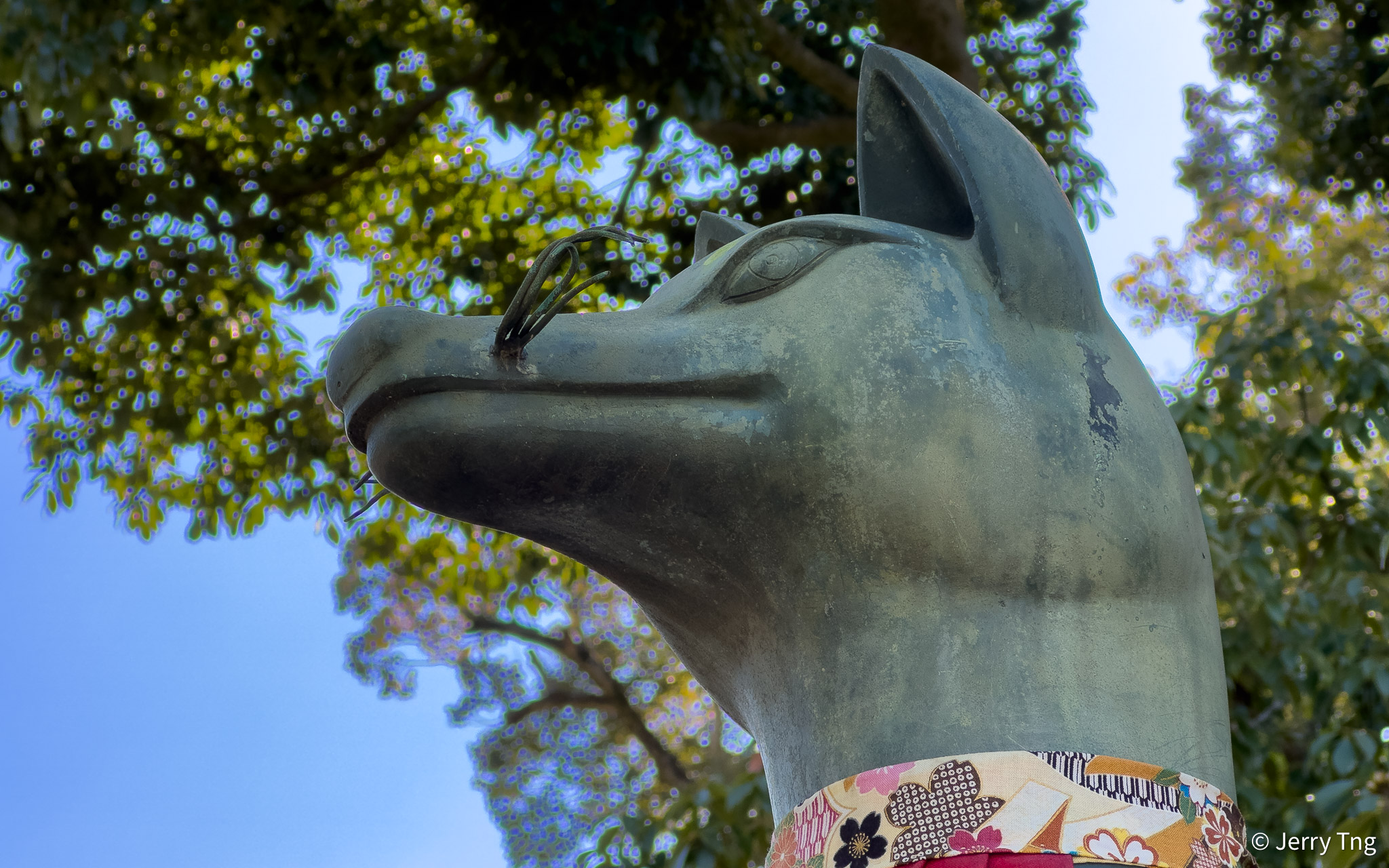
Foxes are thought to be Inari’s messengers, resulting in many fox statues across the shrine grounds. Fushimi Inari Shrine has ancient origins, predating the capital’s move to Kyoto in 794.

While the primary reason most foreign visitors come to Fushimi Inari Shrine is to explore the mountain trails, the shrine buildings themselves are also attractive.
Sites and Sights of Fushimi Inari Taisha 伏見稲荷大社
Romon 楼門 | Tower Gate

At the shrine’s entrance stands the Romon Gate 楼門, which was donated in Tensho-17 天正17年 (1589) by the famous leader Toyotomi Hideyoshi 豊臣秀吉.

車祓所 Kurumabarai-sho, or “Car Blessing Spot”, is where people can bring their vehicles to be blessed for safety by Shinto priests. Car blessings are a common practice in Japan, especially for new vehicles, where owners seek divine protection for safe travels.
Haiden 拝殿 | Worship Halls

After passing through the main gate, you will see the dance stage called Gehaiden 外拝殿, or Outer Worship Hall, where the shrine maidens perform during yearly rituals.


In Shinto shrine architecture, the haiden 拝殿 is the hall of worship or oratory. It is generally placed in front of the shrine’s main sanctuary (honden 本殿) and often built on a larger scale than the latter.

The haiden is often connected to the honden by a heiden 幣殿, or hall of offerings. While the honden is the place for the enshrined kami and off-limits to the general public, the haiden provides a space for ceremonies and for worshiping the kami 神.

Behind stands the shrine’s main hall (Honden 本殿) where all visitors are encouraged to pay respect to the resident deity by making a small offering. Because a worship service was on, we didn’t get closer to the Holden.
Higashimaru-jinja 東丸神社 | Higashimaru Shrine

Just to the right of the Gehaiden 外拝殿, you will see a small 摂末社 setsumatsusha (sub-shrine) called Higashimaru-jinja 東丸神社.

This shrine is where people come to pray for academic success. Students hoping to pass an entrance exam sometimes fold 1,000 origami cranes. There is a belief in Japan that if you fold 1,000 origami cranes, you wish will be granted. Cynical people might wonder if the time might not be better spent actually studying. Whatever the case, the cranes are beautiful.
Senbon Torii 千本鳥居 | Thousands of Torii Gates

At the very back of the shrine’s main grounds is the entrance to the torii gate-covered hiking trail, which starts with two dense, parallel rows of gates called Senbon Torii 千本鳥居 (“thousands of torii gates”).

This is where all the tourists from all around the world come to see, and they would congregate and take selfies and videos, so it gets really crowded these days. So the caretaker of the Shrine has to manage the crowd by restricting the foot traffic in one direction only. So you enter from the right, and return from the left corridor of torii gates.

On the reverse side of the torii, you will see two kanji: 奉納 hono. These mean “donated” or “offered” and are pronounced “hounou.” They’re read right to left.


The torii gates along the entire trail are donations by individuals and companies, and you will find the donor’s name and the date of the donation inscribed on the back of each gate. The donation amount starts around 400,000 yen for a smaller gate and increases to over one million yen for a large gate.

There are many records of prayers by the imperial court in ancient times. These include prayers for bountiful harvests of grain, prayers for the rain to come or stop so that the crops would have the right conditions for growing, and prayers for peace throughout Japan.


In the Heian period (794-1185), people prayed for things like good matches in marriage. Toyotomi Hideyoshi, a prominent daimyo of the 16th century, prayed fervently when his mother fell ill, and she recovered. Over the years, people also began to pray for business prosperity, prosperity of industries, safety of households, safety in traffic and improvement in the performing arts, a tradition that continues today.
Fushimi Jinpo Jinja 伏見神宝神社 | Fushimi Kandakara Shrine

Unlike the other shrines in the compound, the Fushimi Jinpo Jinja 伏見神宝神社 is an independent shrine that is not part of the Inari worship. Fushimi Kandakara Shrine, located halfway up Mt. Inari, is a shrine that enshrines Amaterasu Omikami and Inari Daimyojin, and enshrines ten kinds of sacred treasures1.


The shrine was founded in the Heian period (794-1185), and was once enshrined near the summit of Mt. Inari, where it was deeply worshiped by Emperor Uda and other members of the imperial family, but it declined in the medieval period due to political upheavals, and was moved to its current location in 1957.

On the beam near the ceiling of the worship hall is a plaque with the words “Rokon Shojo” 六根清淨 written on it. The six roots are the human senses of sight, hearing, smell, taste, and touch, plus the mind, and are prayer words (suggested to the gods) that have the meaning of keeping one clean with divine virtue when faced with defilement.


Guarding the shrine are two mythical beasts, Tenryu 天龍 (on the right of the altar) and Jiryu 地龍, who are said to be the followers of Amaterasu Omikami. Dragons play an important role in Shinto: Ryūjin, the dragon god of the sea, controls the ocean, and dragons are also linked to agriculture, crops, and rain.
Takenoko-ishi たけのこ石 | Bamboo Shoot Stone


The bamboo torii shrine located at the innermost part of the shrine grounds is the birthplace of the Tale of the Bamboo Cutter 竹取物語3, aka Tale of Princess Kaguya かぐや姫伝説, and enshrines a bamboo shoot-shaped advent stone called Takenoko-ishi たけのこ石. As this is the birthplace of The Tale of the Bamboo Cutter, there are many bamboo thickets in this area.
Walking About Fushimi Inari Taisha 伏見稲荷大社

The hike to the summit of the mountain and back takes about 2-3 hours, however, visitors are free to walk just as far as they wish before turning back. Along the way, there are multiple smaller shrines with stacks of miniature torii gates that were donated by visitors with smaller budgets. There are also a few restaurants along the way, which offer locally themed dishes such as Inari Sushi and Kitsune Udon (“Fox Udon”), both featuring pieces of aburaage (fried tofu), said to be a favourite food of foxes.
Visited Mar 2025
Footnote
- 社名になっている神宝とは
・沖津鏡(おきつかがみ)
・辺津鏡(へつかがみ)
・八握剣(やつかのつるぎ)
・生玉(いくたま)
・死返玉(まかるかへしのたま)
・足玉(たるたま)
・道返玉(ちかへしのたま)
・蛇比礼(おろちのひれ)
・蜂比礼(はちのひれ)
・品物之比礼(くさぐさのもののひれ)
の十種神宝(とくさのかんだから)のことを言い、饒速日命が天降りする際に天上からもたらされたものとされています。https://shrinetempledotblog.jp/2023/10/11/伏見神宝神社(ふしみかんだからじんじゃ)/ ↩︎ - 歌は、「ますらをは名をし立つべし後の世に聞き継ぐ人も語り継ぐがね(四一六五歌)」と「鶉鳴く古りにし里ゆ思へども何ぞも妹に逢ふよしもなき(七七五歌)」である。
The songs are “The Masuraba should make a name for itself, and those who hear it and pass it on to future generations will hear it (Poem 4165)” and “I think of the old village where quails cry, but there is no way I can meet my sister (Poem 775).” https://tom101010.hatenablog.com/entry/2023/03/23/090000 ↩︎ - The “Tale of Princess Kaguya”, also known as “The Tale of the Bamboo Cutter”, is a famous Japanese story from the Heian period (794-1185). The story captures the imagination with its enchanting plot and the charming, mysterious Princess Kaguya, a beloved figure in Japanese folklore. ↩︎
0 comments on “Kyoto Fushimi Inari Taisha 伏見稲荷大社”