
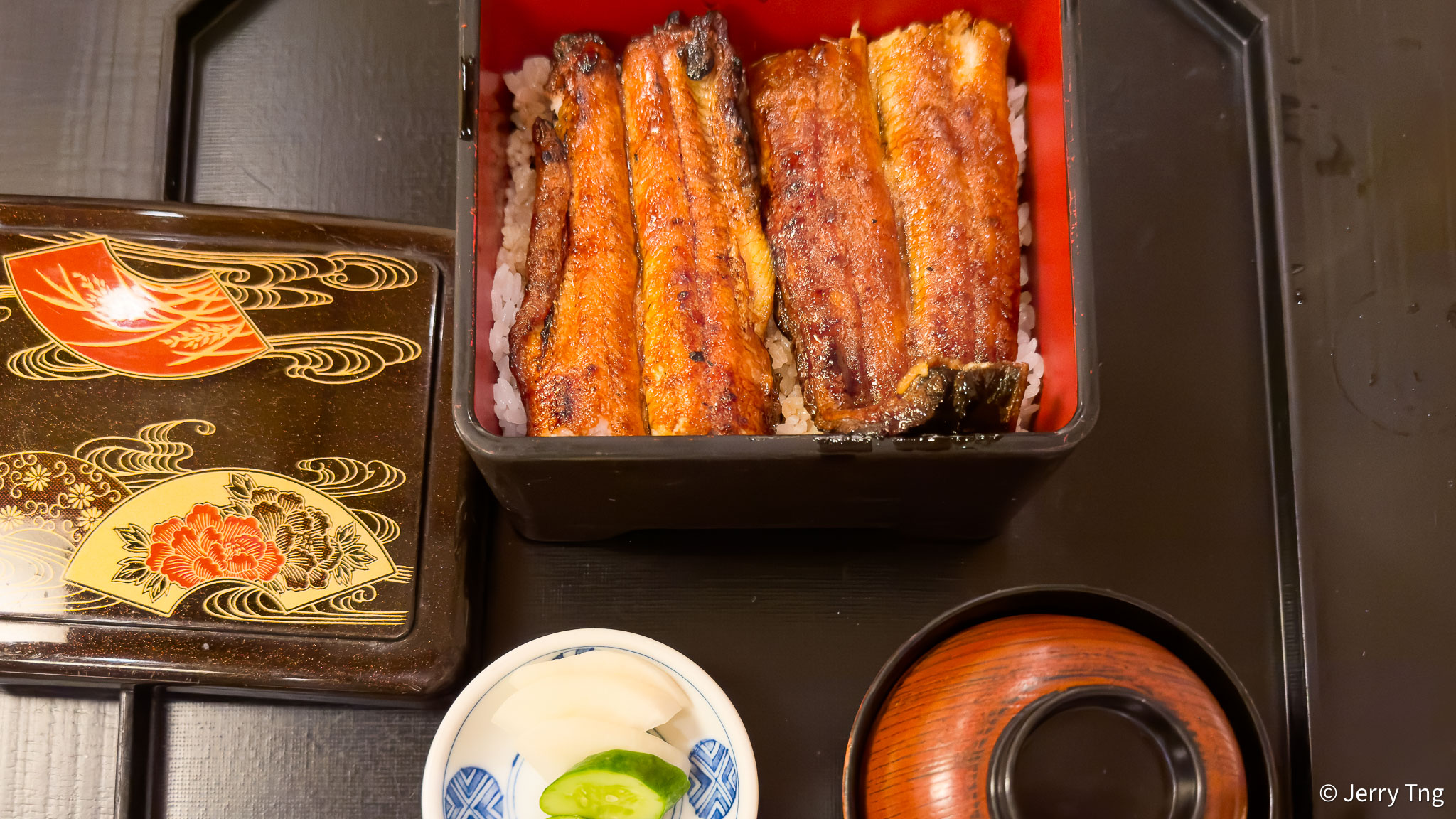
In Japan, Doyo no Ushi no Hi (lit. “Day of the Ox of the end of Summer”), aka Unagi Day, is a summer tradition where people eat unagi (freshwater eel) to combat the summer heat and fatigue. In 2025, the two days are July 19th and July 31st. This was a meal on 19 Jul 2025.

Going to a nice izakaya after work is very common among salarymen in Japan – a place to relax, get to know your co-workers better, and talk freely with the help of alcohol. Kuroza Akatsukirou 黒座暁樓 was our choice this evening because it was a special day for unagi, one of their specialty.

It seems like we came in from the backside entrance, so we walked through a corridor which is like a nice old Japanese isle, then you come out to the restaurant area which is quiet Japanese-ish with base colour of black as well.

Summer in Japan brings unique seasonal dishes featuring Ayu (sweetfish), Katsuo (skipjack tuna), Hamo (pike conger), and Unagi (eel). These ingredients are at their peak flavour during the summer months, with specific dishes highlighting their freshness and texture.
ユース仕立て Course-style
Because of intense competition among the izakayas (and a dwindling expense account among Japanese enterprises), they offer a value-for-money course package that comes with an appetiser course, sashimi, sukiyaki, fried dish, dessert and of course, the unajyu.
お通し Hors d’oeuvre

An otoshi is a small appetiser, usually served at dinner time when alcoholic beverages are consumed. In general, an otoshi fee is added to the bill as a seating charge. Tonight’s otoshi was one of my favourite. Mozuku モズク is a unique Okinawan seaweed loaded with many health benefits and many creative ways to serve, most commonly with sweet vinegar.
先付 Appetisers


フルーツトマト白ねえ
フルーツトマト白ねえ
Tofu, winter melon and pickled cherry tomato


The opening course was 5 kinds of Japanese appetisers, among which I found the 酔つ払い大海老 drunken king prawn (first from left) to be the most delicious and satisfying. I was surprised by the inclusion of fried kibinago fish in ponzu among the selection, as kibinago (silver-stripe round herring) tastes wonderful deep fried. Tofu, winter melon and pickled cherry tomato was my least favourite appetiser, although it was refreshing during these summer heat.
刺身 Sashimi

For the sashimi course, the in-season katsuo (bonito) was served. Three slices of the lean red fish were served without any other preparation. The meat of the skipjack tuna looks similar and has a similar texture to hon magura (bluefin tuna) meat, but costs so much less. And when it is shun 旬 (in-season), it can be as tasty as if not tastier than akami tuna.
すき焼 Sukiyaki

In my rush to eat this next course, sukiyaki wagyu beef, I forgot to take a picture of the raw egg yolk that came as a dipping sauce. Came with a stalk of pickled myoga (Japanese ginger) to ease the greasiness and sweetness of the beef.
揚げ物 Fried Dish


The fried dish featured a slice of kinmedai 金目鯛 with eryngii エリンギ (baby trumpet mushroom), shishito (Japanese pepper) and baby corn. I would prefer that they served the tangy sauce separately, it made all the ingredients slightly soggy.
鰻重 “Unaju” Eel Rice Bowl
The earliest mention of the association of cooked eel with summer heat is in the Man’yōshū anthology of Japanese poetry (8th century). In Otomono Yakamochi‘s poem, it is explained that in order not to lose weight due to the summer heat, cooked eel will be beneficial for health.
To Iwamaro
“Eat Eels”; 8th century Japanese poem from “Man’yōshū ” by Otomono Yakamochi
I say this:
If you’ve slimmed down in summer
There’s one thing that works:
Catch and eat eels!

“Doyo no Ushi no Hi” 土用の丑の日 is about the transition period from Summer to Autumn. This period is when the extreme heat of the long summer has accumulated, and the body becomes completely exhausted. More than just delicious, unagi is packed with nutrients: rich in vitamins A, B1, B2, D, protein, and omega-3 fatty acids. Even though there was no scientific basis for the benefits of eels, they must have been naturally accepted as the wisdom of their ancestors.

Kabayaki 蒲焼 is a preparation of unagi, where the fish is split down the back (or belly), gutted and boned, butterflied, cut into square fillets, skewered, and dipped in a sweet soy sauce-based marinade before grilling on charcoal. This is the most common method of preparing unagi that we know outside of Japan. The ell was prepared superbly, crispy and burnt on the skin side, and tender and smokey on the meat side. The sauce was just the right sweetness and consistency, and did not overpower the natural flavours of the eel.

Kuroza is actually famous for their unagi no shiroyaki うなぎの白焼き, which is an irresistible dish for eel lovers because it maximises the original taste of the eel. Unagi no shiroyaki removes excess fat contained in eel, and the flavour and umami are condensed as it is.
汁・香 Soup, Pickles

As with any rice dish, it will always come with the Japanese pickles 香物 and soup 汁

Soup for unajyu is typically not miso based because of the sweet sauce. 肝吸付 liver soup is a clear soup. To the untrained diner, this might seem like a random piece of meat in a bowl of soup, but instead this unassuming piece is actually the liver attached to the stomach of the eel.
デザート Dessert


Yokan 羊羹 is a wagashi (Japanese sweets) made of red bean paste, agar, and sugar. It is usually sold in a block form, and eaten in slices. Yōkan comes from the Chinese word yang geng 羊羹 (lit. mutton soup). But since there was no custom of eating animal meat in Japan, the Japanese replaced the meat with a paste made of kneaded barley or azuki bean flour. Around 1800, during the Edo period (1603–1868), yōkan became what it is today. Traditional, but not my favourite dessert. I rather have Japanese fruits. (PS: there were ice creams but I skipped that too.)
つけもの盛りAssorted Pickles

Tonight’s dinner came with an “all-you-can-drink” package known “technically” as Nomihōdai 飲み放題 for 90 mins. They will refill the drinks, but the rule is to finish what ever is in your cup first before they bring the next. As we finished the course in 45 min, we had another 45 mins of drinks to go. So we added some pickles to go with the drinks.

山芋の醤油漬け Yamaimo pickled in soy sauce (previous photo), grilled slightly for that smokiness, was the perfect drinking side dish. つけもの盛りAssorted pickles were also very good, particularly the pickled eggplant and onions.

These days, there is a lot of controversy on the unagi trade, especially among chain restaurant that use imports from China that exceeded in antibiotics and growth enhancers level. Here, the eel used are all locally sourced from 鹿児島 Kagoshima. And when in season, they also serve an excellent suppon nabe すっぽん鍋 (soft-shelled turtle hotpot). Will return for that delicacy.
Kuroza Akatsukirou 黒座暁樓
Akasaka Nakagawa Bldg 1F, 3-11-3 Akasaka, Minato 107-0052 Tokyo Prefecture
東京都港区赤坂3-11-3 赤坂中川ビル1F
Tel : +81-3-6229-2668
Visited Jul 2025
0 comments on “Kuroza Akatsukirou 黒座暁樓 @ Akasaka (2025)”