
To celebrate my brother’s birthday, we booked San Shu Gong Chaoyue at New Bahru as the Geylang outlet was one of his favourite restaurant.

The Geylang outlet was in the latest edition of Michelin as a recommendation, and they expanded to this new outlet in New Bahru at Kim Yam Road. This reverent Teochew institution delves into Cantonese cuisine with its second location. Expect new smoky signature dishes courtesy of the latest addition to its culinary arsenal: a woodfire charcoal grill. Our waiter reminded us of that 🙂

They adopted the same reservation system as their Geylang outlet as they are constantly booked out in advance. There are two seatings – 6.00-7.30pm, 8.00-9.30pm. Remember if you have the first seating, you must vacate the table by 7.45pm max. So if you want a leisurely dining pace, come slightly earlier to order, and start service promptly at 6.00pm.

There are plenty of private rooms for parties at San Shu Gong’s new premises, with a minimum spend for use of these rooms depending on the size. I was lucky we got this space for nothing as the hall was fully booked, and the elongated table was not the preferred choice of many Chinese diners. It was decorated with an autographed jersey of Ronaldo when he was in ManUtd.

There’s no corkage when you BYOB, but there’s only one type of wine glass available. Tea was reasonably priced too for a fine dining setting.
Dinner Menu (Aug 2025)
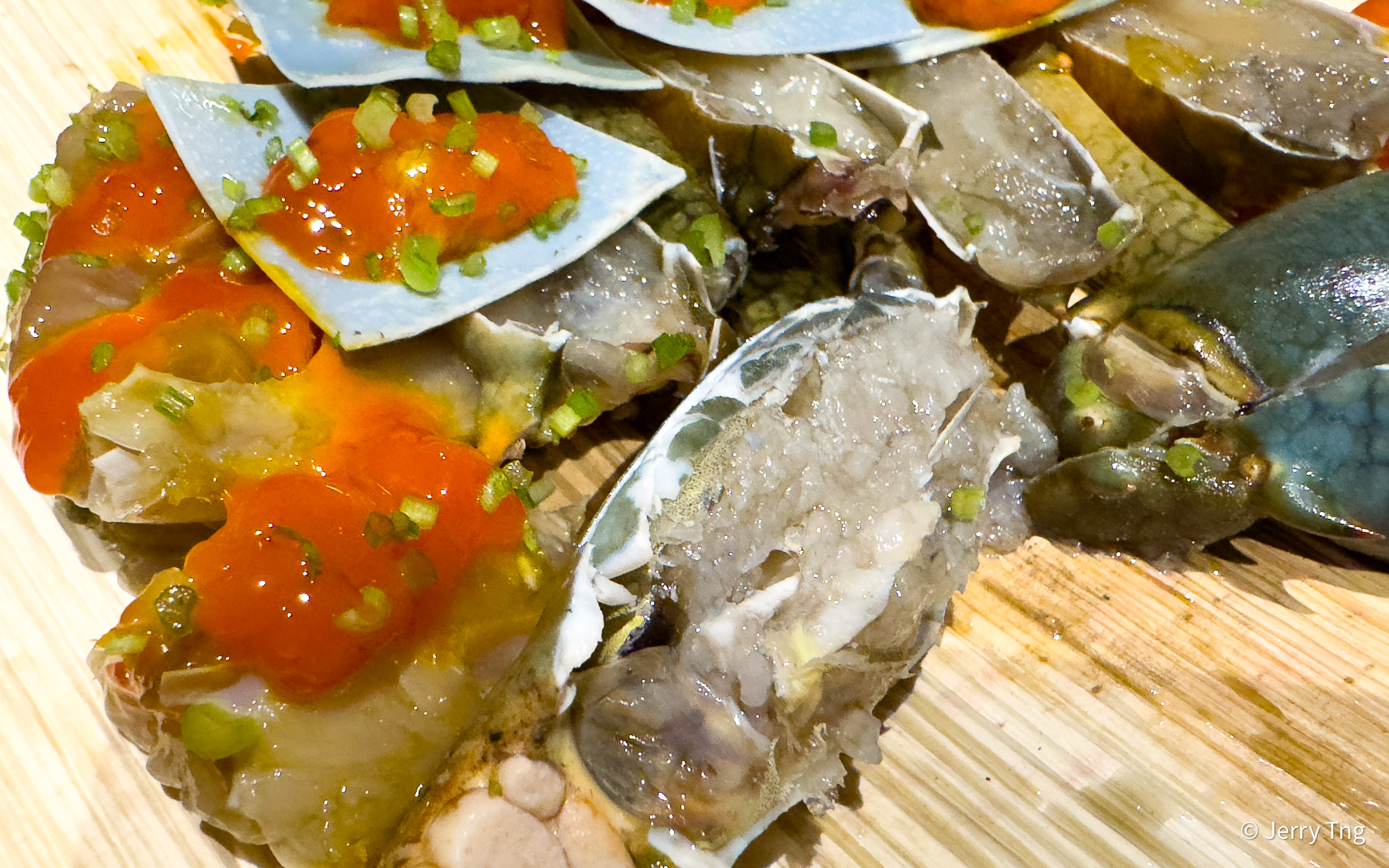
Salted Yellow Roe Crab 生腌膏蟹

Although this dish does not need prior reservation, this dish is so popular that I would recommend that you prebook it when reserving the table. We used to do this salted crab at home when I was a toddler. But it got harder and harder to get live crabs without fear of pathogens, so we gave up making this ourselves. Likewise, you have to order this in advance, and they cannot guarantee that you will get it on the day you come to dine. They will not serve you if the quality of the crab does not meet the strict criteria of the chef.

The Teochew version of ganjang gejang (marinated crab), the difference is the type of crab used – the Teochew use the mud crab, and the Koreans use the blue swimmer crab. This crab did not disappoint; the crab was marinated very well and the presentation was spot on. It also came with the quintessential condiment of white vinegar and garlic chilli 蒜泥醋.
Braised Whole Chicken Stuffed with Pig’s Stomach in Peppery Soup 胡椒猪肚鸡汤

Next up, we had one of their signature dish, Chicken Stuffed with Pig’s Stomach in Peppery Soup, that required advance booking. The whole chicken is stuffed with slices of pig’s stomach and ginkgo nuts, and the whole chicken is stewed in a peppery, sticky stock made from boiling an obscene amount of chicken and pork bones with pepper and other secret ingredients.
The chicken was presented in a claypot that was reheated at table side. Once the soup was boiling, the chicken was cut open to reveal all the goodness inside its stomach.


The soup was sticky with collagen from boiling all those ingredients together. There’s a strong peppery taste that reminded me of 猪肚汤 pig’s stomach pepper soup that we used to sell at our coffee shop. However it also had the umami that would only come from shellfish. I am pretty sure there’s some dried whelk or similar dried mollusc in the stock, but they would not reveal the secret.
Stir-Fried Sea Cucumber with Chayote 特炒海参佛手瓜

Next, we tried one of their seasonal (and new) dish featuring the chayote 佛手瓜. The sea cucumber dish was reimagined with a change in texture (crunchy instead of the usual soft when braised) by sautéing the sea cucumber with chayote, a melon like gourd commonly used in Chaoshan region for pickles. The surprise was the crunch from the fried fritter 油条 which absorbed the special sauce of this stir-fry. Their stir-fries have very heavy wokhei, so if you are in for that type of smokiness, do try them.
Pan-Fried Oyster Omelette 香煎蚝烙

The Oyster Omelette was similar in terms of ingredients that my mom would use for her recipe, but that’s where similarity ends. Their gourmet version was pan-fried perfectly even; one side was totally crispy while the other was soft and tender. It was much less rustic and more deliberately thoughtful than you find in elsewhere.

Despite the crispiness, it was not oily like many oyster omelettes these days. They were very fresh and juicy but to make the omelette evenly flat, the oysters were chopped up. OverallI recommend that you order this as an appetiser.
Chinese Double Sausage & Chicken Claypot Rice 碳香滑鸡双肠砂煲饭

The claypot rice needs at least 30 mins to prepare, so if you decide to have this instead of the usual Teochew char kuay teow, remember to place the order right at the beginning.


The claypot rice is not exactly a Teochew dish, but the HK Cantonese-style claypot rice 砂煲饭 was really worth the wait. The claypot rice was then slow-cooked on charcoal fire for that smokiness that I mentioned earlier.


Pre-soaked rice is cooked in the claypot from scratch, leaving behind the wonderful burnt rice 锅巴 at the bottom of the pot. I added a portion of salted fish, which was flaky and really savoury, perfect for the rice. Do ask for more of the soy sauce that they used for the claypot rice as it needed that additional kick.
White Bitter Gourd with Minced Pork and Sole Fish “Ti Po” 苦瓜肉碎铁脯(大地鱼)

White Bitter Gourd with Minced Pork and Sole Fish “Ti Po” is a flavourful dish that combines the bitterness of white bitter gourd with the savoury umami of minced pork and the unique, intense flavour of dried sole fish (“ti po”). I like bitter gourd, but my Princess don’t so I order them only when I dine out. The dried sole fish, which we called in Teochew as 铁脯 “ti po”, is a flavour enhancer that is even better than MSG. And the quality of their “ti po” was really superb.
Teochew Dessert 潮州糖水

They are served individually but we ordered a few of each to share among ourselves. Steamed Yam Paste with Gingko Nuts & Pumpkin 金瓜白果芋泥 (R) and Teochew “Tau Suan” with Gingko Nuts & Flour Fritter 油条福果豆爽 were both very good; they have kept the standard from last time I was here, but the portions were smaller.
Steamed Yam Paste with Gingko Nuts & Pumpkin 金瓜白果芋泥

Wow, their yam paste was really smooth and the pumpkin was not smashed like other places. It is one of the rare occasion when my sister declared it was good. The only flaw, they did not use lard. But it was seriously good even though it used vegetable oil.
Teochew “Tau Suan” with Gingko Nuts & Flour Fritter 油条福果豆爽

The very down-to-earth tau suan has been given an upgrade with the introduction of dried mandarin peel 陈皮 in the hot dessert. The last time we had this at their Geylang outlet, it had a more refreshing taste as it uses fresh orange zest. This time the peel was overpowering the light, sweet tasting of the tau suan.
Deep-fried Yam Stick Encrusted with Fine Sugar 反沙芋条

If there’s one dessert that Teochew chefs dislike making, it’s the yam stick encrusted with sugar 反沙芋條. First, you deep fry the best yam you can find. Then you must toss the hot yam sticks in caster sugar to create a crust. The temperature is crucial: too hot turns the sugar to caramel, too slow makes it crusty, and if too wet, the sugar won’t coat properly. When I tried it at their Geylang outlet, it was the best 反沙芋條 I’ve had in Singapore, and my picky sister agreed.

And when done perfectly, it was not exactly the dessert that would appear in a fine dining restaurant, more like a sugar coated sweet potato fries. But I always order this for nostalgia. The yam used wasn’t the best, you will need yam that are starchy like Russet potatoes, and not wet like the Yukon. But it is difficult to get proper yam in Singapore for the job.

This particular outlet has more Cantonese dishes on the menu than Teochew. For one, they do not serve their signature braised goose and other Teochew-style braise in this outlet. And the 鱼饭 “fish rice” needs prior ordering. Other than that, this was a really nice outlet versus their Geylang branch.

This used to be the location of Nan Chiau High School (*sniggers*) and taken over last year by Lo & Behold Group to develop a new “food, retail, wellness, enrichment, arts and culture destination”. New Bahru (Bahru meaning “New” in Malay) reflects the hope of bringing together a new creative community, and is a cheeky nod to our city’s penchant for repeating words for emphasis (like swee-swee, jalan-jalan, play-play…).
San Shu Gong Chaoyue 三叔公潮粤
46 Kim Yam Road #01-01, Singapore 239351
Tel : +65 6322 3322 (Reservations)
Visited Aug 2025
0 comments on “San Shu Gong Chaoyue 三叔公潮粤 @ River Valley”