
Last night in Korea, Princess and I splurged on a formal fine dining dinner in the kaiseki style.


Modowoo 모도우 offers Korean fine dining in the style of a kaiseki. It had two locations, and this one in Gangnam was quite difficult to locate even though it was just opposite COEX and Seven Stars Casino. It’s below ground in B1 but the entrance is hidden at a side staircase of the virtual golf driving range on the ground floor. And by the way, all the major GPS did not point it in the right location.

The restaurant is made up of a private rooms, which is good for business dinners and family gatherings. You can enjoy a leisurely meal in a comfortable and private room and the restaurant is one of the most popular Sangyeonrye (office celebrations) and birthday celebrations in Samseong-dong,

“Modowoo” is a pure Korean word meaning “a meticulously prepared Korean beef dining experience.” Executive Chef Lee Hee Joon had over 15 years of experience working in Grand Hyatt, most recently as Head Chef of the Steak House, and Executive Chef of Teppan. He brought his Western cuisine techniques into this traditional Korean dining experience.

Modowoo reinterprets Korean cuisine by incorporating modern cooking techniques from around the world to make it easier to enjoy.
Special 모도우 3대 진미 코스 | Special Modowoo 3 Major Delicacies Course
This is a special course with added weight of the three major delicacies, ‘sea urchin, caviar and truffle, and is a special course for gourmets who want to enjoy the existing signature course even more richly.
트러플 밤타락죽 Truffle Chestnut Porridge

First course, we started with a chestnut porridge infused with truffle oil and chestnut chips with freshly shaved black truffle. It was unlike cream soup in European food as there wasn’t butter or cream in the soup, just loads of chestnuts. Very good start to the dinner.
제철 숙성회와 성게알 Sashimi and Seasonal Vegetables
광어 – 국내산 |성게알 – 페루산 | 단새우 – 국내산 Flounder – Domestic | Sea Urchin – Peruvian | Sweet Shrimp – Domestic

The sashimi included flounder (hirame), sweet prawn (amaebi) and sea urchin (uni). And instead of the usual soy sauce with wasabi, it was served with a tangy sesame sauce.

And the vegetables were cherry tomatoes with a variety of seaweeds common around the Korean peninsula (seaweed salad with Miyeok 미역, red-coloured Semogasari 세모가사리 and pieces of translucent Hancheon 한천), giving it a lot of crunch and flavours of the ocean.
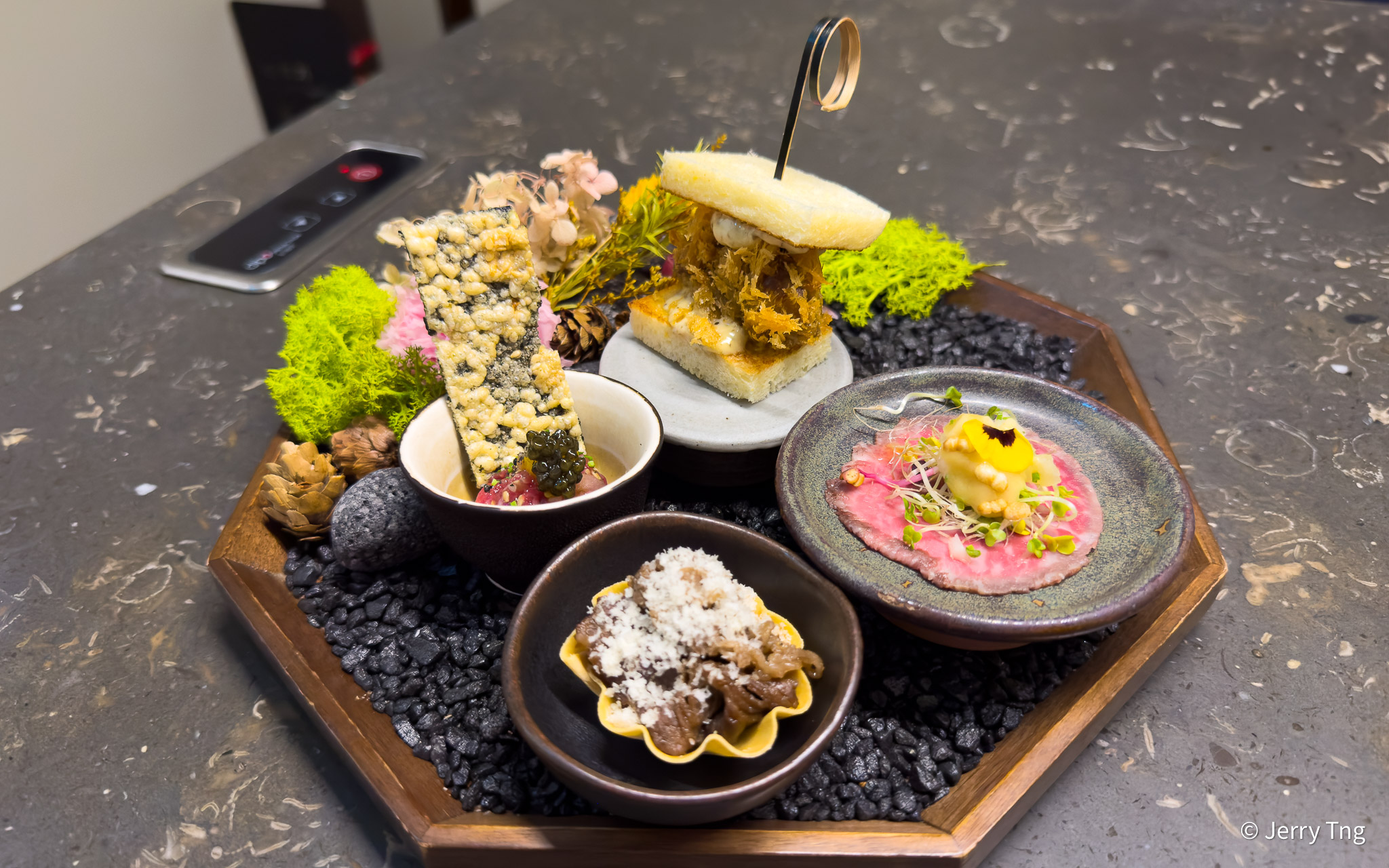
한우 네품 캐비어 Four Selections Korean Beef Caviar
볏짚구이 편채 Sliced Sirloin | 안심샌드 Tenderloin Sand | 족편 Jokpyeon | 캐비어 육회와 김부각 Caviar Beef Tartare , 소고기 – 국내산 한우 Domestic Korean Beef

Next, a beautifully plated quartet of Hanwoo beef creations that was well-thought through. Each bite featured the Hanwoo in a different style.
안심샌드 Tenderloin Sando

The word “sando” is a direct Japanese adaptation of the English word “sandwich”. It has also come to mean the Japanese style of sandwich which uses shokupan (a soft, fluffy white bread) and an overdose of fillings in between. Katsu-sando was invented in 1935 by Toki Ishizaka, the landlady of the tonkatsu restaurant “Isen” in Ueno, Tokyo. Since then decadent version using wagyu beef cutlet has emerged.
캐비어 육회와 김부각 Caviar Beef Tartare

Beef tartare is called yukhoe 육회 in Korean but not exactly the same. Yukhoe is a Korean delicacy made of raw beef, pear, garlic, green onion, soy sauce, honey, black pepper, sesame oil, and seeds. Served with seaweed rice crackers called kimbugak 김부각 and caviar.

Kimbugak tastes very crispy, airy, savoury, and full of the fresh flavor of the sea. And combined with the delicious yukhoe offers a delicious contrast between the rich, spicy-sweet flavours of the seasoned raw beef and the crunchy, savoury, and often slightly sweet taste of the fried seaweed. What an excellent starter.
족편 Jokpyeon

Jokpyeon is an aspic made with ox feet, jujube, manna lichen, and chili threads. It got its name because its slices are said to resemble rice cakes. Jokpyeon is said to have been used in royal banquets. Here, it was served in a flower-shaped cup made from cracker and topped with shaved horseradish. The flavours of the different ingredients came through brilliantly. Delicious.
볏짚구이 편채 Sliced Sirloin

Pyeonchae 편채 is a Korean dish with lean slices of beef, pan-fried and then eaten with julienned vegetables. It comes with a vinegary soy sauce dip and a mustard sauce. Byeosjipgu-i pyeonchae 볏짚구이 편채 featured Hanwoo sirloin that has been grilled with straw fire like warayaki in Japan. You can taste the smokiness of hay and yet enjoy the melty texture of Hanwoo. Served with sprouts and puffed rice for different texture.
전복 새우 튀김 Fried Abalone Shrimp
전복 – 국내산 Abalone – Domestic

Next dish, a whole abalone native to the waters of Korea served with its own liver sauce. The abalone was stuffed with shrimp paste, lightly floured and deep fried, and finished with a topping of pickled onion and gamtae 감태, a very fine green algae with a salty taste and a strong fishy / oceanic smell.

I am a fan of abalone as it was not as tasty as other shellfish and had to borrow the taste from other ingredients. The liver sauce was the saving grace in most cases, but this version had the sweetness of the shrimp and the umami of the seaweed incorporated. Delicious.
제철 생선 구이 Seasonal Grilled Fish

The next course has no beef. It features a seasonal fish and tonight was grilled sea bass delicately balanced on a piece of stewed radish on a bed of boiled barley with basil pesto and a soy sauce glaze.

The grilled sea bass was very soft and delicious, with a crusty skin to balance the texture. The sauce was not as exciting, just a glaze made from a reduction of the radish stew. e all, the sauce mixed with barley with basil pesto was the best.

But the best part of the dish was the radish. Perfectly stewed, soft and thoroughly simmered with all the flavours of the braising liquid, I wished they would give us more radish.
계절 국수 Seasonal Noodle
소고기 – 국내산 한우 Beef – Domestic Hanwoo

This cold noodle dish came after the appetisers, which was a surprise in terms of sequence. Mul naengmyeon 물냉면, or cold noodles in soup, acted like a palate cleanser. The noodles came in a clear, refreshing broth that’s made with beef broth with a dash of dongchimi 동치미 (radish water kimchi) broth.
1++ 한우 프리미엄 모둠 구이 Grilled 1++ Korean Beef
안심 | 채끝 | 살치살 | 새우살 Ansim | Chaekkeut | Salchisal | Saeusal

The Korean BBQ (KBBQ) in Seoul is distinctive due to its high-quality beef, particularly Hanwoo, which is not exported outside South Korea. Hanwoo is expensive and rare due to its premium quality, akin to wagyu, and high demand that exceeds supply. Additionally, South Korea has limited land for raising indigenous cattle, which are smaller than those in Japan.
Korean barbecue is built on the smokey richness of Maillard-charred meat and rendered fat. Here, they prepped the hot grill with rosemary to give a tinge of herby fragrance. Although the other ingredients (trumpet mushrooms, shiitake, zucchini, garlic, pepper) on the plate play important roles and were delectable on their own, they serve as supporting players that balance and enhance the waves of meat that were cooking on the grill.

1++ Korean beef, known as Hanwoo 한우, is the highest grade of Korean beef, recognised by its exceptional marbling, tender texture, and rich flavour. It is considered the Korean equivalent of premium Japanese A5 wagyu. This top-tier classification reflects the cow’s optimal fat distribution, resulting in a balanced flavour profile that is intensely beefy but less fatty than wagyu, which IMHO, tastes better than wagyu.

I have nothing but praises for the quality of the beef tonight, as well as the grilling technique. We were served the Salchisal 살치살 (chuck flap tail) and Saeusal 새우살 (ribeye cap) first. The salchisal is a rare and highly prized cut of beef renowned for its exceptional marbling, rich flavour, and melt-in-your-mouth tenderness. Next, the saeusal is a flavourful and tender cut of beef that is a limited part of the cow, with only about 1 kg available per animal. The name translates to “shrimp muscle” and refers to the cut’s appearance and desirable texture.

As we ate the “sals”, the ansim 안심 (tenderloin) was placed on the grill. The flavour of Hanwoo can best be described as a combination of Japanese wagyu and American Black Angus.

As we were enjoying our food, the waiter asked if we wanted to start grilling the last cut of the evening, the deungsim 등심 (sirloin) as these beef taste the best when warm. Further cooking will dry them out so it’s optimum to eat them when they come of the grill unlike the Western technique of leaving the meat to rest. Of the four cuts, I enjoyed the tenderloin the most but every one of them was delicious.
한우 미역국 반상 Korean Beef Seaweed Soup
소고기 – 국내산 한우 Beef – Domestic Hanwoo | 쌀 – 국내산 Rice – Domestic

Miyeokguk 미역국, or Korean beef seaweed soup, is a traditional soup served at one’s birthday in a traditional Korean birthday celebration. Every Korean friend would remember the hearty flavours and warm feelings of family and friends with this soup.


And together with the soup and steamed rice, a selection of banchan 반상 (飯
床), or side dishes. The Han characters literally mean “rice bed”, which is the table of used to serve little plates of dishes in a royal banquet.

The rice bowl is set up on the left and the soup bowl is on the right side. Side dishes are made up of foods suitable for eating rice, and there are from 3 to 12 dishes. Based around kimchi, it is selected and mixed from a variety of cooked, pickled and raw foods. The formula is formalised so that the same recipe and the same food are not duplicated.
오늘의 디저트 Today’s Dessert

Today’s dessert consisted of a traditional Korean sweet called yanggaeng and a Western style sorbet. And today’s flavour was 복숭아 자두 소르베 Peach Plum Sorbet.

The sorbet was refreshingly sweet and tangy. Rather calling it sorbet, they might as well called it crushed ice. The plum flavour was similar to assamboi (sour plum) which I like. And the peach flavour was also delightful.
오늘의 다과 Today’s Refreshments


The yanggaeng 양갱 is a traditional Korean and Japanese sweet that is adense, soft, and sweet snack, often served chilled, with variations. Malcha yanggaeng 말차 양갱 (green tea gummy) was just the right amount of sweetness, and a refreshing chilled memilcha 메밀차 (buckwheat tea) rounded up a wonderful evening of excellent food.

Modowoo has several locations and according to online reviews, each location has its own level of quality and service even though the menu (and prices) are similar. This particular one was quite popular online, but many negative comments stated disbelief in the high number of good reviews. I have only one complaint, the difficulty to find the place because of poorly placed signs and inaccurate GPS location. Other than that Princess and I had a lovely evening of good Hanwoo and fine dining.
Modowoo Korean Beef Upper Dining Samseong 모도우 삼성점
35 Teheran-ro 87-gil, Gangnam District, Seoul, South Korea
Tel : +82 2-565-8324 (Reservations)
Visited Aug 2025
0 comments on “Modowoo 모도우 @ Gangnam”