
A wonderful day out at the museum, Princess and I needed a place to rest our tired feet and have a nice cuppa with some sweets.

Built in 1937, Songshan Cultural and Creative Park (SCCP) 松山文創園區 began its life as the Songshan Tobacco Factory of the Taiwan Governor-General Monopoly Bureau. As the first cigarette-rolling factory in Taiwan, it manufactured cigarettes and cigars, generating considerable income for Taiwan at the time.

In 1998, the factory ceased production and in 2001, the tobacco factory was listed by the Taipei City Government as Taipei’s 99th municipal historic site. On November 15, 2011, it was transformed into SCCP, and has been officially open to the public ever since.

For more efficient reuse of space, SCCP was built on the historic site as a production base for designers and cultural & creative businesses, as well as a venue for performances and exhibitions.

The park introduced to its premises a Taiwan Design Museum and a Design Library that has the largest collection of design related books and publications in Asia. Opened in 2011, the museum collects classic works in Taiwan’s design history. It organises exhibitions every now and then, featuring diverse and interdisciplinary themes, design trends, and important award-winning works at home and abroad. The ticket to the museum allows you to visit the library.

I was chatting to one of the store owners, she shared with me that the rental was subsidised and the place was perfect to try out their concepts and consumer acceptance before deciding whether to invest in a proper store. Some others have got stores elsewhere but not in Taipei, coming up north to explore a new and bigger market.

On the weekends, there are many paid exhibitions of different themes. Princess and I came specifically for the Ukiyo-e Immersive Art exhibition that used one of the old warehouse as the venue. The Tobacco Factory was first built with 10 warehouses. Warehouses 11 to 15 were added after WWII. As some warehouses were seriously damaged, only Warehouses 1 to 5 still remain and currently serve as important multi-purpose spaces for exhibitions and performances.

I came to look at this famous Ukiyo-e 浮世繪 work. Hokusai’s famous work, The Great Wave off Kanagawa, was among the first prints in Japan to use Prussian blue, a new synthetic pigment that resisted fading, imported from China and the Netherlands (the only countries Japan traded with in the 1830s). Before Prussian blue reached Japan, printmakers used the blue dyes indigo and dayflower blue, which are much less vibrant. The drama of the gigantic wave about to engulf the three small boats together with the new blue colour made the print incredibly popular in Japan.
As a tie-up with Cama Coffee Roasters, ticket holders get discounts on the specialty coffees and desserts thought up specially for the exhibition.
昭和富士和果子 Showa Fuji Japanese Sweet Confectionery

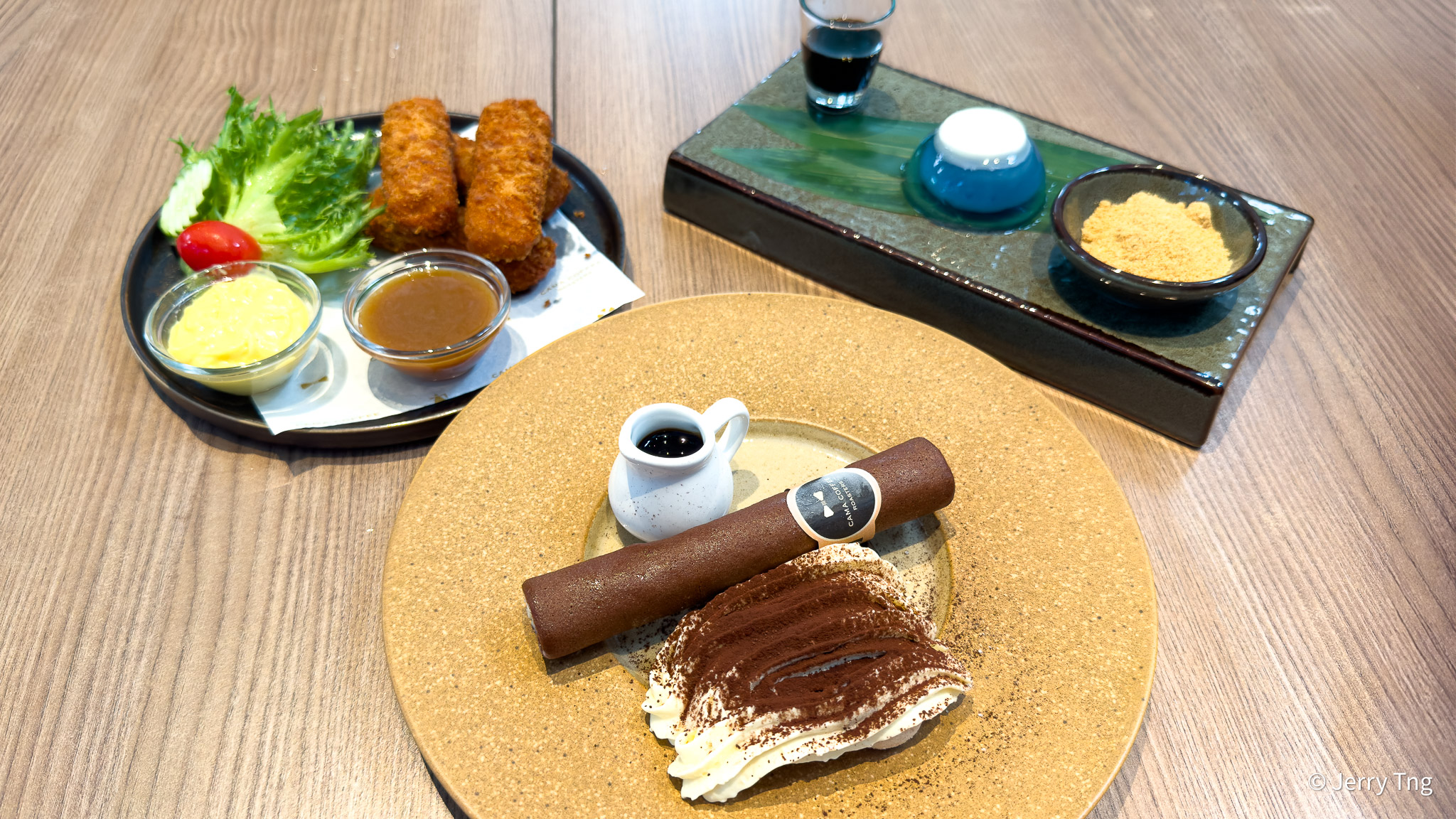
This is like a deconstructed warabimochi 蕨餅. Warabimochi is a classic Japanese confection, a wobbly, jelly-like sweet made from bracken starch (warabiko), water, and sugar, giving it a soft, chewy, melt-in-your-mouth texture distinct from glutinous rice mochi. It’s traditionally dusted with kinako (sweet roasted soybean flour) and drizzled with kuromitsu (brown sugar syrup) and served chilled as a refreshing summer treat.

The kinako and kuromitsu were served separately. The warabimochi was made to serve the theme of the exhibition and was shaped after Fujisan. The snow-capped mountain was made from milk-flavoured mochi, and the blue slopes were fashioned after Hokusai’s Tsunami print. Interesting concept, taste was rather blah.
昭和夏日奶霜拿鐵 Showa Summer Milk-capped Latte

Another tie-up item, it was inspired by the Prussian blue and the colours of Japanese summer. And it incorporated the in vogue milk cap 奶蓋 that became an internet craze in China. The coffee was some kind of Ethiopian single sourced coffee which tasted slightly acidic. But the coffee was really diluted by the melting ice. And once you stirred up the latte, everything was just a mess and waste of time.
巧克力餅乾 Chocolate Cookie

Princess has a soft spot for chocolate cookie, those large ones that you get from Subway. This cookie was too hard and crisp for our liking, as we were expecting a chewy one. And was that Nutella on the cookie?
松菸招牌雪茄 Songyan “Cigar”

Continuing with the deconstruction of famous dessert, the signature Songyan “Cigar” paid homage to the history of the place and tore apart the Italian classic tiramisu. We were advised to pour the expresso over the tiramisu and use the “cigar” cake as a mixer and a scoop. Everything simply crumbled together and the plate could not contain the espresso. Yes, it tasted like tiramisu, and the concept was innovative. But the execution needed some tweaking. Perhaps a plate was not appropriate vessel to hold it together.
煙囪拿鐵 Chimney Latte

And then there’s the Chimney Latte. It was basically the Showa latte without the blue dye. This was a nod to the chimneys that surrounded the boiler room. The coffee had the same deadly flaw.
酥炸鱈魚條 Deep Fried Cod Filet

We needed something savoury after all the sweets, and ordered the deep fried cod filet. Tasted like supermarket frozen aisle variety, which Princess and I quite liked in the first place. It could have been perfect if the sauces were better. Straight up Japanese mayo and emulsified vinaigrette weren’t up to scratch in many ways.

Overall, the coffee was so-so, the snacks were blah, and there are better restaurants and cafes on site. If not for the link-up with the Ukiyoe exhibition, I would not have chosen this place for a coffee otherwise.
About The Boiler Room 鍋爐房

The Boiler Room 鍋爐房 was the heart of the SCCP, and its towering chimney was once one of the Tobacco Factory’s iconic landmarks. It used to burn heavy oil to generate steam, but after the 1970s, when the use of heavy oil ceased, the Boiler Room was decommissioned.

The boiler room played a very important role in the era of the Songshan Tobacco Factory. All the thermal energy for the entire tobacco factory was provided by the boiler room. Inside the room are two rectangular spaces with high-rise ceilings. One space is big, and the other is small. Three giant boilers were placed inside. Steam produced from the boilers was transmitted to the plant through pipes; from there, it was used to fumigate tobacco leaves.

To prevent bugs from laying eggs on the tobacco leaves, they were fumigated once with steam after they were taken out of the warehouse. This helped dry tobacco leaves turn soft, enabling workers to do the next steps of sorting and cutting leaves.

The boiler room provided many functions that made the tobacco factory’s operations possible. For example, water was heated up in the boiler room, and then transmitted to the bathhouse for employees to enjoy a hot shower. Steam from the boiler room was transmitted to the kitchen as well!
Songshan Cultural and Creative Park 松山文創園區
No. 133, Guangfu S. Rd., Xinyi Dist., Taipei City Taiwan, R.O.C
Visited Aug 2025
0 comments on “Cama Coffee Roasters @ Taipei”