
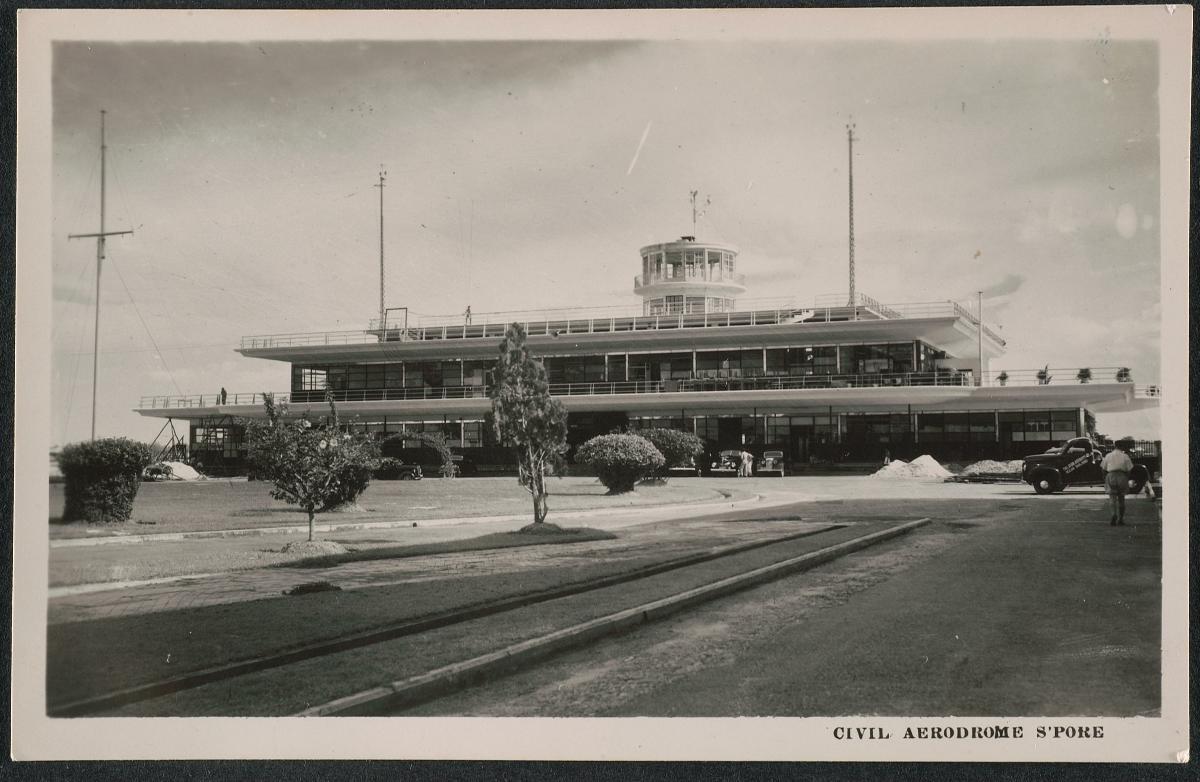
For those growing up in the 60s/70s Singapore would be familiar with Kallang Airport and Old Airport Road Food Centre, but did not know that this was were the RAF and Imperial Japanese airforce used to operate from.

Kallang Airport was Singapore’s first purpose-built civil airport, opening in 1937 and serving as a key international hub until 1955, known for its impressive modernist terminal (now a landmark) and seaplane facilities, eventually succeeded by Paya Lebar Airport and later Changi Airport, with the historic terminal conserved and planned for lifestyle use.

The Kallang Airport was opened on 12 June 1937 by the Governor of the Straits Settlements, Sir Shenton Thomas. The top photograph depicts the opening ceremony, with B. Govindasamy Chettiar, the proprietor of the Indian Labour Company, seated with Sir Shenton.


The main terminal building had a control tower and two side blocks with attached hangers. Reflecting early-modernist British architecture, its interiors were detailed with Art Deco ornamentation like its intricate railings and columns.


Its grassy landing zone, slipway for seaplanes, as well as a handsome terminal building, gave Kallang a reputation as the “finest airport in the British Empire”. During a 1938 stopover, Amelia Earhart called the airport “an aviation miracle of the East”. Its magnificent grass landing was made into a concrete runway by the Japanese who built a concrete runway in World War II , extending to 5,500 ft. It was further extended after the war, but it was not until 1949 that all civil traffic operated again in Kallang.

This aerial photograph of the Kallang Airport airfield was taken by Cecil Owen Ellison of the Royal Air Force. Opened in 1937, the Kallang Airport was the first purpose-built civilian aerodrome in Singapore. Situated on reclaimed land around the Kallang Basin, the airport was designed to serve both land and sea planes. It ceased operations in 1955 following the opening of the new Paya Lebar Airport.

Carl Alexander Gibson-Hill, c. 1950s | Gelatin silver print | National Museum of Singapore collection
Taken by Carl A. Gibson-Hill, then-curator and later director of the Raffles Museum, this photograph shows an aeroplane shortly after taking off from Kallang Airport. The Fullerton Building can be seen on the horizon, along with some boats docked by the waterfront.

Carl Alexander Gibson-Hill | Late 1940s to early 1950s | Gelatin silver print | National Museum of Singapore collection
Another photograph by Carl A. Gibson-Hill captures a close-to-sea-level view of the Singapore waterfront. It was most likely taken from Tanjong Rhu, which was partly reclaimed by the Japanese during World War Two, using largely Dutch prisoners of war for labour. This view shows sailing barges carrying timber at the waterfront, with the Cathay Building and the 7th Storey Hotel in the background.

1947 | Gelatin silver print | Gift of Mr Owen Ellison, National Museum of Singapore collection
While some reclamation along Beach Road had started in the 1840s, the major reclamation project that created the waterfront which we are familiar with today took place from the 1930s. Despite disruption by World War Two, part of the project was completed by the time this photograph was taken. Shot by Cecil Owen Ellison of the Royal Air Force, it presents a clear view of the extensions of the shoreline from the Esplanade to Beach Road and Kallang The entrance to the Stamford River can be seen here, with the rest of the river converted into a covered canal.

This 1938 map shows the plans for the last major reclamation projects conducted by the colonial government. The Kallang Basin reclamation was heralded by the government for rehabilitating a mangrove area that was regarded as useless, but this impacted the Orang Laut coastal settlers there, including the Orang Biduanda Kallang.


The main terminal building was gazetted for conservation on the 5th of December in 2008 by the Urban Redevelopment Authority (URA) of Singapore. The original airfield was used for the National Stadium, which was demolished in 2010 and replaced with the current new National Stadium and the Kallang Sport Hub.
History of Singapore

Singapore’s history is a journey from ancient settlement to modern metropolis. Initially known as Temasek, it was a 14th-century trading post, later falling under the influence of various empires. Sir Stamford Raffles established a British trading post in 1819, transforming the island into a thriving port. Post-World War II, Singapore gained self-governance and eventually independence, first as part of Malaysia and then as a sovereign nation in 1965.

The Singapore Treasures series focuses on the artefacts, relics and key monuments and moments that shaped this young nation. It is divided into four main parts.
- Pre-colonial before 1819
- British Colonial Rule (1819-1942), Japanese Occupation (1942-1945) and Post-War (1945-1955)
- Self government (1955-1963) and merger with Malaysia (1963-1965)
- Independence since 1965


0 comments on “Singapore’s First Airport – Kallang Airport (1937-1955)”