
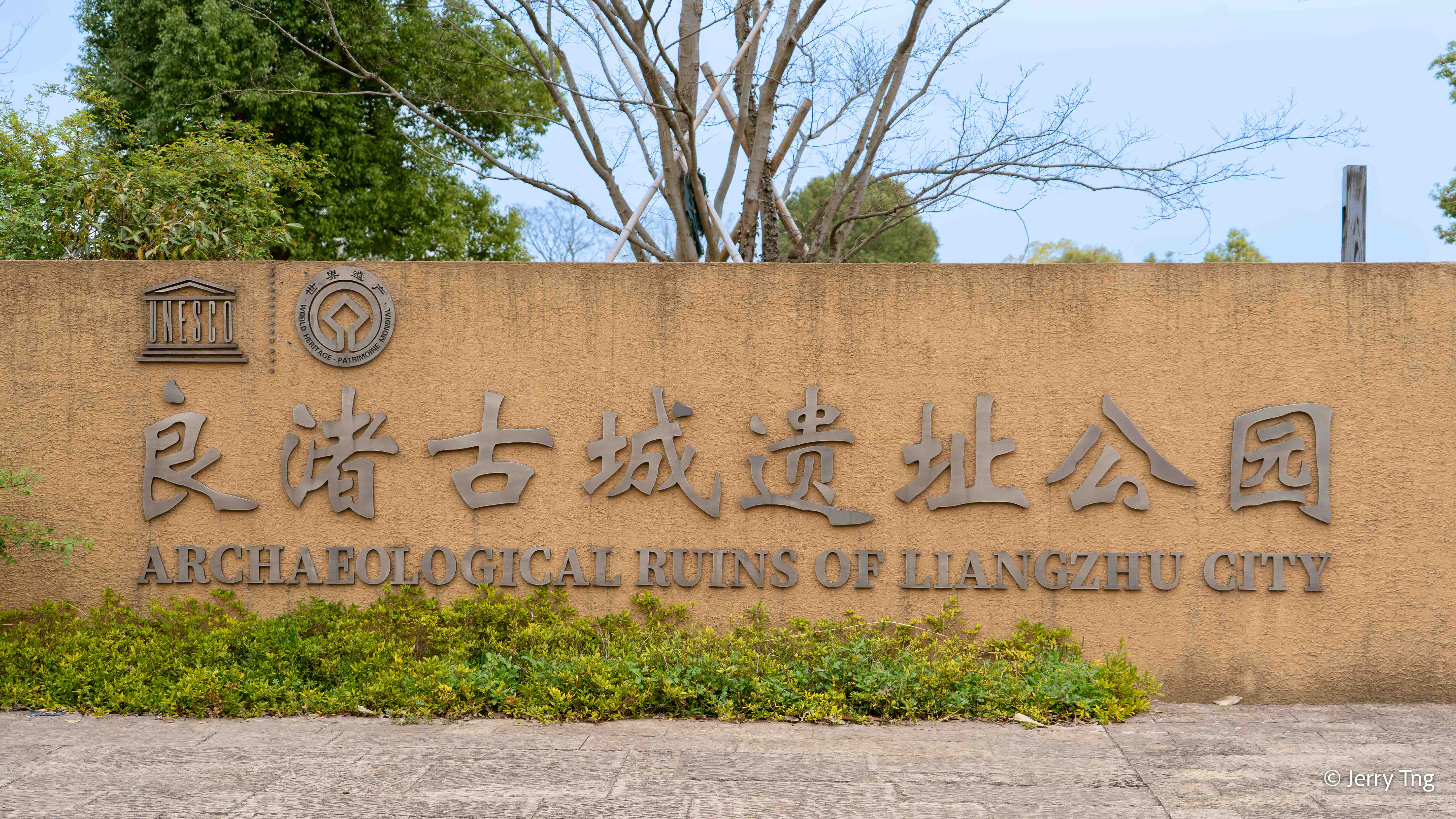
Dating back more than five millennia, the archaeological ruins of Liangzhu 良渚古城遗址 (around 3300-2300 BC) stand as one of China’s most remarkable Neolithic sites. his impressive civilisation not only pioneered advanced urban planning — featuring monumental architecture, complex water management systems, and fortified walls — but also left behind a legacy of stunning jade artefacts, demonstrating exceptional craftsmanship and spiritual depth.
Table of Contents
The Discovery of Archaeological Ruins of Liangzhu City

Located in the Yangtze River Basin on the south-eastern coast of the country, Archaeological Ruins of Liangzhu City was the centre of power and belief of an early regional state in the Circum-Taihu Lake Area. It reveals an early regional state with rice-cultivating agriculture as its economic base, and social differentiation and a unified belief system, which existed in the Late Neolithic period in China.


This 5,300-year-old city was first discovered by Mr. Shi Xingeng in 1936, and then became known to the world after many years of archaeological excavations, and now is a key artefacts protection site in China. As a prehistoric large-scale settlement site in East Asia with significant representation in the history of the development of human civilisation, Archaeological Ruins of Liangzhu City represents the highest achievement of rice agriculture in the origin stage of Chinese civilisation, and as a representative of Liangzhu culture, it has a wide and far-reaching impact on the development of Chinese civilisation in the next five thousand years.

The Peripheral Water Conservancy System with complex functions and socially graded cemeteries (including an altar), and the excavated objects represented by series of jade artefacts symbolising the belief system illustrates the transition from small-scale Neolithic societies to a large integrated political unit with hierarchy, rituals and crafts, which authentically and credibly demonstrate the degree of development of the rice-cultivating civilisation in the lower reaches of the Yangtze River in the Neolithic period and provide a panorama of Archaeological Ruins of Liangzhu City as an early regional urban civilisation.
City Wall and City Gate

City walls around the four sides of the Inner City of Archaeological Ruins of Liangzhu City formed the city in the shape of a rounded rectangle. River courses inside and outside the City Site were connected through water gates, forming a complete pattern of waterway transportation. The waterside habitation landscape is a typical example for settlement in which people began to manage the wetland in rice-cultivating areas in East Asia.1

Built on the swampy wetland, Liangzhu Ancient City is like the “Venice of the East”, with a dense river network and a developed water system, and canoes and bamboo rafts are the main means of transportation for Liangzhu people. A total of eight Water Gate and one Land Gate were found in Liangzhu Ancient City Site, and the inner and outer cities of Liangzhu were connected by eight Water Gate, and each wall had two water gates.
Land Gate Site 陆城门遗址

Located in the middle of the south city wall and consisting of 3 separate stylobates and 4 gateways with a total width of 150 meters, this was the only land gate to the Inner City. The stylobates were enclosed by metal mesh and the area between the metal mesh was the gateways of the land gate. You can imagine how grand the gate to the capital city was at that time.2


Southern City Wall Site 南城墙遗址

In 2006-2008, during the dissection excavation at Shangsicun section of the south city wall, it was founded that when stacking the city wall, a layer of green silt was paved on the ground firstly, stones were paved on the green silt, and then yellow clay was stacked on the stones. Both the stacked earth and stone foundation of the city wall reveal obvious ridges, and vividly reflect the process and method of construction which manifest the different sources of stones and stacked earth.3
Western City Wall Site 西城墙遗址

In 2006, the excavation of west city wall (Putaofan Section) revealed the existence of city wall of the Archaeological Ruins of Liangzhu City for the first time. Large amount of Liangzhu culture domestic refuse deposits belonging to different periods of Liangzhu culture were found in the moat on the west side of the city wall, which demonstrates that the city wall had been used for a long time.4

In 2007, during the archaeological excavation of west city wall (Baiyuanfan Section), moats were found both inside and outside the city wall and the slope foot of the city wall was paved with stones as revetment. In addition, the deposits of early phase of late Liangzhu culture period were found on both the inner and outer edges of the city wall.5
Cultural Layer 文化层

Cultural layer is an archeological term that refers to the accumulation layer formed by traces, relics and organics left over from ancient human activities in archaeological ruins. Each layer represents a certain period of time. Without breaking the relationship, the lower layer is earlier than the upper layer. Here, we can see that the section of the city wall is divided into a Liangzhu culture foundation stone layer and a Liangzhu culture paved earth layer. Above the earth layer is a Han Dynasty layer and a Song Dynasty Layer. The top layer is a modern farming layer.6
Giant Wooden Component For Palace Building 宫殿巨型木构

Since 2017, archaeologists have discovered 15 wooden components of varying lengths during several excavations of the Zhongjagang ancient river course. Six of them are larger in size, and the longest wooden component reaches 17.2 meters. According to C14 dating, those giant wooden components have been buried in the river course adjacent to the palace area for about 5,000 years.7

In order to further study the wooden components found in the Zhongjiagang river course, the wooden components have been sent to the laboratory and are currently being dehydrated. Before being extracted, the archaeologists had already 3D scanned the wooden components in advance. Using 3D printing technology, these wooden components were reborn and once again met everyone where they were found.8

Stratified Cemeteries 分等级墓地

Tombs found in Archaeological Ruins of Liangzhu City can be divided into four grades of the highest, higher, middle and low or more grades according to the characteristics of site location, burial arrangement, the number and level of burial objects, revealing that there were at least 4-stratum differentiation in the society of Liangzhu culture period which are matched with multiple stratum differences in social status, identity, etc.. Stratified cemeteries are comprised of five cemeteries distributed in different areas. Yaoshan Cemetery is located at the Area of Yaoshan Site; Fanshan Cemetery, Jiangjiashan Cemetery, Wenjiashan Cemetery and Bianjiashan Cemetery are located at the Area of City Site.9
Jiangjiashan Cemetery 姜家山墓地

Jiangjiashan Cemetery was discovered in 2015, located on the earthen terrace artificially built relying on the natural downland to the west of the Mojiaoshan Terrace. 14 tombs have been discovered so far in Jiangjiashan Cemetery, which are roughly distributed in three rows. In the 14 tombs, Tomb MI of male occupant located in the middle of the south row is the highest-grade one. 425 pieces (including sets) of burial objects were unearthed in the cemetery including jade artifacts, stone artifacts, potteries, bone artifacts, etc. Jade artifacts account for a large proportion with the total number of 363 pieces (including sets). Jiangjiashan Cemetery as a higher-grade family cemetery, jointly with a series of graded cemeteries like Fanshan, Yaoshan, Wenjiashan, Bianjiashan, features the Liangzhu social stratum differentiation.10
Attractions in Liangzhu Ancient City Site
Liangzhu Ancient City Site, which is more than 2.9 million square meters, is the core site of Archaeological Ruins of Liangzhu City with the most densely distributed, richest variety, highest grade, largest scale, and most complex structure in Liangzhu culture.
Mojiaoshan Terrace 莫角山台地

Mojiaoshan is a must-visit destination in Archaeological Ruins of Liangzhu City. As the central area of Liangzhu Ancient City Site, Mojiaoshan Terrace is the location of the palace area of Liangzhu Ancient City. Liangzhu Palace Area is located in the central high platform area, and the elaborate design highlights its unique status.

There are three separate earthen platforms built on the central high platform, namely Large Mojiaoshan 大莫角山台基, Small Mojiaoshan 小莫角山台基 and Mount Turtle 乌龟山台基, and between the three earthen platforms, there is a 70,000-square-meter Sand Square 沙土广场.
Large Mojiaoshan 大莫角山台基

Located in the core area of Liangzhu Ancient City Site, Mojiaoshan Terrace is a palace area containing a ceremonial square and several large building foundations. It is the largest of the three earthen platforms in the Mojiaoshan Terrace, with the highest point reaching 16.5 meters, far exceeding the wall height of the city wall. Standing on the platform of Large Mojiaoshan, the mountains around Liangzhu Ancient City Site are clearly visible.
Small Mojiaoshan 小莫角山台基

Small Mojiaoshan is the smallest earthen platform on the Mojiaoshan Terrace, about 90 meters long, 40 meters wide and 6 meters high, where a model of the building column is restored according to the arrangement of pillar holes.

House Foundation F17 is 15.5 m long from east to west and 9m wide from south to north, with a building area of about 138m2. The House Foundation F17 is divided into the east part and west part, in which there are foundation trenches on the four sides. Postholes were found inside the foundation trenches, which may be the wall columns. There is a residual gap about 1.1 m wide in the middle of the west foundation trench, which may be the east doorway of the west room, and two postholes were found in the doorway, which may be the gateposts.11
Fanshan Mausoleum 反山墓地

Fanshan is an artificially built rectangular earthen platform, about 6 meters high and covering an area of about 10,000 square meters. It is just separated from the Mojiaoshan Palace on the west side by only one river. Fanshan Mausoleum is the highest-level cemetery in Liangzhu Ancient City Site.

So far, a total of 11 tombs have been excavated from the Fanshan Mausoleum, and more than 1,200 exquisite funerary objects such as jade, stone, pottery, ivory, lacquerware, etc. have been unearthed, of which more than 90% are precious jade.
Tomb No. 12


Tomb No. 12 in the centre of the cemetery is the highest level tomb in Fanshan Mausoleum, with 658 funerary objects, including 647 pieces of jade, and the national treasures King Jade Cong and King Jade Yue symbolising the supreme theocracy and kingship were unearthed here, proving the honoured status and supreme power of the tomb owner.
Tomb No 23


Tomb M23 is located to the north of Tomb M14 and its quantity of burial objects ranks the fourth in Fanshan Cemetery with 467 single pieces (excluding jade particles and jade slices). The burial objects include jade cong but without jade yue. In addition, jade huang, jade ornaments of loom, round jade plaques and other burial objects were unearthed from Tomb M23. It demonstrates that the occupant of Tomb M23 might be a female aristocrat.14
The Fanshan Exhibition Hall

The Fanshan Exhibition Hall in Liangzhu Ancient City Site displays various excavated artefacts, which can provide a deeper view of the excavation process of the site. As a civilisation linked by theocracy15, the Liangzhu Civilisation is more similar to the Egyptian Civilisation.


The Fanshan Exhibition Hall has opened a special area to introduce God with Animal’s Face19, which is used as a symbol of power and faith, reflecting the supremacy of theocracy and the close combination of theocracy and kingship in the Liangzhu period.
Zhongjiagang 钟家港

Zhongjiagang is the handicraft workshop exhibition area, through which imitation metal figure sculptures show the process of handicraft and labor of Liangzhu people up close, reproducing the busy scene of the handicraft workshop area of Liangzhu Ancient City 5,300 years ago.

Living at the river was a style popular in Ancient Liangzhu City. Crossties, sole timber and standing timber were found to be used for revetment at the Meirendi Site. While for the Zhongjiagang Site, wooden stakes and bamboo plaited articles were used for revetment. In the area to the south of the Yangtze River, living at the houses built at both sides of the river is continued today, but nowadays block stone or concrete casting was used for revetment.20

Handicraft Workshop

The large-scale handicraft workshop remains show that there are complex functional divisions and specialised social division of labor in Liangzhu Ancient City, of which jade processing accounts for a large proportion, reflecting the organisation and management ability of Liangzhu society for high-end handicrafts such as jade making.
About Archaeological Ruins of Liangzhu City 良渚古城遗址公园

Archaeological Ruins of Liangzhu City is composed of four areas: Area of Yaoshan Site (01), Area of High-dam at the Mouth of the Valley (02), Area of Low-dam on the Plain-Causeway in Front of the Mountains (03) and Area of City Site (04). Its early time of formation, great achievement and rich diversities show the outstanding contribution made by the Yangtze River Basin to the “Diversity in Unity” feature of the origin of Chinese civilisation. Archaeological Ruins of Liangzhu City also fill the blank of Neolithic city sites in East Asia in the World Heritage List, offering unique evidences for the 5,000-year history of Chinese civilisation.21

The centripetal triple spatial pattern adopted by Archaeological Ruins of Liangzhu City, including the Palace Area, the Inner City and the Outer City, is a typical technique to establish the social class order and highlight the symbolism of power centres in ancient China, and also has revealed the planning characteristics created by the urban civilisation of the early state in the Yangtze River Basin, which can be frequently seen in the capital planning of the ancient Chinese ritual society.22
Getting Around

The park is really huge (3 km2 or about 420 FIFA football fields) and although you can cover it by walking or by bicycle, my suggestion is to use the shuttle buggy service (chargeable) to go to the attractions. There are two routes to choose from:

- Deer Park Sightseeing Route : East Gate→ Zhongjiagang→ Daguanshan Service Area→ Deer Park→ Chizhong Temple (池中寺) Granary→ West Gate
- Sightseeing Buses Route (the route I took when I visited the place): East Gate→ East City Wall→ Zhishan Observation Deck→ Mojiaoshan Palace→ Fanshan Mausoleum→ West City Wall → West Gate

On July 6, 2019, the Archaeological Ruins of Liangzhu City was officially inscribed on the World Heritage List at the 43rd World Heritage Convention. It is China’s 55th World Heritage Site. With its inscription onto the World Heritage List, the number of China’s world heritage sites now ranks No.1 in the world.
Getting There
Address : 200 meters northwest of the intersection of Fengdu Road and 104 National Road, Yuhang District, Hangzhou
Ticket inquiry: +86-571-85855300
Opening Hours : 9:00-17:00, last entry at 16:00

If you want to learn more about Liangzhu’s culture and history, you can also visit the nearby Liangzhu Museum, which is only 5 kilometers from Archaeological Ruins of Liangzhu City.
All photos taken at Archaeological Ruins of Liangzhu Ancient City and Liangzhu Museum Oct 2024, unless otherwise noted.
Footnotes :
- 良渚古城内城的四面城墙,形成圆角长方形的城市形态。作为一座营建于湿地之上的城市,河道运输是良渚古城最普遍的交通方式。内城城墙上共辟9座城门,包括8座水城门和1座陆城门。城内外的河道经由水城门连通,形成完整的水路交通格局。临水而居的水乡景观,是东亚稻作农业地区人类早期湿地开发的典型范例。 ↩︎
- 陆城门
Land Gate
这是良渚古城内城唯一的陆城门,位于南城墙中部,由3个独立的台基和4个门道组成。金属网包围的部分是台基,金属网之间的区域是陆城门的门道,四个门道总宽度达150米,由此可以想象当时的王城城门有多么恢弘。 ↩︎ - 南城墙遗址(上泗村國)
South City Wall Site (Shangicun Section)
2006—2008年,在南城墙上泗村段解剖发掘,发现城墙在堆筑时,先在地面上铺垫一层青胶泥,然后铺垫石块再在石块上堆筑黄色粘土。城墙堆筑土与石头地基,都呈明显的条垄状,生动反映出堆筑的过程与方式,表明堆筑的石头和堆土的来源于不同地方 ↩︎ - 西城墙遗址(葡萄畈段)
West City Wall Site (Putaofan Section)
2006年西城墙葡萄畈段的发掘,首次揭露了良渚古城城墙的存在。城墙西侧的城河中,发现大量良渚时期的生活废弃堆积,分属良渚文化不同时段,说明城墙使用历经相当长时间。 ↩︎ - 西城墙遗址(白元畈段)
West City Wall Site (Baiyuanfan Section)
2007年在西城墙遗址白元畈段考古发掘时,发现城墙内外均有城河,城墙的坡脚也铺垫石头护坡。内外城墙的边缘均有良渚文化晚期前段的堆积。 ↩︎ - 文化层
Cultural Layer
文化层也称“文化地层”,特指遗址中人为活动所形成的土层堆积。土层中包含人工遗迹和遗物,故称之为“文化层”。考古学家通常将一个遗址文化层堆积的厚度作为判断遗址遗存丰富度的直观标准。文化层形成的一般规律是时间早的在下面,时间晚的在上面。在这个剖面上可以看到,下部是良渚城墙的剖面,它又分成垫石层和堆土层;中间是汉代和宋代地层;最上面是现代的耕作层。 ↩︎ - 宫殿巨型木构
Giant Wooden Component For Palace Building
从2017年开始,考古人员对钟家港古河道进行了多次发掘,先后发现了15根长短不一的木构件,其中6根体量较大,最长的达17.2米。经测定,木构件已经被埋藏了约5000年。这些巨型木构件位于紧临宫殿区的河道中,会是建造宫殿的梁柱吗?或是还有其他的功能?就让我们走进考古现场,一探究竟吧! ↩︎ - 重生之路
The Road to Rebirth
为了进一步保护和研究出土的木构件,原件已经被送到考古实验室,目前正在脱水保护处理。在被提取出探方前,考古学家们已经提前对木构件进行了3D扫描,利用3D打印技术,这些木构件得以重生,再度和大家在它们被发现的地方相遇 ↩︎ - 分等级墓地
Stratified Cemeteries
良渚古城遗址内发现的墓葬,根据选址特征、墓葬排列方式、随葬品的数量和级别,可分为高、较高、中、低4个或更多的等级,揭示出良渚文化时期社会上至少存在着4种以上的阶层分化,形成社会地位与身份等方面的多重级差。分等级墓地主要由5片分布在不同地块的墓地组成,瑶山墓地分布于瑶山遗址区,反山、姜家山、文家山和卞家山墓地都分布于城址区。 ↩︎ - 姜家山墓地
Jiangjiashan Cemetery
姜家山墓地发现于2015年,位于莫角山台地西侧一处依托自然岗地人工堆筑的土台上。
姜家山墓地发现14座墓葬,大致呈三排分布,位于南排中央的男性墓葬1号墓是等级最高的墓葬。该墓地出士随葬品425件(组),包括玉器、石器、陶器、骨器等,其中玉器共363件(组)。姜家山墓地是一处较高等级家族墓地,与反山、瑶山、文家山、卞家山等一系列分等级墓地,共同揭示出良渚社会阶层分化的特点。 ↩︎ - 17号房屋基址
House Foundation F17
17号房屋基址东西长15.5米,南北宽9米,建筑面积约138平方米。房址分东西两室,两室四面均有基槽,内有柱坑,推测是墙立柱。在西部基槽的中间存在一条残宽约1.1米的缺口,可能是西隔间的东门道,门道内发现柱坑2个,可能是门柱。 ↩︎ - Jade huang with sacred animal motif
兽面纹玉璜
Jadeite | Neolithic Liangzhu Culture | Unearthed from Tomb M23 Fanshan Site, Yuhang Zhejiang | Collection of Liangzhu Museum. 玉器|新石器 良渚文化|浙江余杭反山遗址23号墓出土|良渚博物院藏 ↩︎ - Set of jade circular ornaments
玉圆牌一组
Jadeite | Neolithic Liangzhu Culture | Unearthed from Tomb M23 Fanshan Site, Yuhang Zhejiang | Collection of Liangzhu Museum. 玉器|新石器 良渚文化|浙江余杭反山遗址23号墓出土|良渚博物院藏 ↩︎ - 23号墓位于14号墓的北侧,随葬品数量居反山墓地第四位,以单件计467件(不含玉粒和玉片)。随葬有玉琮,但无玉钺,随葬品中的玉璜、玉纺织件、玉圆牌等说明该墓应属女性贵族墓。 ↩︎
- “神王合一”的国家形态
State Form of “Combined Authority of Deity and Kingship”
最完整的神人兽面纹发现于反山12号墓的玉琮王和玉钺王之上。钺是掌握军权、琮是掌握神权的标志,反山12号墓出土刻有统一“神人兽面纹”的“琮王”和“钺王”,可论定良渚文化至此已经实现了神权与王权集于一人的统治形态,形成“神王合一”的早期国家形态。
The most complete deity and animal mask motif was found on the “king of jade cong” and “king of jade yue” in Tomb M12 of Fanshan Cemetery. yue and cong are separately the signs of holding the military power and authority of the deity. “King of jade cong” and “king of jade yue” carved with unified “deity and animal mask motif” unearthed from Tomb M12 of Fanshan Cemetery can affirm that Liangzhu culture has achieved the ruling status of holding authority of deity and kingship by one person, forming the early state form of “combined authority of deity and kingship”. ↩︎ - Jade cong with sacred human-animal motif
神人兽面纹玉琮
Jadeite | Neolithic Liangzhu Culture | Unearthed from Tomb M12 Yaoshan Site, Yuhang Zhejiang | Collection of Liangzhu Museum. 玉器|新石器 良渚文化|浙江余杭瑶山遗址12号墓出土|良渚博物院藏 ↩︎ - Jade three-pronged ornament with sacred human-animal motif
神人兽面纹玉三叉形器
Jadeite | Neolithic Liangzhu Culture | Unearthed from Tomb M14 Fanshan Site, Yuhang Zhejiang | Collection of Liangzhu Museum. 玉器|新石器 良渚文化|浙江余杭反山遗址14号墓出土|良渚博物院藏 ↩︎ - Set of jade tube with dragon head pattern and three-pronged ornament
龙首纹玉管、三叉形器组合
Jadeite | Neolithic Liangzhu Culture | Unearthed from Tomb M2 Yaoshan Site, Yuhang Zhejiang | Collection of Liangzhu Museum. 玉器|新石器 良渚文化|浙江余杭瑶山遗址2号墓出土|良渚博物院藏
The three-pronged hairpin typically has a rounded outline with three branches, and often a jade tube is attached to the middle and upper part. The mortise at the bottom of the rounded end connects to the hairpin body and is inserted into the hair.
三叉形器边缘轮廓一般为圆弧形,上有三个分叉,中又上方往往再配装玉管。圆弧底端的卯孔与簪体套接,插于发上。 ↩︎ - 神人兽面纹
Deity and Animal Mask Motif
神人兽面纹是良渚文化玉器上最常见的纹饰题材,一般上部是头戴羽冠的人的形象,中间是圆眼獠牙的猛兽的面目,下部是飞禽的利爪。有浮雕、透雕、阴刻等几种不同的技法。神人兽面组合图像出现之后,就根据载体的不同而形成两种不同风格的表现形式,随后又各自形成不同的简化和抽象趋势。
The deity and animal musk motif is the most common pattern theme on jade artifacts of Liangzhu culture. The upper part of it is a deity image wearing a crest, the middle part is the appearance of beast with round eyes and tusks and the lower part is the bird’s sharp claws. Various techniques like embossment, openwork carving, and intaglio were adopted to engrave on jade artifacts. The combined image of deity and animal mask forms into two kinds of different styles of expression according to different carriers after its formation and then is formed into different simplified and abstract trends separately. ↩︎ - 夹河而居是良渚古城内较常见的生活景象。美人地遗址发现用枕木、垫木和立木来做河道护坡。钟家港遗址则用木桩和竹编对河道进行护岸。在江南地区,这种沿河道两岸建房居住的生活方式一直延续到今天,只不过现今的驳岸方式大多改为了块石垒砌或混泥土浇铸。 ↩︎
- 良渚古城遗址由瑶山遗址区(01)、谷口高坝区(02)、平原低坝-山前长堤区(03)和城址区(04)4个片区组成。良渚古城遗址作为良渚文化的权力与信仰中心,以建造于约3300-2300BC间的规模宏大的城址、功能复杂的外围水利系统、分等级墓地(含祭坛)等一系列相关遗址,以及以具有信仰与制度象征的系列玉器为主的出士物,揭示了中国新石器时代晚期在长江下游环太湖地区曾经存在过一个以稻作农业经济支撑的、出现明显社会分化和具有统一信仰的区域性早期国家,并以其时间早、成就高、内容丰富而展现出长江流域对中华文明起源阶段“多元一体”特征所作出的杰出贡献;填补了《世界遗产名录》东亚地区新石器时代城市考古遗址的空缺,为中国5000年的文明史提供了独特的见证。
Archaeological Ruins of Liangzhu City is composed of four areas: Area of Yaoshan Site (01), Area of High-dam at the Mouth of the Valley (02), Area of Low-dam on the Plain-Causeway in Front of the Mountains (03) and Area of City Site (04). As the center of power and belief of Liangzhu culture, Archaeological Ruins of Liangzhu City are characterised by the large-scale City Site built between 3,300 and 2,300 BC, the Peripheral Water Conservancy System with complex functions, the stratified cemeteries (including altar) and a series of other related sites, as well as excavated objects represented by serial jade artefacts symbolising belief and institution, which reveal the existence of one early regional state supported by rice farming with obvious social differentiation and unity of belief in the area around Taihu Lake in the lower reaches of the Yangtze River in late Neolithic China. Its early time of formation, great achievement and rich diversities show the outstanding contribution made by the Yangtze River Basin to the “Diversity in Unity” feature of the origin of Chinese civilisation. Archaeological Ruins of Liangzhu City also fill the blank of Neolithic city sites in East Asia in the World Heritage List, offering unique evidences for the 5,000-year history of Chinese civilisation. ↩︎ - 良渚古城遗址城址区在空间形制上展现出的向心式三重结构—官殿区、内城与外城,成为中国古代城市规划中进行社会等级的“秩序”建设、凸显权力中心象征意义的典型手法,揭示出长江流域早期国家的城市文明所创造的规划特征,并在中国古代礼制社会的都城规划中多次出现。良渚古城遗址所展现的”水城”规划格局与营造技术,反映了人们在湿地环境中创造的城市和建筑特色景观,特别是作力城市的水资源管理工程,外围水利系统在工程的规模、设计与建造技术方面也展现出世界同期罕见的科学水平,展现了5000年前中华文明、乃至东亚地区史前稻作文明发展的极高成就,在人类文明发展史上堪称早期城市文明的杰出范例。
The centripetal triple spatial pattern adopted by Archaeological Ruins of Liangzhu City, including the Palace Area, the Inner City and the Outer City, is a typical technique to establish the social class order and highlight the symbolism of power centres in ancient China, and also has revealed the planning characteristics created by the urban civilisation of the early state in the Yangtze River Basin, which can be frequently seen in the capital planning of the ancient Chinese ritual society. The “water city” planning pattern and construction technology demonstrated by Archaeological Ruins of Liangzhu City reveal the characteristic landscape of city and architecture created by people in the wetland environment. Especially with the Peripheral Water Conservancy System as the urban water resources management project that represents outstanding scientific level rarely observed at that time across the world in terms of project scale, design and construction, it also reveals the great achievement of Chinese civilisation as well as prehistoric rice-cultivating civilisation developed in East Asia, which can be outstanding examples of early urban civilisation in the history of human civilisation. ↩︎
0 comments on “Hangzhou Archaeological Ruins of Liangzhu City 良渚古城遗址”