
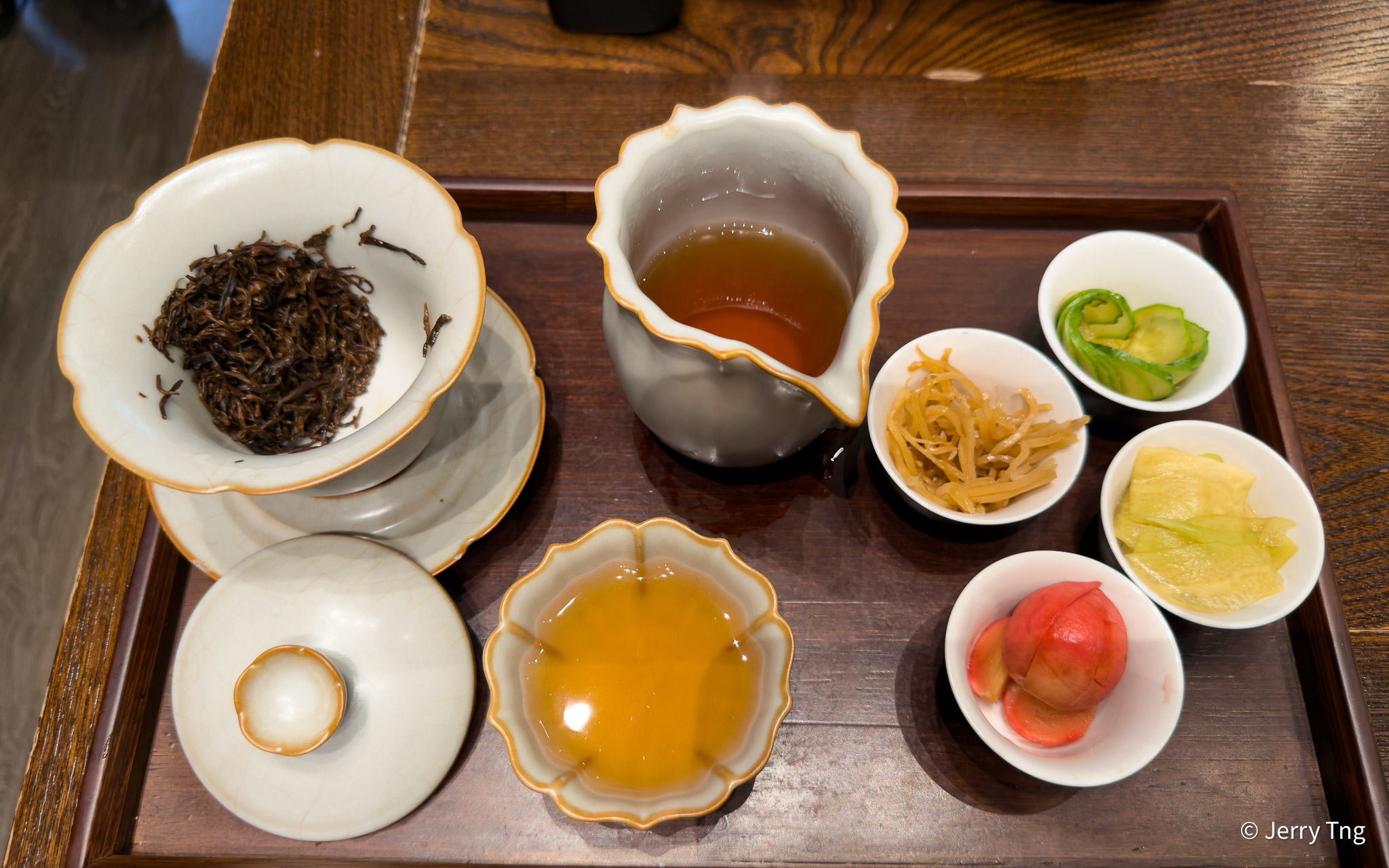
Museums are going through a revival in terms of visitor numbers. Besides the relics and artefacts, the meals in the museums have moved a long way from cold sandwiches and pastries from a counter.
Taipei – National Palace Museum

This is one of my favourite museum in the world. National Palace Museum (NPM) in Taipei is one of two NPMs in Taiwan (the other is in Tainan.) I will not go into the history but this museum came into existence because of treasures from the Palace Museum in Beijing moving to Taiwan along with retreating Nationalist army during the Chinese civil war. They have several places to have a meal.

Firstly, within the main building on the 4th floor is a cafe/bistro that offers a quick and easy meal or dessert called 三希堂人文空间 Sanxitang Space. This is a good choice if you just want a nice place to relax your tired feet as they offer 金箔蜂蜜蛋糕 Gold-leaf Honey Cake Set meal that includes one non-alcoholic drink below NT230, and one 鳳梨酥 pineapple shortcake (flavours are matched randomly).


Princess and I picked one flavour (matcha and original honey) each and they paired it with an original flavour pineapple cake (black colour), and osmanthus flavour pineapple cake (yellow), and two pieces of ruby candies. The cakes were very dense and moist, and the pineapple cakes were quite unique. They were great with the coffee.

In an adjacent building, there is a full service Chinese restaurant called Silk Palace 故宮晶華 that offered Shanghainese and Taiwanese cuisine with utensils and tableware closely matching NPM artefacts. In the basement, they have a simple dining choice serving Taiwanese beef noodles in porcelain faux dings called 台灣冠軍牛肉面 Taiwanese Champion Beef Noodles.
Tokyo – Tokyo National Museum

In the Tokyo National Museum, there is a treasure hall of Horyu-ji Temple 法隆寺宝物館. Among the four buildings in the museum, it can be said that it is the most inconspicuous exhibition hall. Therefore, unless something serious happens, the Horyuji Treasure Hall will not be crowded. A restaurant is located on the first floor. The restaurant is a collaboration between Hotel Okura and the museum

This restaurant serves mainly Western style simple meals like sandwiches, pasta and rice in the yoshoku style. You can also order a set meal that comes with a soup of the day, a main course and a coffee.


ハッシュドビーフ Hashed beef is a yōshoku 洋食 that originated from the UK hashed beef, but the Japanese version has a demi-glaze over the sautéed beef and vegetables served with steamed rice. The beef was tender and juicy, not some cheap cut, and the glaze was quite amazing with a hint of sherry. It was pretty delicious and portion was just right for a small eater.


The Mont Blanc chestnut cake is an elegant, classic dessert of French and Italian origin, named for its resemblance to the snow-capped Alpine mountain. The Japanese version is usually a small individual cake, composed of a sponge cake covered with spiralling vermicelli of yellow chestnut puree. This was a limited edition for autumn, and I always order it when it comes on season as I love chestnuts.

I like that they gave me a card to show the origin of the coffee, even though it was just a set meal コーヒー coffee. Japanese service is something that is always above the rest of the world, even when the food is just average.

Besides this restaurant, they have another one serving Japanese set meals in the main building (very crowded), and a Japanese teahouse at the back of the compound where they showcase the different famous teahouses collected from around Japan. Right, you didn’t read me wrong, the actual physical teahouses relocated here.
Beijing – Zhongshan Park


And speaking of teahouse, let me introduce you to one that saw the birth of modern China. Located in the centre of Beijing, and on the west of Tian’anmen Square, Zhongshan Park 中山公园 used to be part of the Forbidden City and covers an area of 23.8 hectares. It is a classical Imperial altar and temple garden with a monumental purpose. It is also one of the best places in Beijing to see autumn leaves.


Inside the park is a building known as 来今雨轩 Pavilion of Old and New Rain that had been the gathering place for many of Beijing literati in 1920s. The name of this teahouse came from a prelude to Du Fu’s poem 《秋述》,“秋,杜子卧病长安旅次,多雨生鱼,青苔及榻,常时车马之客,旧雨来,今雨不来。” The rain in this poem refers to friends. The poet Du Fu laments that only old friends came to visit him when he was down. The name of this teahouse is to represent that both old and new friends can come here to gather.

Lu Xun, father of modern Chinese literature, used to be a frequent patron of this teahouse (and restaurant); so were famous people like Lin Huiyin, wife of the father of modern Chinese architect Liang Sicheng and the first female modern architect (certified by Penn State U) herself, and Zhou Enlai, first Premier of PRC.


Lu Xun used to order a couple of steam buns with preserved vegetable 冬菜包子 and a pot of tea, and would spend a whole day with his literati friends in this teahouse. I ordered similar set that Lu Xun would have ordered if he was there.

Besides Lu Xun’s special set, they also offer some simple meals and Imperial desserts and pastries like this 豌豆黄 yellow pea cake that was the Empress Dowager’s favourite. This is a much quieter place to rest your feet versus the eateries in the Palace Museum.
London – Victoria and Albert South Kensington


The Victoria and Albert Museum in London is the world’s largest museum of applied arts, decorative arts and design, housing a permanent collection of over 2.8 million objects. There’s a cafe in the museum that served simple cooked food and pastries, with a beautiful dining room that you can use.


Coming to this cafe by the central court garden is quite easy, you just walk along the corridor on the main floor to the other side of the building. Or if weather permits, cut across the central courtyard.

I ordered a shepherd’s pie, which just came out of the oven, with a side of lentil and pumpkin salad, to be washed down with Victorian lemonade. Don’t expect too much for British pub grub even in this beautiful museum. They still tasted like those you get fromS Sainsbury.
Paris – Chateau de Versailles

The Paris 2024 Olympics equestrian events were held at the historic Palace of Versailles, specifically in its grand park, offering a stunning backdrop of the opulent palace for dressage, jumping, and eventing competitions, a fitting choice given Versailles’ deep royal history with horses.

And nestled among the lush forage of the enormous ground of the palace is a little cafe Le Dauphin that serves a small bite and simple snacks – the sandwich and pastries that I mentioned at the beginning of the post. I love this particular location because of its surrounding trees. The ground can get a bit mushy if it has rained earlier, like this particular day I was there with Princess.


Almost everything was pre-made and heated when you order them. But they do have crepe made a la minute and delicious freshly brewed coffee.


Of course if quiches and eclairs aren’t your thing, they also have fine dining restaurants and a cafeteria in the palace itself. But they are very popular with the tourists and would need to queue. Also do not expect quick service, it’s a proper French meal, so do set aside at least an hour for a sit-down meal.
0 comments on “Dining in Museums”