
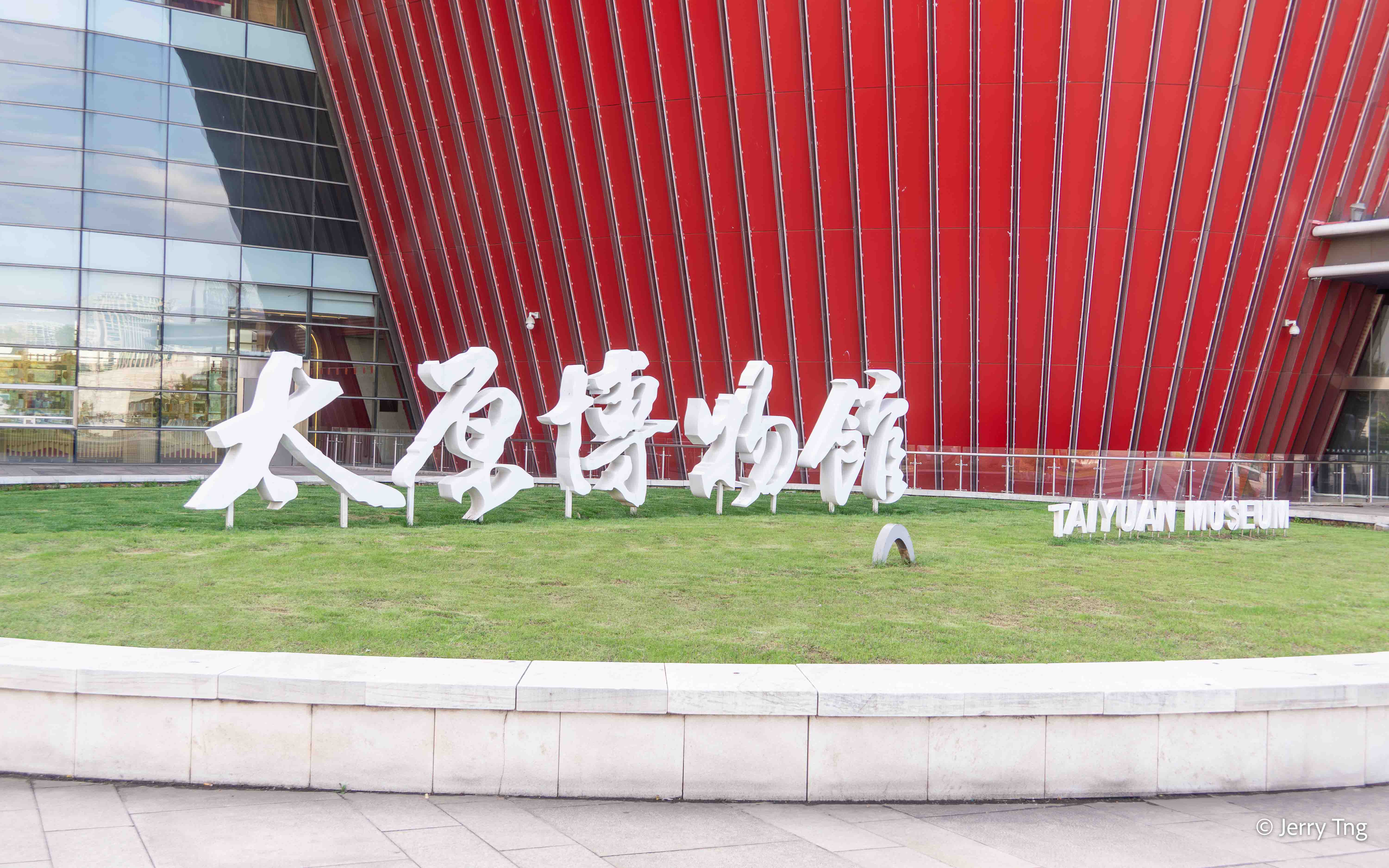
Sharing the same premises as Shanxi Bronze Museum, Taiyuan Museum is the city museum of the capital city of Shanxi.

Taiyuan Museum’s exterior is dignified and unique, inspired by Chinese red lanterns. The main building is composed of five relatively independent yet interconnected elliptical inverted cone blocks, with Chinese red and bronze as the main colours for the exterior walls.
Table of Contents
Beautiful Taiyuan 锦绣太原

Pottery | The Paleolithic Age (c. 3 million-10,000 years ago) | Unearthed from Dugou Ruins, Qingxu County, Taiyuan | Taiyuan Museum collection. 陶器|新石器时代(距今约10000-4000年)|太原市清徐县都沟遗址出土|太原博物馆藏

Pottery | Хіа (c. 2070-1600 BC) | Unearthed from Yinjiayao, Loufan County, Taiyuan | Taiyuan Museum collection. 陶器|夏(约公元前2070-前1600年)|太原市娄烦县尹家窑出土|太原博物馆藏
As early as 500,000 years ago, there were traces of human activity in Taiyuan. During the Neolithic Age, the Yijing Culture and Guangshe Culture emerged. During the pre-Qin period, Zhao Jianzi founded Jinyang City, and Zhao Xiangzi established a state and capital there. When Qin Shi Huang unified China, Taiyuan Prefecture was first established. Emperor Wen of Han ascended the throne from there, and Emperor Wu of Han defeated the Xiongnu.

During the Five Dynasties period, Jinyang was the capital of the state four times. When Zhao Guangyi of the Song Dynasty destroyed the Northern Han, he burned and flooded the ancient city of Jinyang to suppress the “royal aura”. Later, he built Bingzhou City in Tangming Town in Fenhe and established Taiyuan Prefecture. The Yuan, Ming and Qing Dynasties all continued to call it “Taiyuan”.1
Battle for Bingzhou 黄云画角见并州

(3) Bronze dun (container) with design interlaced hornless dragons 蟠螭纹铜敦
Bronzeware | The Warring States Period (475-221 BC) | Yangqu Bureau of Cultural Relics and Tourism collection.
青铜|战国(公元前475-前221年)|阳曲县文物旅游局 藏
Bingzhou is the ancient name for Shanxi-Taiyuan region.2 This section The exhibition showcases the crucial role of Taiyuan Commandery in Bingzhou as a vital military stronghold in northern China since the Qin and Han dynasties, serving as a pillar of the Central Plains. It also displays the preliminary results of the ongoing archaeological excavation at the Dongshan Ancient Tombs and Cemetery site, encouraging visitors to pay closer attention to and anticipate further archaeological discoveries while touring the museum.

Since the Qin and Han dynasties, Jinyang has served as a crucial military stronghold in northern China, a pillar of the Central Plains. Liu Heng, the Prince of Dai, ruled from Jinyang for seventeen years before ascending the throne, ushering in the prosperous reigns of Emperors Wen and Jing. Only Emperor Wu of Han, after conquering Bingzhou and the Geng tribe, permanently resided in Taiyuan.

Bronzeware | Han Dynasty (206 BC-220 AD) | Unearthed from Guoshuchang, Jinyuan District, Taiyuan | Taiyuan Museum collection. 青铜|汉(公元前206-公元220年)|太原市晋源区果树场出土|太原博物馆藏
At the end of the Eastern Han Dynasty, Cao Cao settled five Xiongnu tribes around Jinyang, resulting in a proliferation of various nomadic groups along the Fen River.

Stone | The Sixteen Kingdoms Period (304-439) | Taiyuan Institute of Cultural Relics and Archaeology collection.
石|十六国(304-439年)| 太原市文物考古研究所 藏
During the “War of the Eight Princes” in the Western Jin Dynasty, the Xiongnu leader Liu Yuan rose in rebellion, establishing the first nomadic regime (Former Zhao 前赵, 304-329) in the Central Plains.

Bamboo | Han Dynasty (206 BC-220 AD) | Unearthed from Yuelongtai Han Tomb, Dianpo Village, Yingze District, Taiyuan | Taiyuan Museum collection. 竹|汉(公元前206-公元220年)|太原市迎泽区店坡村悦龙台汉墓出土|太原博物馆藏
Subsequently, various nomadic regimes fought amongst themselves, resulting in continuous warfare. “Bingzhou, bordered by famous passes to the east and powerful nomadic tribes to the north, boasts abundant harvests and a prosperous population; it is a land of constant battles, a battleground for both offence and defence.” Liu Kun’s ten-year defence of Jinyang made him a shining example of heroism in that era.3

At the end of the chaotic Wei, Jin and Northern and Southern Dynasties, Erzhu Rong and Gao Huan relied on their military power to dominate the Central Plains and ruled the world from Jinyang. At the end of the Sui Dynasty, Li Yuan and his son started their uprising in Jinyang and established the Tang Dynasty.
The Mighty Military Stronghold of Taiyuan 并门雄镇军权重

The third section showcases the development of the famous city of Jinyang from the Northern Dynasties to reaching its peak in the Tang Dynasty. In particular, during the nearly five hundred years from the late Northern Dynasties to the Five Dynasties and Ten Kingdoms period, Taiyuan held a special position, serving as a vital military stronghold in the Central Plains and a core area for the exchange and interaction between agricultural and nomadic cultures. Its development and changes demonstrate the development process of the diverse yet unified culture of the Chinese nation.

Northern Qi was the successor state of the Chinese Xianbei state of Eastern Wei and was founded by Emperor Wenxuan. Emperor Wenxuan had a Han father of largely Xianbei culture, Gao Huan, and a Xianbei mother, Lou Zhaojun. As Eastern Wei’s powerful minister Gao Huan was succeeded by his sons Gao Cheng and Gao Yang, who took the throne from Emperor Xiaojing of Eastern Wei in 550 and established Northern Qi as Emperor Wenxuan.
Splendour of Silk Road 丝路华章

Jadeite, glass | Northern Qi Dynasty (550-577) | Unearthed from Han Zunian’s Tomb in Dajingyu Village, Wanbailin District, Taiyuan | Taiyuan Museum collection.
玉、玻璃|北齐(550-577年)|太原市晋源区王郭村娄睿墓出土|太原博物馆藏
The Silk Road was the most significant trade and cultural exchange route in the ancient world, promoting the overall development and advancement of civilisations in both the East and West. During the Northern Dynasties, Shanxi was a major route on the Silk Road, exerting a significant influence on the entire country and even the Sui and Tang Dynasties.

Celadon | Northern Qi Dynasty (550-577) | Unearthed from the Tomb of Xu Xianxiu in Wangjiafeng Village, Yingze District, Taiyuan | Taiyuan Museum collection.
陶器|北齐(550-577年)|太原市迎泽区王家峰村徐显秀墓出土|太原博物馆藏
During the Eastern Wei and Northern Qi Dynasties, Jinyang (present-day Taiyuan) was the military and political centre of the north, attracting numerous political figures, envoys, and merchants from other regions, making it one of the most important cities at the eastern end of the Silk Road. The Jinyang city ruins and its surrounding area have yielded rich and diverse material cultural relics related to the Silk Road, encompassing political, economic, military, cultural, scientific, artistic, and religious fields, fully demonstrating Jinyang’s important position on the Silk Road.4

Glass | Northern Qi Dynasty (550-577) | Earthed from Han Zunian’s Tomb in Dajingyu Village, Wanbailin District, Taiyuan | Taiyuan Museum collection. 玻璃|北齐(550-577年)| 太原市万柏林区大井峪村韩祖念墓出土|太原博物馆藏
The cup measures 10.1 cm in height, 8.5 cm in mouth diameter, 9.4 cm in belly diameter, and 4.5 cm in girth. It has a slightly constricted, round mouth, deep belly, straight walls, and a flared foot. Five rows of circular decorations adorn the outer wall. The cup is made of greenish, opaque glass, suggesting it was introduced from the West. The smooth walls reveal a tightly packed, concave structure, demonstrating the complexity of its craftsmanship.5

During Northern Qi dynasty, Buddhism in Taiyuan (then Jinyang) was a state-sponsored, booming religious era, with the city serving as an auxiliary capital and major Buddhist hub. Key developments included the construction of massive cliff-side carvings like the 63-meter Mengshan Giant Buddha, the establishment of the Tongzi Temple, and the initiation of the Tianlongshan Caves, largely driven by royal devotion.


The Avatamsaka Sutra, also known as the Mahavaipulya Buddhāvataṃsaka Sūtra, is hailed as the “Ancestor of All Sutras” and the “King of Sutras,” forming the core of the Huayan school of Buddhism. In 699 AD, during the second year of the Shengli era of the Tang Dynasty, Empress Wu Zetian commissioned the eminent monk Shikshananda and others from Khotan to translate the eighty-volume Avatamsaka Sutra in Luoyang. The following year, its inscription began to be carved in Jinyang, the northern capital, with Empress Wu Zetian personally writing the preface. The inscription preserves a large number of Tang Dynasty small-script calligraphy works of varying styles, serving as important material evidence of the development and transformation of Chinese calligraphy. The newly created characters of Empress Wu Zetian appearing in the stone inscriptions are of great significance to the study of the Wu Zhou dynasty’s character creation. 6

The museum holds a significant collection of Northern Dynasty (386-581) to Tang Dynasty (618-907) porcelain, highlighting distinctive northern celadon and the evolution of ceramic techniques. Key pieces include rare Northern Dynasty celadon with lotus designs, olive-green Tang porcelain, and Tang three-color (sancai) ware.
Rebirth of Taiyuan 太原烽火照中原

During the Five Dynasties and Ten Kingdoms period, the Later Tang, Later Jin, Later Han, and Northern Han regimes all used Jinyang as their capital or secondary capital. After Emperor Taizong of Song occupied Jinyang, due to the geomancer’s saying that “the stars Shen and Shang cannot prosper together,” he ordered the city of Jinyang to be burned down, downgraded Taiyuan Prefecture to Bingzhou Jinzhou Military Prefecture, and moved its capital to Yuci. Later, because Yuci was not a strategic location, he ordered Pan Mei to expand Tangming Town, moved the prefectural capital there, and selected capable ministers to govern it.

In the fourth year of the Jiayou reign of Emperor Renzong of Song (1059 AD), the old name of Taiyuan Prefecture Hedong Military Commission was restored. During the Song and Yuan dynasties, Taiyuan’s economy was prosperous, with rapid development in coal and iron industries, handicrafts, and commerce. Marco Polo traveled to Taiyuan and recorded its prosperity at that time.7
Tomb of Lou Rui 娄睿墓

The tomb was excavated from 1979 to 1981 at Wangguo Village, Jinci District. Excavation confirmed that the tomb was indeed the joint burial tomb of Lou Rui, Prince of Dong’an of the Northern Qi Dynasty (550-557 AD), and his wife. Although the tomb had been looted and damaged, a large number of cultural relics, including pottery figurines, porcelain, ornaments, and murals, were still unearthed.

Pottery. | Northern Qi Dynasty (550-577) | Unearthed from the Tomb of Lou Run in Wangguo Village, Jinyuan District, Taiyuan. | Taiyuan Museum collection. 陶器|北齐(550-577年)|太原市晋源区王郭村娄睿墓出土|太原博物馆藏
Lou Rui 娄睿, a member of a prominent Xianbei family and nephew of Lou Zhaojun, wife of Gao Huan, held various official positions including Prince of Dong’an, Grand Commandant, and Grand Minister of Works. He died in 570. Gao Huan 高歡 was a powerful general that dominated the court of the Eastern Wei dynasty 東魏 (534-550). Gao Yang 高洋, son of Gao Huan and cousin of Lou Rui, founded the Northern Qi dynasty (550-577). The Northern Qi empire covered the lower region of the Yellow River, modern Shanxi, the Shandong Peninsula, and the northern parts of modern Jiangsu and Anhui.


Jinci Museum, Taiyuan collection 太原市晋祠博物馆 藏
The tomb murals, arranged in a multi-column layout, cover more than 220 square meters and depict processions and return ceremonies. A total of 848 artifacts of various materials, including pottery, glazed pottery, jade, stone, and gold, were buried with him. Lou Rong’s tomb is a major discovery in Northern Qi archaeology and the highest-ranking Northern Qi tomb unearthed in the Taiyuan area to date. Its murals fill a gap in the history of Northern Qi art.8
Minister Zhao’s Tomb Chariot and Horse Pit 赵卿墓车马坑

The excavation of the Minister Zhao’s Tomb and its chariot and horse pits was listed as one of the top ten archaeological discoveries in China in 1988. The tomb is a large, triple-coffin structure made of stone and charcoal, covering an area of nearly 40 square meters. It contained 3,421 funerary objects, including ritual vessels, musical instruments, weapons, chariot and horse fittings, production tools, daily necessities, bronze, agate, jade, crystal, turquoise, gold, bone, and shell artefacts. Among these were 669 jade artefacts and 1,402 bronze artefacts, most of which were newly cast, specifically made for burial.

Bronzeware | Spring and Autumn (770 BC – 476 BC) | H: 100 cm, D (mouth): 105 cm, L: 129 cm, Wt: 220 kg | Unearthed from Minister Zhao’s tomb, Taiyuan City, Shanxi Province | Shanxi Museum collection. 铜器|春秋(公元前770—前476年)|通高100厘米,口径105厘米,耳间距129厘米,重220公斤|山西省太原市一电厂赵氏墓地出土| 山西博物院藏
These included the largest bronze ding (above) from the Spring and Autumn Period (770 BC – 476 BC) , an ornate bird-shaped zun (wine vessel), and a rare tiger-shaped stove. Many bronze cauldrons also contained the bones of sacrificial animals such as cattle and sheep, evidence of a grand sacrificial ceremony held during the funeral. These national treasures mark the brilliance of Shang and Zhou bronze art.

Bronzeware | Spring and Autumn (770 BC – 476 BC) | H: 25.3 cm, L: 33 cm | Unearthed from Minister Zhao’s tomb, Taiyuan City, Shanxi Province | Shanxi Museum collection. 铜器|春秋(公元前770—前476年)|通高25.3厘米,长33厘米|1988年太原市金胜村赵卿墓出土 | 山西博物院藏
Based on numerous clues and historical records, researchers have deduced that the tomb’s occupant was none other than Zhao Jianzi 赵简子 (?-476 BC), aka Zhao Yang 赵鞅, the chief minister of the Jin state and the founder of Jinyang City. In the late Spring and Autumn Period, the Jin state’s ruling house declined, and the six ministers held absolute power. To establish a powerbase, Zhao Jianzi commissioned his retainer Dong An to build Jinyang City, sometime before 497 BC. It wasn’t until 1988 that people learned that this ambitious and talented city builder had never left the city he created, faithfully upholding his promise: “When the state of Jin is in trouble… Jinyang is not far away; it will surely be my home,” quietly remaining there, along with his warhorses, chariots, jade chimes, and bronze tripods.11

Bronzeware | Spring and Autumn (770 BC – 476 BC) | H: 25.3 cm, L: 33 cm | Unearthed from Minister Zhao’s tomb, Taiyuan City, Shanxi Province | Shanxi Museum collection. 铜器|春秋(公元前770—前476年)|通高25.3厘米,长33厘米|1988年太原市金胜村赵卿墓出土 | 山西博物院藏
This is one of the rare tombs that uncovered a complete set of seven dings, the standard set in the Rites of Zhou for a marquis.12 Zhao is not a marquis, but the period of which he lived was a tumultuous time where the dukes were usurping the power of the Jin marquis, in what was known in history as Partition of Jin 三晋称雄 (which happened during his son Zhao Xiangzi 趙襄子 and grandson Zhao Ji 趙籍’s time.)
About Taiyuan Museum 太原博物馆


Taiyuan Museum, established on March 23, 2000, is located on the Central Cultural Island 中央文化岛 in the Changfeng Cultural and Business District of Taiyuan City, Shanxi Province. It is situated with the Fen River in front and an inner river behind, adjacent to the Shanxi Grand Theatre to the north and the Shanxi Science and Technology Museum to the east. Nicknamed the “cup noodles”, it is one of the landmark buildings in Taiyuan.
The Taiyuan Museum boasts a vast and diverse collection of cultural relics, encompassing more than ten categories including pottery, porcelain, jade, bronzes, calligraphy and paintings, and furniture, reflecting the historical and cultural landscape of Taiyuan over a considerable period.
Opening hours: 9:00 – 17:00 (closed on Mondays, the Lunar New Year’s Eve and the first day of the first lunar month.)
Ticket: Free, but you must register on their WeChat account for a ticket. Foreigners need to bring your passport.
Taiyuan Museum 太原博物馆
No. 13, Guangjing Road, Wanbailin District, Taiyuan City, Shanxi Province (about 9 km, 25 minutes’ drive to the south of Shanxi Museum)
All photos taken at Taiyuan Museum Nov 2025, unless otherwise noted.
Footnotes :
- 早在50万年前,太原已经有了人类活动的踪迹;新石器时代,义井文化、光社文化等异军突起;先秦时期,赵简子创建晋阳城,赵襄子立国建都;秦始皇统一中国,太原郡初设;汉文帝由此登基,汉武帝依此击败匈奴;魏晋南北朝乱世之末,尔朱荣高欢凭借武力,先后霸临中原,据晋阳而号令天下;隋末李渊父子由晋阳起兵,建立大唐王朝;五代扰攘,晋阳四次立国为都;宋赵光义灭北汉,为镇压“王气”,火焚水淹,毁灭了晋阳古城,后又在汾东唐明镇新建并州城,设太原府,其后元、明、清皆沿称其为“太原”。https://zhuanlan.zhihu.com/p/20211597508, accessed 2 Mar 2026 ↩︎
- 《史记》中讲:“舜以冀州之北广大,分置并州。”相传禹治洪水,划分域内为九州。据《周礼》、《汉书·地理志上》记载, 并州为九州之一。
汉武帝时,置并州刺史部,为十三刺史部之一,约当今山西省大部,河北省及内蒙古自治区的一部分地。东汉、曹魏、西晋以来,并州的治所就在太原郡晋阳县,晋末治台壁,后来仍治晋阳。并州包括今山西省大部,北朝以来并州辖境逐渐缩小,但仍以太原为中心。
隋炀帝时改并州为太原郡,其地约当今山西省太原市、大同市和河北省保定市一带地区。李渊、李世民晋阳起兵之处便属于太原郡。唐高祖恢复并州之称,武则天的家乡就在并州的文水县。唐玄宗开元十一年(723年),并州改为太原府。北宋灭建都太原府的北汉,又改太原府为并州,旋即升为太原府。https://zh.wikipedia.org/zh-sg/并州 ↩︎ - 秦汉以来,晋阳作为北中国军事重镇,砥柱中原。刘恒为代王都晋阳十七年,南下登基,成就文景之治。仅武帝没并州刺更部,常驻太原。东汉末,曹操将匈奴五部安置于晋阳周边,汾河流域遍布杂胡。西晋“八王之乱”,匈奴首领刘渊揭竿而起,建立了中原地区第一个胡族政权。其后诸胡政权迭相厮杀,战火连绵。“并州之地,东带名关,北逼强胡,年谷独孰,人庶多资,斯四战之地,攻守之场也。”刘琨据守晋阳十年,成为那个时代的一抹英雄亮色。Museum information card, Nov 2025 ↩︎
- 丝路华章
丝绸之路是古代世界贡献最大的贸易之路与文明交流之路,促进了东西方社会文明的整体发展和提升。山西在北朝时期是丝绸之路的主要线路,对全国乃至隋唐都有重要影响。东魏北齐时期,晋阴为北方军政中心,政要云集,使节络绎,胡商纷至,商贸发达,成为丝路东端最重要城市之一。在晋阳城遗址及其周围发现有丰富多彩的丝绸之路物质文化遗存,涉及政治、经济、军事、文化、科技、艺术、宗教等领域,充分显示出晋阳在丝绸之路上的重要地位。Museum information card, Nov 2025 ↩︎ - Glass cup 玻璃杯
Glass | Northern Qi Dynasty (550-577) | Earthed from Han Zunian’s Tomb in Dajingyu Village, Wanbailin District, Taiyuan | Taiyuan Museum collection. 玻璃|北齐(550-577年)| 太原市万柏林区大井峪村韩祖念墓出土|太原博物馆藏
通高10.1,口径8.5,腹径9.4,径4.5厘米。圆口微敛,深腹,直壁,喇叭形底足。腹外壁五排圆形饰。泛绿色不透明玻璃质,应为西域传入品。杯壁光滑,映出紧密排布的窝状体结构,足见其工艺之复杂。Museum information card, Nov 2025 ↩︎ - 《华严经》全称《大方广佛华严经》,被誉为“万经之宗”“诸经之王”,是构成华严宗学说的核心。唐圣历二年(公元699年),武则天在洛阳请于阗国高僧什叉难陀等译成八十卷《华严经》,第二年开始在北都晋阳镌刻,武则天亲自作序。碑文中保留了大量风韵各异的唐人小楷,是中国书法发展变革时期的重要实物资料。石经中出现的武则天新造字,对武周造字的研究有着重要意义。Museum information card, Nov 2025 ↩︎
- 五代十国时期后唐、后晋、后汉北汉等政权以晋阳为国都或陪都。宋太宗占领晋阳后,因堪舆学家“参商不两兴”之说,下令焚毁晋阳城,降太原府为并州紧州军事,迁治榆次。后因榆次地非要会,命潘美扩建唐明镇,迁州治于此,并选派能臣镇之。宋仁宗嘉祐四年(公元1059年),恢复太原府河东节度的旧称。宋元时期,太原经济发达,煤铁业、手工业、商贸业发展迅速,故有“花花真定府,锦绣太原城”之说。马可•波罗游历太原,记录下当时的繁荣景象。Museum information card, Nov 2025 ↩︎
- 1979至1981年晋祠王郭村发掘出土。娄睿,鲜卑望族,高欢妻娄昭君内侄,历封东安王、太尉、大司空等职,武平元年(公元570年)卒。墓葬壁画长卷多栏式布局,残存220余平方米,描绘出行、回归仪仗等。陪葬陶、釉陶、玉、石、金等多种质地器物,共计848件。娄容墓是我国北朝考古的重大收获,也是迄今为止太原地区出士的最高级别北齐墓葬,其壁画作品填补了中国美术史北齐实物画作的空白。Museum information card, Nov 2025 ↩︎
- 附耳牛头螭纹蹄足镬鼎,别名赵卿鼎,为春秋晚期青铜器,1988年出土于太原晋源区金胜村赵卿墓(春秋时期等级最高、规模最大的晋国高级贵族墓葬),墓主可能为晋国执政卿赵简子(赵鞅)或赵襄子,考古界稳妥起见称赵卿墓。该鼎通高100厘米,口径105厘米,耳间距129厘米,重220公斤,是迄今发现的春秋时期最大青铜鼎,现藏山西青铜博物馆,在太原龙潭公园有硕大的复制品 。
这件大鼎被称为镬鼎,镬是古代一种大锅,烹煮牲肉的炊具。据《周礼》记载,镬鼎用以煮牲,依形制大小分为牛镬、羊镬和豕镬,此鼎足以煮上一头整牛,是当之无愧的“牛镬”。出土时鼎内放有牛肩胛骨,参照该鼎的大小推断它应该是可以煮全牛的牛镬。后来被命名为“附耳牛头螭纹蹄足镬鼎”。此鼎通高100厘米,口径105厘米,重达220公斤,是迄今为止发现的春秋时期最大的青铜鼎。
该鼎于1988年在太原一电厂扩建工程中意外发现于金胜村的一座春秋晚期积石积炭墓。]据专家考证,墓主人为赵鞅,考古界为稳妥起见称此墓为“赵卿墓”,该鼎因此得别名“赵卿鼎”。 文物出土时,鼎内放有牛肩胛骨。https://baike.baidu.com/item/镬鼎/5451126, accessed 2 Mar 2026 ↩︎ - 晋国晚期青铜杰作。盛酒器。形如昂首挺立的鸷鸟,形体肥硕,双目圆睁,颈细长,钩喙。腹腔中空,与颈、喙相通,锋锐的钩喙为自由开合的流口,倾倒酒液时自动开启,复位时闭合,设计巧妙。鸟背设盖,上有虎形提梁,盖以链条与提梁相连。鸟双腿直立,足间有蹼,为了使器体平衡稳固,在鸟尾下设一虎形支脚,小虎前腿支地,后腿向上蹬,形成三点支承器体。通体浮雕羽翼,羽纹华丽清晰,富有层次感。https://baike.baidu.com/item/春秋赵卿鸟尊/11011265, accessed 2 Feb 2026 ↩︎
- 研究者根据墓葬诸多迹象和文献记载推定,墓主正是晋阳城的缔造者— 晋国正卿赵简子。春秋末,晋国公室衰微,六卿专权,赵简子为建立后方基地,委派家臣董安于肇建晋阳城,时在公元前497年略早。而时至公元1988年,人们才有幸得知这位雄才大略的城市老人竟然从未离开过他开创的城市,信守着”晋国有难,……无以晋阳为远,必以为归”的诺言静静地守候于此,连同他的战马军车、玉磬铜鼎。https://baike.baidu.com/item/太原东周赵卿墓/12584499, accessed 2 Mar 2026 ↩︎
- 该鼎的出土具有三重历史坐标意义:形制特征印证赵氏家族在晋阳(今太原)的经营始于公元前497年;七鼎配置反映春秋晚期”礼崩乐坏”的社会变革;作为三家分晋前夕的实物见证,衔接晋国与赵国的历史断代。https://baike.baidu.com/item/附耳牛头螭纹蹄足镬鼎/16559244, accessed 2 Mar 2026 ↩︎
0 comments on “Taiyuan Museum 太原博物馆”