
This special exhibition is a collaboration by Tianjin Museum and Yinxu Museum, assisted by Anyang Museum and Anyang Research Institute of Cultural Relics and Archeology. The exhibition ran from 23 Aug 2025 – 6 Jan 2026. I was glad that I managed to catch this when I was there.

Bronzeware | Late Shang (Yinxu Phase III)1 (ca. 1250-1100 BC) | Excavated from M160, western Guojiazhuang, Anyang, 1990 | Collection of the Institute of Archaeology, Chinese Academy of Social Sciences
铜器|晚商(殷墟三期)(约公元前1250-前1100年间)|1990 年安阳郭家庄西部 M160 出土|中国社会利学院考古研究所藏
As the golden age of ancient Chinese bronze civilisation, the Shang Dynasty achieved unprecedented success in all fields of handicrafts. In the late Shang Dynasty, the Yin Ruins formed a large-scale industrial cluster with a state-run system and the collaboration of various craftsmen. It not only became a model of early handicrafts but also integrated the system of rites and music with the wisdom of state governance into the bloodline of civilisation, becoming the source of the continuous vitality of Chinese civilisation.2

The exhibition is mainly divided into five sections: 《百工通览》”Overview of Crafts”, 《营造商邑》”Building a City”, 《器用皆工》”Craftsmanship”, 《制礼作乐》”Rites and Music”, and 《车马交通》”Transportation”. 3
Special Exhibition : Shang Capital Crafts 商邑百工
Overview of Crafts 百工通览

Bone | Shang period, King Wuding (?-1192 BC) | Collection of Tianjin Museum
骨|商武丁(?—前1192年)|天津博物馆藏
In the late Shang Dynasty, Yinxu developed four major production areas, centred on the palace and temple area and surrounded by handicraft industrial zones on the south, west, and east sides. These areas were interconnected through a well-developed network of waterways and land transportation, forming a highly efficient handicraft production system.

 (huo)卜骨
Bone | Shang period, King Wuding (?-1192 BC) | Collection of Tianjin Museum
骨|商武丁(?—前1192年)|天津博物馆藏5
The handicraft industry in Yinxu implemented a dual-track management system of “royal coordination and clan-based execution.” The royal family provided macro-level control, while the clan-based settlements were responsible for organising the entire production process, with designated personnel managing each stage from raw materials to finished products. These settlements combined production, residence, and burial functions, forming a composite form of “integrated industry, residence, and burial.”

 瓶銅方彝6
瓶銅方彝6Bronzeware | Late Shang Dynasty | Excavated from M1046, Liujiazhuang North Site, Anyang, 1999 | Collection of the Institute of Archaeology, Chinese Academy of Social Sciences.
铜器|晚商|1999年安阳刘家庄北地 M1046 出土|中国社会科学院考古研究所藏
It was precisely based on this highly specialised, state-run handicraft system that the ancient people created a highly developed material civilisation.7
Building a City 营造商邑

The Huanbei Shang City was laid out in a square pattern, with the palace, handicraft area, and residential area progressing in layers, surrounded by auxiliary settlements such as Taojiaying. Yinxu, with the Huan River as a natural barrier, had its palaces and ancestral temples situated on a high platform northeast of Xiaotun, surrounded by workshops, clan settlements, and tombs, with a clear functional division of roads.

The wooden official palaces stood on massive rammed earth foundations, and the courtyards featured a drainage system composed of pre-embedded ceramic water pipes and stone-lined ditches. The royal tombs were located northwest of the palaces, with four tomb passages forming a “亞”-shaped burial mound surrounded by sacrificial pits, demonstrating the grand scale of the project.

The construction of the Huanbei Shang City, the Yinxu palace and temple area, and the royal tombs collectively showcased the achievements of the Shang Dynasty in rammed earth construction, timber construction, drainage, and orientation surveying, as well as its ability to mobilise large-scale manual labor.9
Craftsmanship 器用皆工


Bone | Shang period, King Di Yi (?-1076 BC) or Di Xin (?-1046 BC)| Collection of Tianjin Museum
骨|商帝乙(?—前1076年?)、帝辛(?—前1046年?)|天津博物馆藏10
The handicraft industry at Yinxu extensively utilised various raw materials such as bone, jade, clay, wood, silk, and hemp. Craftsmen employed tools like adzes, chisels, saws, awls, knives, whetstones, and drills, employing a rational process of bone processing, jade carving, pottery firing, lacquer application, salt production, winemaking, and hemp retting—a diverse array of techniques complementing each other, each excelling in its own way.

Bone | Shang Dynasty (c. 1600–1046 BC) | Anyang Museum collection. 骨|商|安阳博物馆藏11
The products were widely used in all aspects of daily life; every tool and implement was meticulously crafted, embodying the wisdom of the artisans. These products are a direct reflection of the level of productivity at the time and provided a solid material foundation for the normal functioning of society.

Through the archaeological excavations of raw materials, tools, semi-finished and finished handicrafts from the Shang Dynasty, the bustling production scenes of the Yinxu workshops three thousand years ago can be clearly imagined.12
Jade Workshops


Technology Breakthrough

Pottery | Shang Dynasty (c. 17th-11th century BC) | Original piece in the Freer Gallery of Art, USA |
Collection of the Institute of Ancient Chinese Antiquities, Chinese Academy of Social Sciences.
陶器|商(约前17世纪—约前11世纪)|原件藏于美国弗利尔美术馆|中国社会科学院专古所究所藏
White pottery, made with kaolin clay (FeO < 1.5%), was fired at 980–1050°C. Its pure white body resonated with the Shang dynasty’s belief in the color white, making it an exclusive ritual vessel for royalty and nobility. It was frequently found in large and medium-sized tombs, holding a status comparable to or even higher than bronze ritual vessels.

Pottery | Shang Dynasty (c. 17th-11th century BC) | Anyang Museum Collection.
陶器|商(约前17世纪—约前11世纪)|安阳博物馆藏
Hard pottery, made with high-silica clay (SiO > 70%), was fired at 1100–1200°C, resulting in a dense body (water absorption < 6%). As a crucial transitional form from pottery to porcelain, its high-temperature technology marked the pinnacle of Shang dynasty pottery making.

Pottery | Late Shang Dynasty (Yinxu Phase IV, c. 1250 – c. 1046 BC) | Excavated from M123, Dasikong, Anyang, 2017 |
Collection of the Institute of Archaeology, Chinese Academy of Social Sciences.
铜器|晚商(殷墟四期)|2017年安用大司空 M123出土|中国社会科学院考古研究所藏
Proto-porcelain, made with porcelain stone or refined kaolin clay as the body, with a calcium-based coating, was fired at 1200–1280°C, achieving the first dual combination of clay and body. The body had a high degree of vitrification (water absorption 0.5–3%), producing a clear, resonant sound when struck, pioneering porcelain craftsmanship.16

Pottery | Shang Dynasty (c. 1600–1046 BC) | Anyang Museum collection.
陶器|商|安阳博物馆藏
Few pottery pieces from that period have survived intact, and gray pottery was more common than black pottery. White pottery was even rarer, used only by nobles, and represented a type of ritual vessel in the highest ceremonies. The Yin Ruins period was a highly developed stage for white pottery. This vessel is entirely white, with a cloud and thunder pattern as the base, and an animal face pattern on the collar. The abdomen is decorated with human figures, and the patterns on the neck and abdomen are connected to form a complete human-animal face pattern, which is a typical representative of Yin Ruins white pottery.17
Rites and Music 制礼作乐

Bronzeware | Late Shang Dynasty (Yinxu Phase IV, c. 1250 – c. 1046 BC) | Excavated from M303, Dasikong, Anyang, 2004 |
Collection of the Institute of Archaeology, Chinese Academy of Social Sciences.
铜器|晚商(殷墟四期)|2004年安阳大司空M303出土|中国社会科学院考古研究所藏18
The ritual and music system is an important marker of the origins of Chinese civilisation and the formation of the early state. Shang kings and nobles widely used ritual and music. Driven by sacrifices and warfare, ritual and music gradually merged and rose to the level of a state institution, laying the foundation for further development in later generations.19

 铜铙(nao)
Bronzeware | Shang Dynasty (c. 1600–1046 BC) | Anyang Museum collection. 铜器|商|安阳博物馆藏
Bronze ritual vessels are the cornerstone of the Shang Dynasty’s ritual and music system. Wine vessels such as the gu and jue were used in sets according to rank, and their decorations, including mysterious patterns such as animal faces and kui dragons, displayed majesty. Musical instruments were equally crucial: in sacrificial ceremonies, music and dance were used to entertain ancestors and appease deities; in military activities, music and dance were used to maintain discipline and enhance military prestige. These ritual vessels and musical instruments, crafted by artisans from the Yin Ruins, have survived to this day, allowing contemporaries a glimpse into the ritual and music system of that time.20
 铜铙(nao)
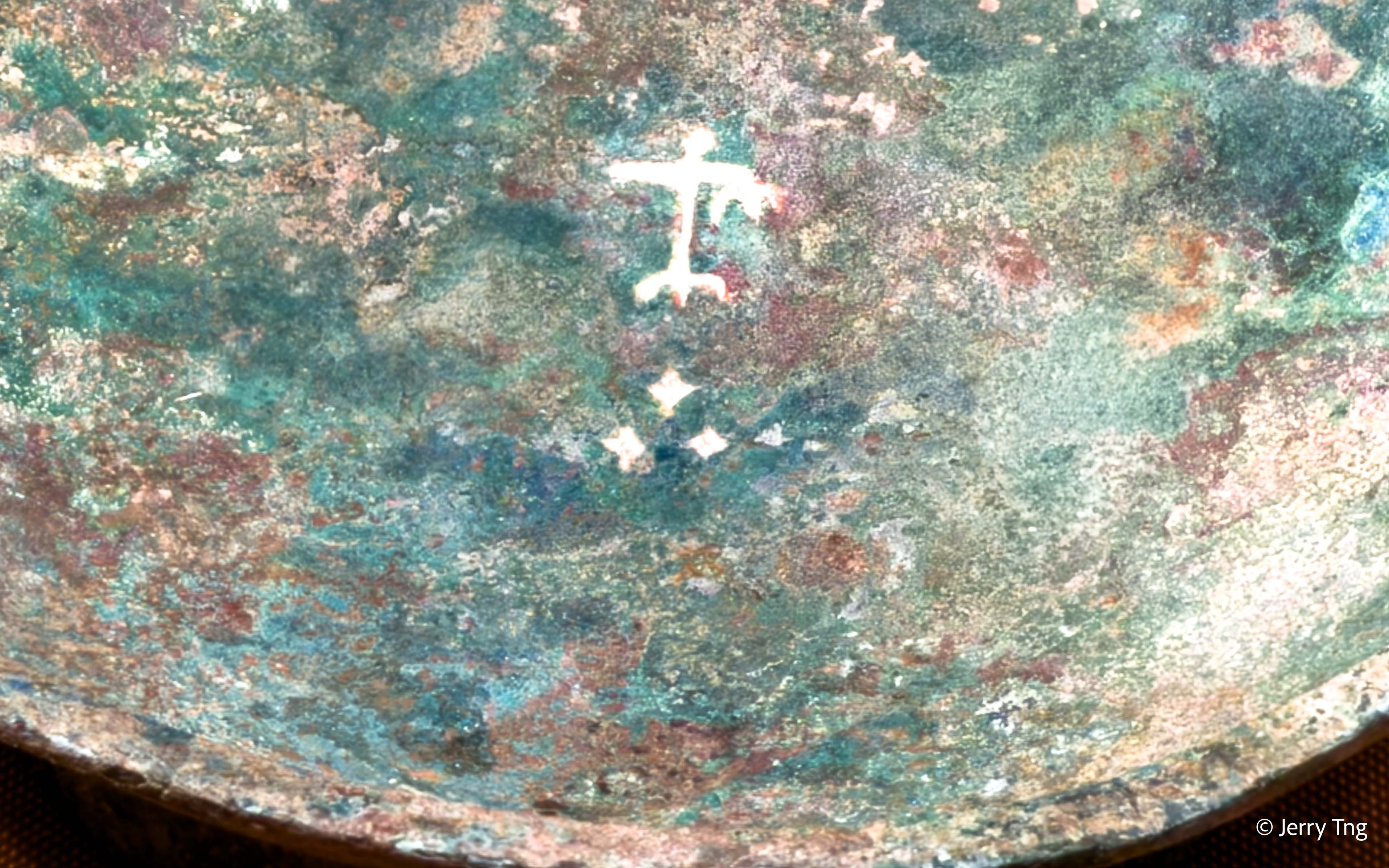
The mouth is concave and arched with sharp corners on both sides. A short, hollow cylindrical handle connects to the body cavity, which is decorated with shallow relief animal-face patterns on both the front and back. This nao (a type of ancient Chinese bell) is relatively small and similar to other Shang Dynasty animal-face bells unearthed at Yinxu. The inner wall of the mouth is inscribed with the two characters “ ”, where “
 ” is a clan name, possibly interpreted as “举” or “冀”, and “(唯女)” is likely the name of a Shang dynasty woman.21
Transportation 车马交通

During the Shang Dynasty, transportation primarily relied on land and water routes, with chariots and wooden boats being the main modes of transport. Chariots were not only essential for Shang nobles’ travel, hunting, and warfare, but also symbols of their status and wealth. The chariot-making technology at Yinxu was exquisite, and its single-axle, two-wheeled design laid the foundation for the basic form of chariots in pre-Qin China.

Bronzeware | Late Shang Dynasty | Excavated from M40, Tiexi Urban Construction Bureau, Anyang, 1995 | Collection of the Institute of Archaeology, Chinese Academy of Social Sciences 铜器|晚商|1995年安阳铁西城建局 M40 出土|中国社会科学院考古研究所藏
The various components used on ancient chariots were called chariot fittings. Currently discovered Shang Dynasty chariot fittings are mainly made of bronze; some have practical functions, while others are decorative. They made the chariots appear magnificent and directly reflected the social status of their owners.

Bronzeware | Shang Dynasty (c. 1600–1046 BC) | Tianjin Museum collection. 铜器|商|天津博物馆藏
The extensive road network and advanced transportation tools provided Shang royalty with a guarantee for effectively controlling areas outside the capital and greatly promoted economic development.22
The Bronzeware Discovery Timeline
Please scroll left-right to see the entire timeline.There’s an information wall outside the exhibition that detailed the major bronze ware discoveries and excavations in China since 1899. This would give you a good picture of how the history of Xia-Shang-Zhou has been pieced together since then. The history of that period is still unfolding as we verified the written against the archaeological finds. (You may scroll left and right to see the entire timeline.)
Highlights of the Exhibition

Bronzeware | Shang Dynasty (c. 1600–1046 BC) | Anyang Museum collection. 铜器|商|安阳博物馆藏
More than 3,000 years ago, the Shang Dynasty people not only created a mature writing system represented by oracle bone script, but also achieved remarkable success in the field of handicrafts, producing a series of exquisite products that still amaze people today, and forming a highly professional state-run handicraft system. This system, with bronze casting at its core, encompassed fields such as architecture, bone carving, pottery making, jade carving, and chariot making, laying the foundation for the basic paradigm of later handicraft development, exerting a profound influence, and leaving an immortal chapter in the history of human civilisation.
Bronze Square Zun from the Yazhi Site 亚址铜方尊


Bronzeware | Late Shang (Yinxu Phase III) (ca. 1250-1100 BC) | Excavated from M160, western Guojiazhuang, Anyang, 1990 | Collection of the Institute of Archaeology, Chinese Academy of Social Sciences 铜器|晚商(殷墟三期)(约公元前1250-前1100年间)|1990 年安阳郭家庄西部 M160 出土|中国社会科学院考古研究所藏
Two similar bronze zun were unearthed from the same tomb; this is one of them. It has a flared square mouth, constricted neck, sloping shoulders, a flat bottom, and a high, flared foot. Each of the four corners and the center of each side has a flange, divided into three sections forming a straight line. The upper flange is longer, extending 3 cm beyond the mouth. Below the mouth is a pair of kui-shaped banana leaf patterns, with the kui heads at the bottom, looking back. There is a clear inscription “Yazhi” on the inner bottom center of the square zun.


The belly and the four sides of the foot are decorated with large, detachable animal mask patterns. At the four corners of the shoulder, there are four round nail heads, each topped with an elephant head. The elephants have round eyes, long, curled trunks, and a pair of conical tusks below the trunk. At the center of each of the four sides of the shoulder, there are also four round nail heads, each topped with an animal head. The animal heads resemble deer, with a pair of large, upward-pointing antlers, each antler tipped with five branches resembling a hand. These eight animal heads were cast separately and can be removed freely. 23
Inlaid Turquoise Bone Tiger 嵌绿松石骨虎

Bones, Turquoise | Late Shang Dynasty (Yin Ruins Phase II) | Excavated from Tomb M5 of Fu Hao at Yinxu, Xiaotun, Anyang in 1976 |
Collection of the Institute of Archeology of the Chinese Academy of Social Sciences.
骨、绿松石|晚商(殷墟二期)|1976年安阳小屯 M5殷墟妇好墓出土 |中国社会科学院考古研究所藏
This Inlaid Turquoise Bone Tiger features erect ears and a slightly concave back. Its limbs are extended forward (one hind leg is missing), with claws touching the ground. The long tail curls upwards. The spine is carved with segmented patterns. Turquoise pieces were inlaid on the eyes, ears, nose, and various parts of the body, but some have fallen off. Based on the circular broken bone at the front of the tiger’s head, this tiger may have been the handle of a carving knife or similar implement.24
Small Bronze Tripod With Lid 带盖小铜鼎

Bronzeware | Shang Dynasty | Unearthed from M1 at the Anyang Agricultural Bank Cadre School in 1995 | Collection of Anyang Municipal Institute of Cultural Relics and Archaeology 铜器|商|1995年安阳农行干校 M1 出土 | 安阳市文物考古研究院藏
Speaking of small and exquisite pieces, one must mention the “smallest bronze ding” from the Shang Dynasty. Its occupant was a young boy. It is speculated that this bronze ding was specially cast as a funerary object. The ding is 5.1 cm high from its legs to its handles and 4 cm in diameter. It dates back to the late Shang Dynasty, roughly during the third or fourth phase of the Yinxu period, more than 3,000 years ago.25

This ding is the smallest Shang Dynasty bronze ding discovered to date. The largest surviving Shang Dynasty bronze ding, the Simuxu Ding, is 26 times its height and nearly 17,000 times its weight. The ability to create both imposing large dings and exquisitely small ones demonstrates the remarkable skill and capability of the Shang Dynasty’s bronze industry.26
Bronze Jin (Food Vessel) with Kui Pattern 夔纹铜禁

Bronzeware | Western Zhou (c.1046 BC – 771 BC) | Tianjin Museum collection.
铜器|西周(约前1046年-前771年)|天津博物馆藏27
This vessel is rectangular in shape, hollow and bottomless. The surface has three slightly raised oval openings, with two rows of sixteen rectangular perforations on the front and back, and two rows of four rectangular perforations on each side. The vessel is decorated with exquisite kui dragon patterns, the designs are vivid, the shape is dignified, and the casting is superb.

The vessel was used as a stand for wine vessels, serving as a table for displaying wine vessels such as you and zun during sacrifices and banquets in ancient times. This kui-patterned bronze vessel is the largest known Western Zhou bronze vessel and is a valuable material for the study of the history of Chinese bronze vessels.

Pottery | Late Shang Dynasty | Excavated from H31, Xiaomintun, Anyang, 2000 | Collection of the Institute of Archaeology, Chinese Academy of Social Sciences. 陶器|晚商|2000年安阳孝民屯H31出土|中国社会科学院考古研究所藏
The mold that was used for casting another similar jin was excavated from the Anyang site, signifying the workshop that was capable of making such large utensils existed in the Shang city.
About Tianjin Museum

Tianjin Museum is the largest museum in Tianjin, China, exhibiting a range of cultural and historical relics significant to Tianjin. The unique architectural style of the museum, whose appearance resembles that of a swan spreading its wings, has meant that it is quickly becoming one of the city’ iconic buildings. It is built to be a large modern spot for the collection, protection and research of historic relics as well as a place for education, leisure and touring.

The Tianjin Museum has an extensive collection of ancient Chinese fine arts and exhibits on Tianjin’s history. There are nearly 200,000 collections of valuable historical and cultural art and relics, including calligraphy, paintings, bronze ware, ceramics, jade, seals, ink stone, oracle bones, coins, historic documents and relics of modern times, and local folk art.
Admission is free with relevant identification document (Foreigners would need your passports for verification.)
Open Tue-Sun from 9am to 5pm, closed on Mondays (except on Public Holidays)
Tianjin Museum 天津博物馆
No. 62 Pingjiang Road, Hexi District, Tianjin 天津市河西区平江道62号
All photos taken at Tianjin Museum, Oct 2025, unless otherwise noted.
Footnotes :
- 晚商殷墟三期(约公元前1250-前1100年间,对应康丁、武乙、文丁时期)是商代鼎盛后的调整与衰落期。青铜文化延续繁荣,但文化面貌较二期发生变化,墓葬规模减小,反映出王权统治的某些调整与社会结构的动荡,是殷商由盛转衰的关键过渡阶段。
↩︎ - 作为中国古代青铜文明的鼎盛时期,商代手工业各领域都取得了空前成就。商代晚期,殷墟形成了官营体系下百工协同、规模宏大的产业集群,不仅成为早期手工业典范,更将礼乐制度与国家治理智慧融入文明血脉,成为中华文明生生不息的源头活水。
↩︎ - 展览主要分为“百工通览”“营造商邑”“器用皆工”“制礼作乐”“车马交通”五个单元,另专设一个独立小单元“大商制造:牛”。 ↩︎
- Consultation Divination Bone for King’s Return to Shang 王人于商卜骨
Bone | Shang period, King Wuding (?-1192 BC) | Collection of Tianjin Museum
骨|商武丁(?—前1192年)|天津博物馆藏
释文:正:(1)•王人于商。(2)口口 【卜】,口,【貞】王人于商。(3)口口【卜】,
㱿,貞生七月王入于【商】。(4)戊寅卜,㱿,貞生七月王入于【商】(5)辛已卜,㱿,貞王于生七月入【于商】。(6)甲申卜,㱿,貞王于生八月入于商。
反:口口卜, 歲母庚。
歲母庚。
说明:此卜骨正面所刻卜辞大意是贞人 㱿(que)在戊寅、辛已、甲申等日重复贞问商王
是否要在未来的七月、八月进人商邑。王襄旧藏。
↩︎ 
↩︎- Rectangular mouth, flat rim, inward-sloping lower belly, flat bottom, high foot ring. The lid is roof-shaped with a knob. Flanges are present on all four corners and the middle of the body, forming straight lines. Arched notches on each side of the foot ring correspond to the middle flanges. Pairs of facing kui (dragon) patterns adorn the lid near the rim, the mouth of the vessel, and the foot ring. The lower part of the lid and the belly are decorated with segmented taotie (animal mask) patterns, filled with deformed inverted kui patterns on the sides. The taotieon the lid is inverted with the mouth facing the central ridge. The wide sides of the lid are decorated with simplified animal masks, and the narrow sides with triangular cloud patterns. All are set on a background of cloud-thunder patterns. An inscription inside the lid reads “Ya Chi” (亚它
 ), and an inscription on the vessel bottom reads “Ya Chi” (亚). ↩︎
 - 商代晚期,殷墟形成了以宫庙区为核心,南、西、东三面手工业区环绕的四大生产区域。这些生产区域通过完善的水路和陆路交通网络相互连按,构成了一个运转高效的手工业生产体系。
殷墟手工业实行“王室统筹、族邑执行”的双轨管理制度。王室主导宏观管控,族邑负责生产全流程组织,并设专员管理从原料至成品的各环节。族邑聚落兼具生产、居住与丧葬功能,形成“工、居、葬合一”的复合形态。
正是依托于这种高度专业化的官营手工业体系,先民们才创造出了发达的物质文明。 ↩︎ - Wooden beam retrieved from an old well 木井架
Wood | Late Shang (Yinxu Phase III) (ca. 1250-1100 BC) | Excavated in 2008 from the northern part of Liujiazhuang, Anyang, H238J31 | Collection of the Institute of Archaeology, Chinese Academy of Social Sciences 木|晚商(殷墟三期)(约公元前1250-前1100年间)|2008 年安阳刘家庄北地 H238J31 出土|中国社会科学院考古研究所藏
此井口距地表深2米,由于井口坍塌严重,平面呈不规则状,最长径5.16、短径266、井深103米。井底用柏木交叉搭成边长1米的“井”字形框架,井架保留的高度约1.1米,周围填满鹅卵石。在井口北侧有盘旋向下的12级台阶。从最下面的台阶向下0.72米有一处平台,东西长2.2米、宽0.8米,台面距井底约5.82米。从整体形状判断,此井建造得非常考究,井口上原来应有建筑物遮挡,东侧半腰的平台可供打水者站立,台阶可供其上下。并内填土共分4层,均为深灰色土,质地松软,包含物较少。木质井框内发现遗落有3件红陶罐、3件灰陶罐,另有铜爵、残铜、铜盖、铜肩部兽首所衔圆环各1件以及罄、提梁卤等若干铜器残片,还发现4件鹿角锥和1件石器等。
The wellhead is 2 meters below the surface. Due to severe collapse of the wellhead, its plan is irregular, with the longest diameter being 5.16 mm, the shortest diameter 266 mm, and a depth of 103 meters. The bottom of the well is constructed with a 1-meter-sided “well”-shaped frame made of cypress wood, with the remaining height of the frame approximately 1.1 meters. The surrounding area is filled with pebbles. On the north side of the wellhead, there are 12 spiraling steps leading downwards. 0.72 meters down from the lowest step is a platform, 2.2 meters long and 0.8 meters wide, approximately 5.82 meters from the bottom of the well. Judging from its overall shape, this well was meticulously constructed. There must have originally been a building over the wellhead, and the platform halfway down the east side provided a place for people to stand and draw water, with steps for ascending and descending. The inner fill consists of four layers of dark gray, loose soil with few inclusions. Inside the wooden well frame, three red pottery jars and three gray pottery jars were found, along with a bronze jue (wine vessel), a piece of bronze, a bronze lid, a bronze ring held by an animal head on the shoulder, as well as several bronze artifacts such as a chime and a handle. Four antler cones and one stone tool were also found.
↩︎ - 洹北商城呈方城格局,宫城、手工业区、居民区层层递进,陶家营等附属聚落拱卫其外。殷墟以洹河为天然辱障,宫殿宗庙踞小屯东北高台,周环作坊、族邑与墓葬,道路纵横,功能分区清晰;木构官殿立于巨型夯土台基之上,院落里有预埋的陶水管、石砌明沟组成排水系统。王陵位于宫殿西北,四条墓道的“亞”字形大墓周布殉祭坑,工程规模宏大。
洹北商城、殷墟宫庙区及王陵的营造,集中展现了商代在夯筑、木构、排水、方位测量等建筑技术上的成就以及大规模调度人工作业的能力。
↩︎ - Divination bones on offering ceremonies 工典其幼其翌卜骨
Bone | Shang period, King Di Yi (?-1076 BC) or Di Xin (?-1046 BC)| Collection of Tianjin Museum
骨|商帝乙(?—前1076年?)、帝辛(?—前1046年?)|天津博物馆藏
此卜骨上所刻的一条卜辞为,“癸卯王卜,贞有亡(囚犬)(huo,也有读为“咎”“忧”“戾”的,均通)在九月,甲晨工典其幼其翌。“ 此处“工”应读为“贡”;“工典”即贡典,也就是献册,指祭祀中的一种仪式,献其逃册以致其祝告之辞也”。”幼”和“翌”均为祭祀典礼的名称。
The inscription on this oracle bone reads, “On the day of Gui Mao, the king divined, inquiring about the death of a prisoner (huo, also read as ‘jiu,’ ‘you,’ or ‘li,’ all of which are acceptable) in the ninth month. On the morning of Jia, the ceremonial office will be held to present the offerings to the young and the next day.” Here, “gong” should be read as “gong”; “gongdian” means offering the offerings, which refers to a ritual in sacrifices where the offerings are presented to convey the prayers. “You” and “the next day” are both names of sacrificial ceremonies.
↩︎ - Kui pattern carved bone ornament 夔纹雕花骨饰
Bone | Shang Dynasty (c. 1600–1046 BC) | Anyang Museum collection. 骨|商|安阳博物馆藏
长条形,面鼓、上窄下宽、宽部有半环形。正面满饰浮雕花纹,主纹为一长身卷尾夔龙,圆眼、卷身,身饰菱形方格纹,以云雷纹为地纹。反面饰阴刻兽面纹。该器随形雕制,制作精巧.
构思巧妙,纹饰线条规整而流畅、雕琢精细,有较高的工艺水准,是研究商代雕琢技艺和制骨工艺的重要实物资料。
The vessel is long and narrow, with a bulging surface, narrower at the top and wider at the bottom, featuring a semi-circular section at the wide end. The front is fully decorated with relief carvings, the main motif being a long-bodied, curled-tailed kui dragon with round eyes and a coiled body adorned with diamond-shaped grid patterns against a background of cloud and thunder patterns. The reverse side is decorated with an incised animal mask. The vessel is carved to fit its natural shape, demonstrating exquisite craftsmanship. Its ingenious design, regular and flowing lines, and meticulous carving showcase a high level of artistry, making it an important material resource for studying Shang Dynasty carving techniques and bone-working processes.
↩︎ - 殷墟的手工业,广泛运用了骨、玉、土、木、丝、麻等多种原材料。工匠们使用锛、凿、锯、锥、刀、磨石、钻陀等工具,采用合理的流程工艺,制骨、琢玉、烧陶、髹漆、煮盐、酿酒、沤麻•••••多样技术交相辉映、各擅胜场。所制广泛用于日常生活的方方面面,器用皆工,凝聚工匠智慧。这些产品是当时生产力水平的直观体现,也为社会的正常运行提供了坚实的物质保障。
通过考古出土的商代原材料、工具、手工半成品和成品,三千年前股墟手工作坊的繁忙生产场景可被清晰想象。
↩︎ - Clam Pendant 蚌觿
Shell | Late Shang Dynasty | Excavated from M527, Liujiazhuang North Site, Anyang, 1993 | Collection of the Institute of Archaeology, Chinese Academy of Social Sciences 贝|晚商|1993 年安阳刘家庄北地 M527 出土|中国社会科学院考古研究所藏
该字兼具实用与礼仪功能,《诗经·卫风》载“童子佩觿”,《礼记》称成人佩大小觿以解结,成为成年的象征 [5]。其用途延伸至星名“觜觿”及通假为“蠵”(大龟)等,《康熙字典》收录其多音异读,粤语读作“kwai4”,潮州话读“hi5” 。
“觿”初见于先秦典籍,早期作“鑴”,后规范为“觿”。《说文解字注》详考其形制“如锥”,《周礼》“鑴”为其假借字。清代段玉裁注强调其解结功能与礼制规范,甲骨文及商代骨觿实物印证了字形演变 。
↩︎ - Jade Jue (Ring) in the Shape of a Dragon 龙形玉玦(Jue)
Jadeite | Shang Dynasty | Collection of Tianjin Museum. 玉器|商|天津博物馆藏
“C”形。玉龙头部较小,嘴略尖且突,口微张露舌,眼球鼓起,短耳无角,尾巴内卷,下颚与尾巴之间有一平齐豁口,背部有一对钻孔,孔径0.3—0.5厘米。双面刻纹相同,为双阴线的简化虺(hui)纹,背部雕节状纹。
“C” shaped. The dragon’s head is relatively small, with a slightly pointed and protruding mouth, a slightly open mouth revealing the tongue, bulging eyes, short ears without horns, and a tail curled inward. There is a flat notch between the lower jaw and the tail. There are two drilled holes on the back, with a diameter of 0.3-0.5 cm. The carvings on both sides are identical, consisting of simplified hui (虺) patterns with double incised lines. The back is carved with segmented patterns.
↩︎ - Jade Ornament with Human Face 人面玉饰
Jadeite | Shang Dynasty | Collection of Tianjin Museum. 玉器|商|天津博物馆藏
白色,纯净温润。片状较厚、弓曲形,正面阴刻人体,发髻(ji)高挽,細眉,卡目,宽鼻,方口,以双线勾勒下肢,背面亦有简单花纹图案,下端有一圆穴。器形小巧精致,商代同类型器遗存较少。
White, pure, and warm in color. It is a relatively thick, arched piece, with a human figure engraved on the front, depicting a high-tied bun, thin eyebrows, narrow eyes, a wide nose, and a square mouth. The lower limbs are outlined with double lines. The back also features simple floral patterns, and there is a round hole at the bottom. The vessel is small and exquisite; similar pieces from the Shang Dynasty are relatively rare. ↩︎ - 白陶以高岭土为胎(Fe.O.<1.5%),经980—1050°C烧制而成,因洁白的胎质契合商人尚白信仰,因此成为王室贵族专属礼器,多随于大中型墓葬,其地位与青铜礼器相当甚或更高。
硬陶采用高硅质黏士(SiO>70%),在1100—1200°C高温下烧成,胎体致密(吸水率<6%)。作为陶器向瓷器过渡的关键形态,其高温技术标志商代制陶工艺顶峰。
原始瓷以瓷石或精炼高岭士为胎,施钙质种,经1200—1280°CC烧造,首次实现胎种二元结合。胎体玻化程度高(吸水率0.5一3%),叩击声清脆,开创瓷器工艺先河。
↩︎ - White Pottery Lei With Animal Face And Human Body Pattern 兽面人体纹白陶罍
Pottery | Shang Dynasty (c. 1600–1046 BC) | Anyang Museum collection. 陶器|商|安阳博物馆藏
殷墟时期是白陶高度发达的阶段。此器通体洁白,云雷纹作底,领部饰兽面紋。腹部饰人体纹,颈腹部纹饰相连构成完整的人身兽面图案,是殷墟白陶的典形代表。The Yin Ruins period was a highly developed stage for white pottery. This vessel is entirely white, with a cloud and thunder pattern as the base, and an animal face pattern on the collar. The abdomen is decorated with human figures, and the patterns on the neck and abdomen are connected to form a complete human-animal face pattern, which is a typical representative of Yin Ruins white pottery.
↩︎ - Mawei Bronze Bells 马危铜编铙
Bronzeware | Late Shang Dynasty (Yinxu Phase IV, c. 1250 – c. 1046 BC) | Excavated from M303, Dasikong, Anyang, 2004 | Collection of the Institute of Archaeology, Chinese Academy of Social Sciences.
铜器|晚商(殷墟四期)|2004年安阳大司空M303出土|中国社会科学院考古研究所藏
编铙1组共3件,形制、花纹、铭文均相同,大、小依次相递减。体呈扁圆形,口内呈凹弧形,平顶,顶较口稍窄。顶中部有管状甬,上端较细,下端较粗,甬、钲相通。两面均饰独立兽面纹,纹饰高出钲体平面。钲体两侧,从口到甬底有铸缝两条,系由两块外范和一块内范合铸而成。
鼓内壁铸有“马危”三字铭文(阳文)。三件中最大的铙出土时鼓体有明显的布纹。
The set of three nao (a type of ancient Chinese bell) is identical in shape, pattern, and inscription, decreasing in size from largest to smallest. The bells are flattened and round, with a concave, arched opening and a flat top, slightly narrower than the opening. A tubular passage runs through the center of the top, thinner at the top and thicker at the bottom, connecting the passage to the nao. Both sides are decorated with independent animal-face patterns, raised above the surface of the bell. Two casting seams run from the opening to the bottom of the passage on both sides of the bell, indicating it was cast using two outer molds and one inner mold. The inner wall of the bell bears the inscription “Ma Wei” (in relief). The largest of the three nao bells had a distinct cloth-like texture on its body when unearthed.
↩︎ - 礼乐制度是中华文明起源和早期国家形成的重要标志。商王和贵族普遍使用礼乐。在祭祀和战争的推动下,礼乐逐渐合流并上升为国家制度,为后世进一步发展奠定基础。 ↩︎
- 青铜礼器是商代礼乐制度的基石,觚(gū)、爵等酒器按等级成套使用,器物上铸造兽面、夔(kui)龙等神秘纹饰彰显威仪。乐器同样关键:祭祀仪式上以奏乐、舞蹈欢娱祖先、慰敬神明,军事活动中凭乐声、舞演整饬(chi)队列、壮大军威。这些出自殷墟工匠之手的礼器和乐器留存至今,让时人得以一窥当时礼乐制度的鳞爪。
↩︎ - Bronze Nao (Bell)
 铜铙(nao)
Bronzeware| Shang Dynasty (c. 1600–1046 BC) | Anyang Museum collection. 铜器|商|安阳博物馆藏
口部呈凹弧型,两侧角尖锐,底部置一中空圆柱状的短柄,与体腔内相通,体腔前后均饰有浅浮雕状的兽面纹。此件铙形体较小,与殷墟出土的商代兽面纹饶类似。口部内壁铸铭文“”二字,其中“ ”为族名,或可释为“举”或“冀”等,“(唯女)“应为一商代女性之名。
The mouth is concave and arched with sharp corners on both sides. A short, hollow cylindrical handle connects to the body cavity, which is decorated with shallow relief animal-face patterns on both the front and back. This nao (a type of ancient Chinese bell) is relatively small and similar to other Shang Dynasty animal-face bells unearthed at Yinxu. The inner wall of the mouth is inscribed with the two characters “哭” (ku), where “哭” is a clan name, possibly interpreted as “举” (ju) or “冀” (ji), and “懒” (lan) is likely the name of a Shang Dynasty woman.
↩︎ - 商代交通以陆路和水路为主,马车和木舟是主要的交通工具。马车不仅是商代贵族出行、田猎、征战的重要仰仗,也是其身份地位的象征。殷墟造车技术精湛,其独辀(zhōu)双轮的设计奠定了中国先秦马车的基本形制。古代车及驾车的马上使用的各种器件称为车马器。目前发现的商代车马器以铜质为主,有的具有实质功能,有的则是装饰品。它们使车子显得华美,直观体现出车主人的社会地位。
四通八达的道路、先进的交通工具,为商王有效控制都城以外地方提供了保障,也极大促进了经济的发展。 ↩︎ - Bronze Square Zun from the Yazhi Site 亚址铜方尊
Bronzeware | Late Shang (Yinxu Phase III) (ca. 1250-1100 BC) | Excavated from M160, western Guojiazhuang, Anyang, 1990 | Collection of the Institute of Archaeology, Chinese Academy of Social Sciences 铜器|晚商(殷墟三期)(约公元前1250-前1100年间)|1990 年安阳郭家庄西部 M160 出土|中国社会利学院考古研究所藏
同墓共出土两件,形制,花纹皆相问同,此为其一。方口外侈,束颈,鈄肩,平底,高圈足外撒。尊之四角及四边中部均有扉棱、扉棱分三段,成一直线。上段的扉棱较长。仲出尊口外3厘米。口下饰一对夔蕉叶纹,夔头在下,作回首反顾状。腹及圈足四面为分解式的大兽面纹。在方尊肩部四角,有四个圆钉头,其上套有象头。象,圓眼,长鼻上卷,长鼻之下有一对锥形牙。肩部四边中部,亦有四个圆钉头,其上套有兽头。兽头似鹿,头顶有向上伸出的一对大角,角端有五个枝叉,如手掌状。这八个兽头都是单独铸造的,可自由取下,在方尊内底中部有铭文“亚址”,甚清晰。 ↩︎ - Inlaid Turquoise Bone Tiger 嵌绿松石骨虎
Bones, Turquoise | Late Shang Dynasty (Yin Ruins Phase II) | Excavated from Tomb M5 of Fu Hao at Yinxu, Xiaotun, Anyang in 1976 | Collection of the Institute of Archeology of the Chinese Academy of Social Sciences. 骨、绿松石|晚商(殷墟二期)|1976年安阳小屯 M5殷墟妇好墓出土 |中国社会科学院考古研究所藏
此骨虎部育竖耳,背略下凹。四肢前届(后肢一足已残),爪着地。长尾上卷。背脊雕节状纹,眼、耳、鼻及身上各部均镶嵌绿松石片,但一部分已脱落。从虎头前端有圆形断骨观察,此虎可能是刻刀之类的器柄。
This tiger skeleton features erect ears and a slightly concave back. Its limbs are extended forward (one hind leg is missing), with claws touching the ground. The long tail curls upwards. The spine is carved with segmented patterns. Turquoise pieces were inlaid on the eyes, ears, nose, and various parts of the body, but some have fallen off. Based on the circular broken bone at the front of the tiger’s head, this tiger may have been the handle of a carving knife or similar implement.
↩︎ - 说到小巧精致,不得不提商代“最小的青铜鼎”。其墓主人是一位少年。据推测,这件青铜鼎是专门铸造用以陪葬的明器。此鼎从鼎足到鼎耳高5.1厘米,直径4厘米,是商代晚期偏晚阶段,大致是殷墟三期到四期的时候铸造的,距今三千多年。https://baijiahao.baidu.com/s?id=1841424850725202712&wfr=spider&for=pc, accessed 12 Mar 2026
↩︎ - Small Bronze Tripod With Lid 带盖小铜鼎
Bronzeware | Shang Dynasty | Unearthed from M1 at the Anyang Agricultural Bank Cadre School in 1995 | Collection of Anyang Municipal Institute of Cultural Relics and Archaeology 铜器|商|1995年安阳农行干校 M1 出土 | 安阳市文物考古研究院藏
此鼎为现今发现最小的商代青铜鼎。存世商代最大青铜鼎司母戌鼎的高度是它的26倍,重量是它的近17000倍。既能做雄浑的大鼎,又能做精致的小鼎,商代青铜工业的实力可见一斑 ↩︎ - Bronze Jin (Food Vessel) with Kui Pattern 夔纹铜禁
Bronzeware | Western Zhou (c.1046 BC – 771 BC) | Tianjin Museum collection.
铜器|西周(约前1046年-前771年)|天津博物馆藏
此器整体呈长方体,中空无底,禁面上有三个微凸起的椭圆形子口,前后各有两排共十六个长方形镂孔,左右各有两排共四个长方形镂孔。禁四周均饰精美夔纹,纹饰生动,造型端庄,铸造精良。禁为承尊器,是古代贵族在祭祀、宴飨时摆放卣、尊等酒器的几案。这件夔纹铜禁是现所知西周铜禁中形体最大的一件,是研究中国青铜禁历史的珍贵实物资料。
This vessel is rectangular in shape, hollow and bottomless. The surface has three slightly raised oval openings, with two rows of sixteen rectangular perforations on the front and back, and two rows of four rectangular perforations on each side. The vessel is decorated with exquisite kui dragon patterns, the designs are vivid, the shape is dignified, and the casting is superb. The vessel was used as a stand for wine vessels, serving as a table for displaying wine vessels such as you and zun during sacrifices and banquets in ancient times. This kui-patterned bronze vessel is the largest known Western Zhou bronze vessel and is a valuable material for the study of the history of Chinese bronze vessels.
↩︎
0 comments on “Tianjin Museum – Special Exhibition : Shang Capital Crafts 商邑百工”