
This area has seen better times, when Shanghai was open for business from around the world. Hongqiao was the playground of Japanese expats, so there were a lot of very authentic (and good) izakayas. Darling and I visited one that I used to go to years ago.

Akatsuki 暁 is one of the stalwart of the Chinese-owned Japanese izakayas in Shanghai. The owner was a returnee from Kagoshima, where he learned the trade of running a proper izakaya. I am pretty sure he wasn’t a chef there, but during the 80s and 90s, nobody cared and he managed to rise to the occasion and became one of the leading restauranteurs offering authentic Japanese food in Gubei area.

Fast forward to the 21st century after a decade of trade wars, the expats are all but gone. Only a handful are left and they are now regular of this izakaya. They streamed in all throughout the evening and went instinctively to their usual spots at the back of the restaurant. We took out seats at the bar counter, my favourite location that has the vantage point of observing everything that is going on.

With one chef at the front preparing everything (and maybe a couple more prepping the ingredients at the back), this izakaya offers a wide variety of staples that would top any izakayas in Shinjuku. Such is the flexibility of these “imports” in China – not just a copy, but even better.
Our Dinner Menu
Aburi Scallops with Sea Urchin and Salmon Roe 火灸扇贝海胆三文鱼籽

The first dish is an izakaya favourite. Sweet hotate ホタテ, which the honest boss told us was not from Japan, served slightly aburi (scorched with a torch) to firm up the texture and infused some smokiness, and scaled up in terms of umami and flavours with a topping of raw uni ウニ (from Dalian) and marinated ikura いくら.
Puffer Fish Milt with Ponzu Dressing 鲜河豚鱼白子配柚子醋

Fugu フグ is an expensive ingredient from Japan not because it is rare, but because it kills if not processed by a proper professional. The raw liver of the puffer fish is known to contain tetrodotoxin, which 12000 times deadlier than cyanide. But the shirako 白子 is totally the opposite. Highly prized as an exquisite winter and spring delicacy, it is renowned for its velvety, custard-like texture and rich, naturally sweet, and mildly oceanic flavour.
Red Sea Bream with Raw Egg Yolk 月见真鲷

Tsukimi 月見, which translates to “moon viewing,” is a traditional Japanese festival dedicated to honouring the full moon – particularly the harvest moon. 月見真鯛 Tsukimi madai refers to a refined Japanese dish made with madai 真鯛 and raw egg yolk (which resembles a full moon, hence tsukimi). In addition, because the madai (red sea bream) that appears around the Mid-Autumn Festival to late autumn and early winter has a reddish-gold luster, it is also poetically called Tsukimi Madai. It has a clean, delicately sweet flavour with subtle umami and a clean mineral finish. So the sesame and nori are totally unnecessary.
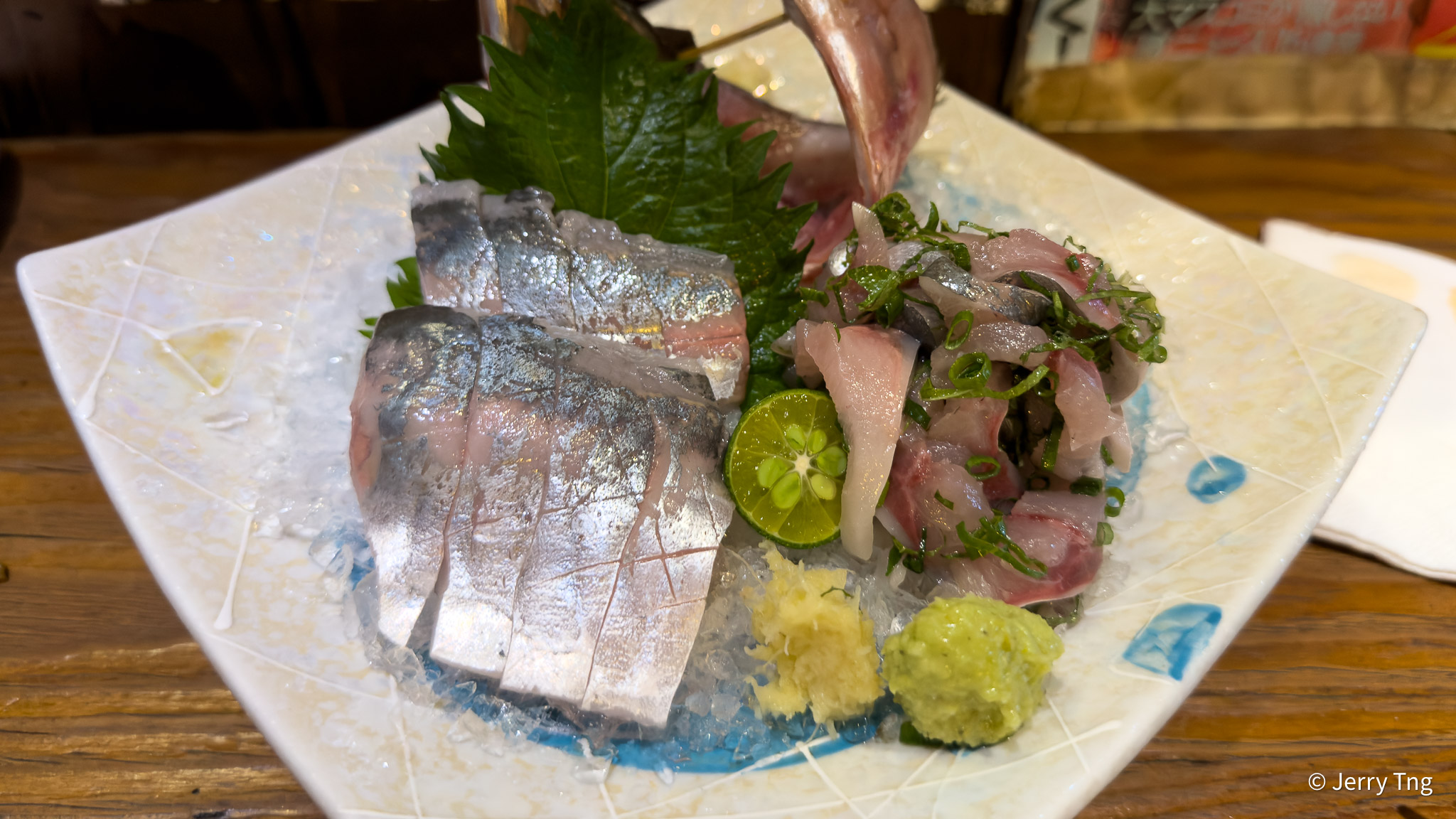
Mackerel in Three Ways 小竹荚三吃

This juvenile saba 鯖 is offered in three ways – sashimi, chopped and mixed with scallions, and bones deep fried. Nothing on the fish is left to waste. The mackerel has to be extremely fresh to be offered as sashimi. Wild ones are prone to having parasitic worms as they are not deep water fish, but the farmed ones are often offered as sashimi as the environment is controlled. I really enjoy these sashimi as they are fatty and flavourful, with a nice texture.

If only the bones were deep fried longer – not crispy enough to just chew through the bones. But this fish is not suitable for making soup, or else the bones could be used for a nice miso soup.
Sendai Gyutan Sashimi 仙台风 牛舌刺身

Sendai is famous for gyutan (beef tongue) cuisine. Gyutan-yaki (grilled beef tongue) is said to have been born in Sendai after World War II. Gyutan Sashimi is a rare Japanese delicacy featuring thinly sliced, raw beef tongue. Known for its pristine, rich flavour and a uniquely tender yet firm texture, it is typically served lightly seared (aburi) or completely raw with ponzu, soy sauce, or grated ginger.
Beef Intestines Casserole in Chicken Stock 鸡汤牛肠锅

One of my favourite izakaya staple especially after a long night of drinking – the beef intestine casserole or motsunable モツ鍋. ‘Motsu’ is actually a colloquial term for an animal’s internal organs and offal which could be anything from liver, heart and lung to skin, cartilage and feet. But the beef small intestines is the main ingredient here as it is not as musky as the rest of the offals. When the casserole came up to the table, I noticed immediately that it as missing garlic chives (nira ニラ) which is essential to avoid the muskiness of the offals.

As the gas burner did its thing, the aromas of the soy and dashi broth began to rise, tantalising our noses. You need to have patience and leave the casserole to do its thing. The intestines would only be ready until the end of the meal, when they are properly simmered and incorporated the flavours of the ingredients in the casserole. I sipped the broth and tasted the greens. Sweet, spicy, garlicky. The intestine was soft and spongy and fatty, but fat is flavour.
Horse Sashimi 马肉刺身

馬刺し Basashi is an acquired taste. Compared to beef, it is low in calories and high in protein, and is known as a healthy food rich in iron and vitamins. Condiments that eliminate any unpleasant odour while enhancing the meat’s flavour are essential. Ginger is the most classic condiment, it leaves a refreshing aftertaste. Garlic pairs perfectly with soy sauce, allowing you to enjoy a punchy flavour. Onions and Japanese ginger (みょうが myoga) provide textural accent while helping with enhancing the flavour. A stronger soy sauce is preferred, together with sesame oil.
Razor Clams with Picked Mustard Green and Broad Bean 雪菜蚕豆蛏子

This was the only fail of the evening; the overall flavour was too salty that made us gave up after the first few mouthfuls. The razor clams were fresh and full of umami, but overwhelmed by the sauce.
Grilled Chicken Wings Stuffed With Mentaiko 烤鸡翅饺子

Darling ordered a stuffed chicken wing (surprised!) as she had not had one for a long time. It was stuffed with a generous amount of mentaiko and deep fried (not grilled) to a nice crisp on the outside. I like the name that they gave to this – chicken wing gyoza. Nice eat with cold beer.
Sea Urchin and Salmon Roe Gunkan 海胆、三文鱼卵军舰

Another surprise for the evening, Darling actually ordered some sushi gunkan. The boss was quite honest again, insisting that these sea urchin are from China, not Japan. But he was confident that the quality wasn’t too far off, and he wasn’t lying. Although I find the sweetness a bit artificial but the texture and the overall umami from the sea urchin was good.
Grilled Kinki Fish 烤金吉鱼

The kinki キンキ (channel rockfish or thornyhead) is exceptionally fatty and juicy, and its intense sweetness is delicious. The fish has become a luxury, as the amount that can be caught in Japan has been reduced in recent years. The moment the juicy white flesh melts in your mouth, the sweet flavour explodes. It feels the fat content is more than the protein, which makes this a very good (and expensive) eat.

Overall a good place to enjoy a drink, engage in some friendly banter, and eat some good Japanese izakaya fare. The price is not that friendly, as you can see from the special menu. The space needs some sprucing up. Not sure how much longer can these original imports last, when the younger consumers want instagrammable food with an environment to match.
Akatsuki Sakana Izakaya 晓あかつき海鲜居酒屋(新世纪广场店)
2nd Floor, Block C, Hongqiao New Century Plaza, 48 Xingyi Road, near Loushanguan Road, Changning District, Shanghai 虹桥街道兴义路48号(新世纪广场C栋2楼)
Tel : +86 13524013880
Visited Apr 2026
0 comments on “Akatsuki 暁あかつき @ Shanghai”