
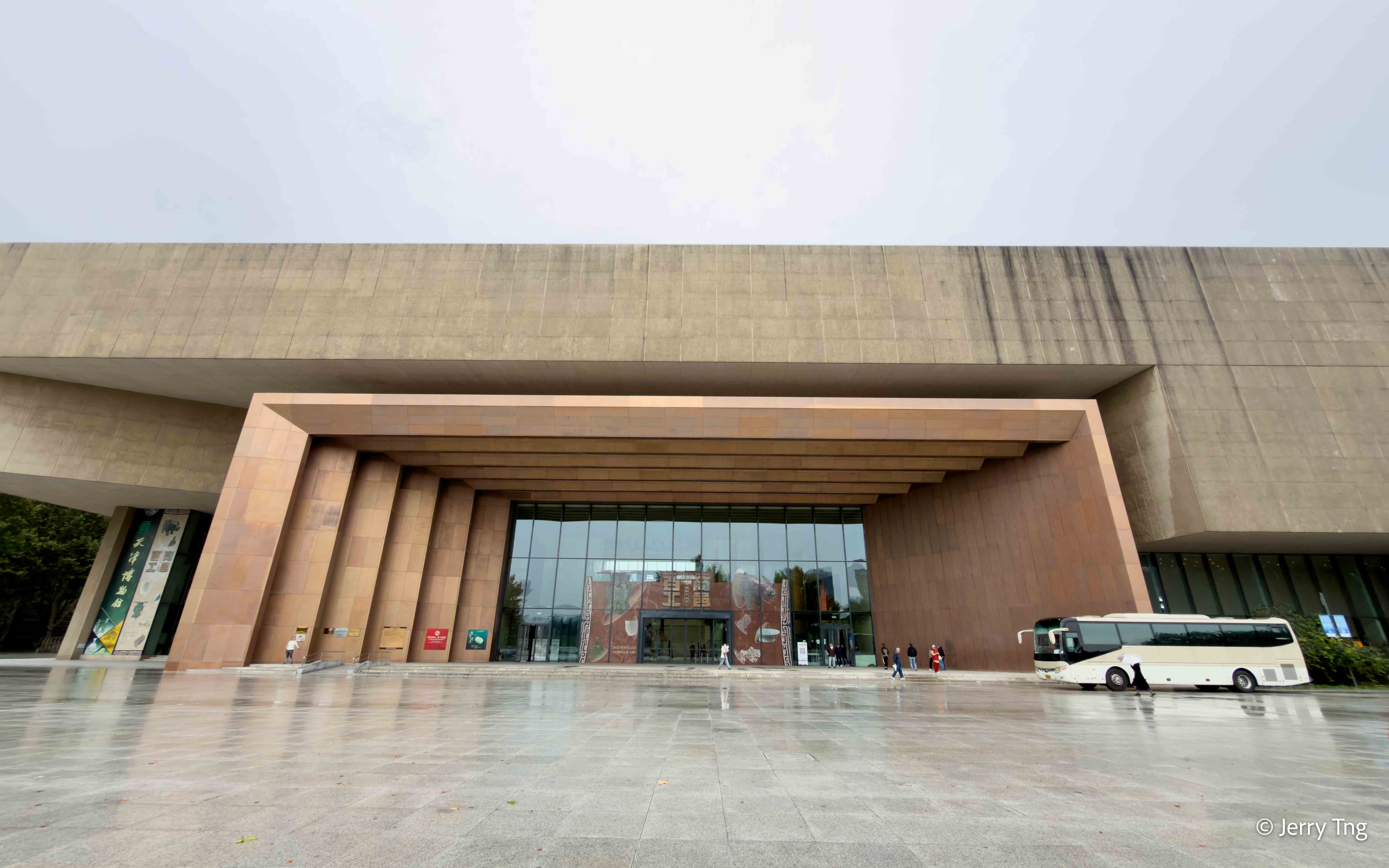
Just 30min by HSR from Beijing, Tianjin is a coastal city that is the weekend getaway for Beijingers. However, Tianjin is an overlooked city in terms of art and culture, particularly in terms of museums. Tianjin Museum is a first class museum that is the oldest in China, and it is almost empty on weekdays, making a visit very enjoyable.

Bronzeware | Western Zhou (c.1046 BC – 771 BC) | Tianjin Museum collection.
铜器|西周(约前1046年-前771年)|天津博物馆藏1
For over a century, Tianjin Museum has been rooted in the rich cultural soil of the city, cultivating a strong tradition of artefact discovery, collection, and research, resulting in a magnificent collection of over 210,000 artefacts. The museum’s collection encompasses major categories such as bronzes, ceramics, calligraphy, paintings, jade, and seals, possessing rich historical and artistic value.


The museum features three permanent exhibitions: 《天津人文的由来》”The Origination of Tianjin Culture” (Level 1) focusing on ancient Tianjin; 《中华百年看天津》”Tianjin — An Epitome of China in the Past Hundred Years” (Level 3) focusing on modern Tianjin; and《耀世奇珍——馆藏文物精品陈列》 “Selected Rare Relics — Collected by Tianjin Museum” (Level 2) showcasing the museum’s finest artefacts.


Besides the permanent exhibitions, there are rotating exhibitions of Tianjin Museum collections in Level 5, namely the paintings and calligraphic works, jades, porcelains, etc. Due to the huge collection, the artefacts are rotated based on specific themes, like《聚赏珍玉——中国古代玉器陈列》”Appreciating Jade — Ancient Chinese Jade Articles”;《墨林汇观 — 馆藏书画精品展》”Ink and Brush — Masterpieces Of Calligraphy And Painting Collected By Tianjin Museum”; 《瓷都芬华 — 馆藏明清景德镇窑瓷器展》”Capital of Porcelain — Ming and Qing Dynasties Jingdezhen Kiln Porcelain Collected by Tianjin Museum.”


And then there’s the special exhibitions of special themes in collaboration with other museums, also in Level 5.《形神合韵 — 清代后期人物画特展》”Perfect Harmony Form and Spirit — Special Exhibition of Figure Painting from the Late Qing Dynasty” put together some paintings from the late Qing dynasty;《商邑百工 — 三千年前的中国制造》”Shang Capital Crafts — Made in China 3000 Years Ago” showcased the archaeological finds from the Yinxu (old capital of Shang dynasty) digs that uncovered some beautiful bronze wares; 《简述中国 — 甘肃出土汉简精品展》”Story Recorded on Wood — Selected Han Dynasty Wooden Slips Unearthed in Gansu Province”, in collaboration with Gansu Museum, featured the life in Xuanquan Zhi 悬泉置 during the Han dynasty told through bamboo slips.

Level 4 was hosting the Communist Party special exhibition (ended in Dec 2025) when I was there, with a display of achievements using Lego at the foyer. Decided to skip this and come back to see the Lego if I had time. But unfortunately I can only cover 4 of the
Tianjin Museum
Selected Rare Relics 耀世奇珍


If you only have an hour, this is the exhibition not to be missed. Selected Rare Relics 耀世奇珍 is one of the permanent exhibitions of Tianjin Museum on Level 2. It displays 63 sets of the most representative cultural relics in an exhibition hall with an area of 840 sq.m. These include ancient bronzes, jades, calligraphy and paintings, porcelains, and crafts. Among them are two cultural relics that are prohibited from being exhibited abroad: Taibao Ding (above left) and Sui white-glazed dragon-handled double-linked bottle.

Jadeite | Song Dynasty (960-1279) | Tianjin Museum collection. 玉器|宋(960-1279年)|天津博物馆藏2
This exhibition features a special display of some of the museum’s most representative treasures, allowing visitors to appreciate the diverse charm of these artefacts. It also serves as a tribute to the collectors who have selflessly dedicated themselves to the development of the Tianjin Museum’s artefact collection and to the hardworking museum staff.3
For more beautiful relics and artefacts from the Tianjin Museum collection, follow the link >> Selected Rare Relics — Collected by Tianjin Museum 耀世奇珍——馆藏文物精品陈列
Capital of Porcelain – Jingdezhen 瓷都芬华

Porcelain | Ming Xuande Period (r. 1426-1435) | Collection of Tianjin Museum.
瓷器|明宣德(在位1426-1435年)|天津博物馆藏
The Tianjin Museum’s collection of porcelain is particularly renowned for its Ming and Qing Dynasty Jingdezhen kiln pieces, boasting a rich and well-organised collection. This exhibition selects some of the museum’s finest pieces, allowing the public to appreciate exquisite ancient ceramic art while understanding the development trajectory of the Jingdezhen kilns during the Ming and Qing Dynasties, the evolution of decorative techniques and characteristics of the era, and further showcasing the brilliant achievements of Jingdezhen porcelain production.


白地绿彩云龙纹盘 (左)明 弘治款 、(右)清 乾隆款
It aims to truly bring cultural relics to life, making them a profound source of nourishment for strengthening socialist spiritual civilisation and an important symbol for expanding the international influence of Chinese culture.4

五彩龙凤纹碗一组 清 乾隆-道光款
Jingdezhen, formerly known as Changnan, derives its name from the exquisite porcelain produced during the Jingde period of the Northern Song Dynasty, earning it the title of “Porcelain Capital.” The Jingdezhen kilns began firing in the Tang Dynasty, flourished in the Song and Yuan Dynasties, and experienced a leapfrog development during the Ming and Qing Dynasties due to the establishment of the imperial kilns. This led to a unique situation where, centred on Jingdezhen, “craftsmen came from all directions, and wares were sold throughout the world,” making it a unique and prominent centre.

During the Ming and Qing Dynasties, the Jingdezhen kilns enjoyed a high reputation both domestically and internationally, and against the backdrop of the Age of Exploration, China’s porcelain trade reached unprecedented prosperity.5
For more beautiful Jingdezhen porcelain from the Tianjin Museum collection, follow the link >> Capital of Porcelain — Ming and Qing Dynasties Jingdezhen Kiln Porcelain Collected by Tianjin Museum 瓷都芬华 — 馆藏明清景德镇窑瓷器展
Tianjin — An Epitome of China in the Past Hundred Years 中华百年看天津

This exhibition covers the history of Tianjin in modern history. The exhibition covers the period from the First Opium War to the liberation by the Communist in 1949. Although there isn’t much in terms of artefacts and relics in this exhibition, the history covered is nevertheless very heavy stuff.
For more information about the history of modern Tianjin, please follow the link >> Tianjin — An Epitome of China in the Past Hundred Years 中华百年看天津
Appreciating Jade 聚赏珍玉

The Chinese have a long tradition of venerating and loving jade. The splendid Chinese jade culture showcases a diverse and colourful landscape that is captivating for its profound connotations and charm. Jade carving was discovered since the earliest periods in China, its use of jade has been enduring and long-lasting, and its jade resources are abundant, resulting in numerous ancient jade artefacts.

The exhibition is like a scroll of ancient jade history, serving as a historical foundation for contemporary jade culture; it allows you to stroll through a forest of ancient jade treasures, benefiting from the appreciation of jade and rekindling a renewed love for it.
For more information of how jade defines the psyche of the Chinese culture, please follow the link >> Appreciating Jade — Ancient Chinese Jade Articles 聚赏珍玉——中国古代玉器陈列
Special Exhibition : Story Recorded on Wood 简述中国

Bamboo slips | Western Han Dynasty (202 BC – 9 AD) | Excavated from the Xuanquan Post Station Site | Collection of Gansu Bamboo and Wooden Slips Museum 竹简|西汉(公元前202年-9年)|悬泉置遗址出土|甘肃简牍博物馆藏
In 138 BC, Zhang Qian was sent on a mission to the Western Regions, marking the beginning of westward exploration. Following the Battle of Hexi in 121 BC, the Han Dynasty controlled the Hexi Corridor. From 121 BC to 111 BC, Emperor Wu successively established Jiuquan Commandery, Wuwei Commandery, Zhangye Commandery, and Dunhuang Commandery, and established the Yumen Pass and Yang Pass, effectively “establishing four commanderies and controlling two passes.” Simultaneously, he constructed a continuous network of beacon towers along the Han border. In 60 BC, the Protectorate of the Western Regions was established.

Bronze | Eastern Han Dynasty (25-220) | Collection of Gansu Bamboo and Wooden Slips Museum 铜|东汉 (25-220)|甘肃简牍博物馆藏
Since 1907, nearly 70,000 bamboo and wooden slips from the Qin, Han, Wei, and Jin dynasties have been unearthed along the ancient Silk Road at various sites including the Qin tombs at Fangmatan in Tianshui City, the Han and Jin tombs in Wuwei, and the Han beacon towers in Hexi Corridor. The majority of these are Han slips. Starting with the discovery and research of Han slips in Gansu Province, and through the tireless efforts of generations of Chinese and foreign scholars, bamboo and wooden slip studies have become a prominent field of study.7

The exhibition was jointly organised by Tianjin Museum and Gansu Bamboo Slips Museum. Based on the basic exhibition of Gansu Bamboo Slips Museum, which won the 2023 National Top Ten Museum Exhibition Award, the exhibition was divided into four sections: “The Bamboo Slips Era”, “A Brief History of the Silk Road”, “Frontier Life”, and “The Charm of Bamboo Slips”. Through more than 260 pieces/sets of exhibits, it tells the history of the discovery of bamboo slips, the magnificent Silk Road stories in bamboo slips, the daily life of frontier residents in the Han Dynasty, and the calligraphy art contained in Han Dynasty bamboo slips.8
For more on the life in Xuanquan Post Station during the Han Dynasty, please follow the link >> Story Recorded on Wood — Selected Han Dynasty Wooden Slips Unearthed in Gansu Province 简述中国 — 甘肃出土汉简精品展
Special Exhibition : Shang Capital Crafts 商邑百工

Bronzeware | Late Shang Dynasty (Yinxu Phase IV, c. 1250 – c. 1046 BC) | Excavated from M303, Dasikong, Anyang, 2004 |
Collection of the Institute of Archaeology, Chinese Academy of Social Sciences.
铜器|晚商(殷墟四期)|2004年安阳大司空M303出土|中国社会科学院考古研究所藏9
This special exhibition is a collaboration by Tianjin Museum and Yinxu Museum, assisted by Anyang Museum and Anyang Research Institute of Cultural Relics and Archeology. The exhibition ran from 23 Aug 2025 – 6 Jan 2026. I was glad that I managed to catch this when I was there. The exhibition is mainly divided into five sections: 《百工通览》”Overview of Crafts”, 《营造商邑》”Building a City”, 《器用皆工》”Craftmanship”, 《制礼作乐》”Rites and Music”, and 《车马交通》”Transportation”. There is also a separate section: 《大商制造:牛》”Made in the Great Shang Dynasty”.10

Bronzeware | Late Shang (Yinxu Phase III)1 (ca. 1250-1100 BC) | Excavated from M160, western Guojiazhuang, Anyang, 1990 | Collection of the Institute of Archaeology, Chinese Academy of Social Sciences
铜器|晚商(殷墟三期)(约公元前1250-前1100年间)|1990 年安阳郭家庄西部 M160 出土|中国社会利学院考古研究所藏
Bronze ritual vessels are the cornerstone of the Shang Dynasty’s ritual and music system. Wine vessels such as the gu and jue were used in sets according to rank, and their decorations, including mysterious patterns such as animal faces and kui dragons, displayed majesty. Musical instruments were equally crucial: in sacrificial ceremonies, music and dance were used to entertain ancestors and appease deities; in military activities, music and dance were used to maintain discipline and enhance military prestige. These ritual vessels and musical instruments, crafted by artisans from the Yin Ruins, have survived to this day, allowing contemporaries a glimpse into the ritual and music system of that time.11
There’s an information wall outside the exhibition that detailed the major bronze ware discoveries and excavations in China since 1899. This would give you a good picture of how the history of Xia-Shang-Zhou has been pieced together since then. The history of that period is still unfolding as we verified the written against the archaeological finds. (You may scroll left and right to see the entire timeline.)
For more exciting bronze wares from the Shang Dynasty as well as other artefacts, please follow the link >> Shang Capital Crafts — Made in China 3000 Years Ago 商邑百工 — 三千年前的中国制造
About Tianjin Museum

Tianjin Museum is the largest museum in Tianjin, China, exhibiting a range of cultural and historical relics significant to Tianjin. The unique architectural style of the museum, whose appearance resembles that of a swan spreading its wings, has meant that it is quickly becoming one of the city’ iconic buildings. It is built to be a large modern spot for the collection, protection and research of historic relics as well as a place for education, leisure and touring.

The Tianjin Museum has an extensive collection of ancient Chinese fine arts and exhibits on Tianjin’s history. There are nearly 200,000 collections of valuable historical and cultural art and relics, including calligraphy, paintings, bronze ware, ceramics, jade, seals, ink stone, oracle bones, coins, historic documents and relics of modern times, and local folk art.
Admission is free with relevant identification document (Foreigners would need your passports for verification.)
Open Tue-Sun from 9am to 5pm, closed on Mondays (except on Public Holidays)
Tianjin Museum 天津博物馆
No. 62 Pingjiang Road, Hexi District, Tianjin 天津市河西区平江道62号
All photos taken at Tianjin Museum, Oct 2025, unless otherwise noted.
Tianjin Museum Collection

National Treasure – White-glazed Double-bellied Vase with Double Dragon-shaped Handles (Sui Dynasty)
When Zhang Qian discovered the land route to the Western regions, little did he realise the impact on Chinese civilisation…

National Treasure – Bronze “Tai Bao” Ding (Western Zhou)
With its elegant long legs, here comes the “supermodel” of ancient bronze ding.

Treasures – Inscribed Famille-Rose Lotus-Form Cup, 34th Year of Guangxu Mark (Qing)
A commemorative cup made for a military exercise, signifying a last ditch effort by a crumbling empire to stand up…
Something went wrong. Please refresh the page and/or try again.
Footnotes :
- Bronze Jin (Food Vessel) with Kui Pattern 夔纹铜禁
Bronzeware | Western Zhou (c.1046 BC – 771 BC) | Tianjin Museum collection.
铜器|西周(约前1046年-前771年)|天津博物馆藏
此器鉴体星长方体,中空无底,禁面上有三个微凸起的椭圆形子口,前后各有两排共十六个长方形镂礼,左右各有两排共四个长方形镂孔。禁四周均饰精美夔纹,纹饰生动,造型端庄,铸造精良。禁为承尊器,是古代贵族在祭祀、宴飨时摆放卤、尊等們器的儿案。这件夔纹铜禁是现所知西周锅禁中形体最大的一件,是研究中国青铜禁历史的珍贵实物资料。
This bronze vessel is rectangular in shape, hollow and bottomless. The surface has three slightly raised oval openings, with two rows of sixteen rectangular perforations on the front and back, and two rows of four rectangular perforations on each side. The vessel is decorated with exquisite kui dragon patterns, the designs are vivid, the shape is dignified, and the casting is superb. The vessel was used as a stand for vessels such as wine vessels and wine cups during sacrifices and banquets in ancient times. This kui-patterned bronze vessel is the largest known Western Zhou bronze vessel and is a valuable material for the study of the history of Chinese bronze vessels. ↩︎ - Jade ornament with loong-head design 龙纹玉杖首
Jadeite | Song Dynasty (960-1279) | Tianjin Museum collection.
玉器|宋(960-1279年)|天津博物馆藏
龙首有双角,长浓眉,圆眼,上唇上卷,下唇下卷,张口,口中衔珠,腮部饰火焰纹,颈部有禁毛和鳞纹。下部穿空并钻三孔,推测可能是宋代宫廷车辗座椅上的端首。The dragon’s head has two horns, long, thick eyebrows, round eyes, an upper lip that curls upwards, a lower lip that curls downwards, an open mouth holding a pearl, and flame patterns on its cheeks. Its neck is decorated with bark and scales. The lower part is perforated with three holes, suggesting it may have been the head ornament on a Song Dynasty imperial carriage seat. Museum information card, Oct 2025 ↩︎ - 天津博物馆创立百余年来,植根本地深厚文化土壤,形成良好的文物发现、集藏、研究传统,造就了至今21余万件文物的馆藏大观。天津博物馆文物涵盖青铜器、陶瓷器、法书、绘画、玉器、玺印各主要品类,具有丰富的历史、艺术价值。本展览选取馆藏最具代表性的部分文物珍品进行特别展示,使观众得以领略多样文物的不同魅力。同时也藉此向那些为天津博物馆文物事业发展无私奉献的收藏家致敬,向辛勤耕耘的文博工作者致敬。Museum information card, Oct 2025 ↩︎
- 天津博物馆藏瓷以明清时期景德镇窑瓷见长,藏品丰富、精美成序。此次展览甄选馆藏部分精品,让大众欣赏精美古代陶瓷艺术品的同时,能够了解到明清景德镇窑的发展脉络,装饰工艺及时代特征的演变规律,进一步展示景德窑瓷器生产所取得的辉煌成就。让文物真正活起来,成为加强社会主义精神文明建设的深厚滋养,成为扩大中华文化国际影响力的重要名片。 ↩︎
- 景德镇古称昌南,因北宋景德年间烧制精美的瓷器而得名,有瓷都之称。景德镇窑始烧于唐代,兴于宋元,明清时期由于御窑厂的建立,促进了景德镇窑跨越式的发展,形成了以景德镇为中心,“匠从八方来,器成天下走”一枝独秀的格局。明清时期景德镇窑享誉中外,在大航海时代的背景下,我国瓷器贸易达到空前繁荣。 ↩︎
- Bronze Camel-Shaped Seal Commemorating the Victory over the Xiongnu 铜驼钮汉匈奴破虜长印
印面边长2.3厘米,通高2.9厘米,铜质铸造,驼钮,右上起顺读。匈奴,两汉时期北疆最强大的少数民资,东汉时分裂成南北两部。破虏,给予助汉政权征伐有功的匈奴贵族的赐号。长,为其族中官吏。此为东汉政权赐少数民族的官印。 ↩︎ - 自1907年至今,沿古丝绸之路,在今天水市放马滩秦墓、武威汉晋墓,河西汉塞烽燧各类遗址中先后出土了近7万余枚秦汉、魏晋时期简牍,其中汉简数量占绝大部分。以甘肃地区汉简的发现和研究为启端,经几代中外学者的不懈努力,简牍学已成为一门显学。 ↩︎
- “简述中国——甘肃出土汉简精品展”由天津博物馆和甘肃简牍博物馆联合举办,以荣获2023年度全国博物馆十大陈列展览精品奖的甘肃简牍博物馆基本陈列为基础,分“简牍时代”“简述丝路”“边塞生活”和“简牍墨韵”四个单元,通过260余件/套展品,讲述简牍发现的历史、简牍中壮阔的丝路故事、汉代边塞居民的日常生活和汉简中蕴含的书法艺术。 https://www.tjbwg.cn/cn/exhibitionInfo.aspx?id=21114 ↩︎
- Mawei Bronze Bells 马危铜编铙
Bronzeware | Late Shang Dynasty (Yinxu Phase IV, c. 1250 – c. 1046 BC) | Excavated from M303, Dasikong, Anyang, 2004 | Collection of the Institute of Archaeology, Chinese Academy of Social Sciences.
铜器|晚商(殷墟四期)|2004年安阳大司空M303出土|中国社会科学院考古研究所藏
编侥1组共3件,形制、花纹、铭文均相同,大、小依次相递减。体呈扁圆形,口内呈凹弧形,平顶,顶较口稍窄。顶中部有管状甬,上端较细,下端较粗,甬、钲相通。两面均饰独立兽面纹,或销商出征体干面。证体两侧,从只到甫瓜有铸缝两条,系由两块外范和一块内范合铸而成。
技内壁铸有“马危”三字铭文(阳文)。三件中最大的铙出土时鼓体有明显的布纹。
The set consists of three identical cymbals, all with the same shape, patterns, and inscriptions, decreasing in size from largest to smallest. The body is flattened and round, with a concave arc-shaped opening and a flat top, slightly narrower than the opening. A tubular passage is located in the center of the top, thinner at the top and thicker at the bottom, connecting the passage to the gong. Both sides are decorated with independent animal mask patterns, or the surface of a merchant’s gong. Two casting seams run from the base to the sides, indicating that the gong was cast using two outer molds and one inner mold. The inner wall of the gong bears the inscription “Ma Wei” (in relief). The largest of the three cymbals had a distinct cloth-like texture on its body when unearthed. ↩︎ - 展览主要分为“百工通览”“营造商邑”“器用皆工”“制礼作乐”“车马交通”五个单元,另专设一个独立小单元“大商制造:牛”。https://www.tjbwg.cn/cn/exhibitionInfo.aspx?Id=20915 ↩︎
- 青铜礼器是商代礼乐制度的基石,觚(gi)、爵等酒器按等级成套使用,器物上铸造兽面、夔(kui)龙等神秘纹饰彰显威仪。乐器同样关键:祭祀仪式上以奏乐、舞蹈欢娱祖先、慰敬神明,军事活动中凭乐声、舞演整饬(chi)队列、壮大军威。这些出自殷墟工匠之手的礼器和乐器留存至今,让时人得以一窥当时礼乐制度的鳞爪。 ↩︎
0 comments on “Tianjin Museum 天津博物馆”