
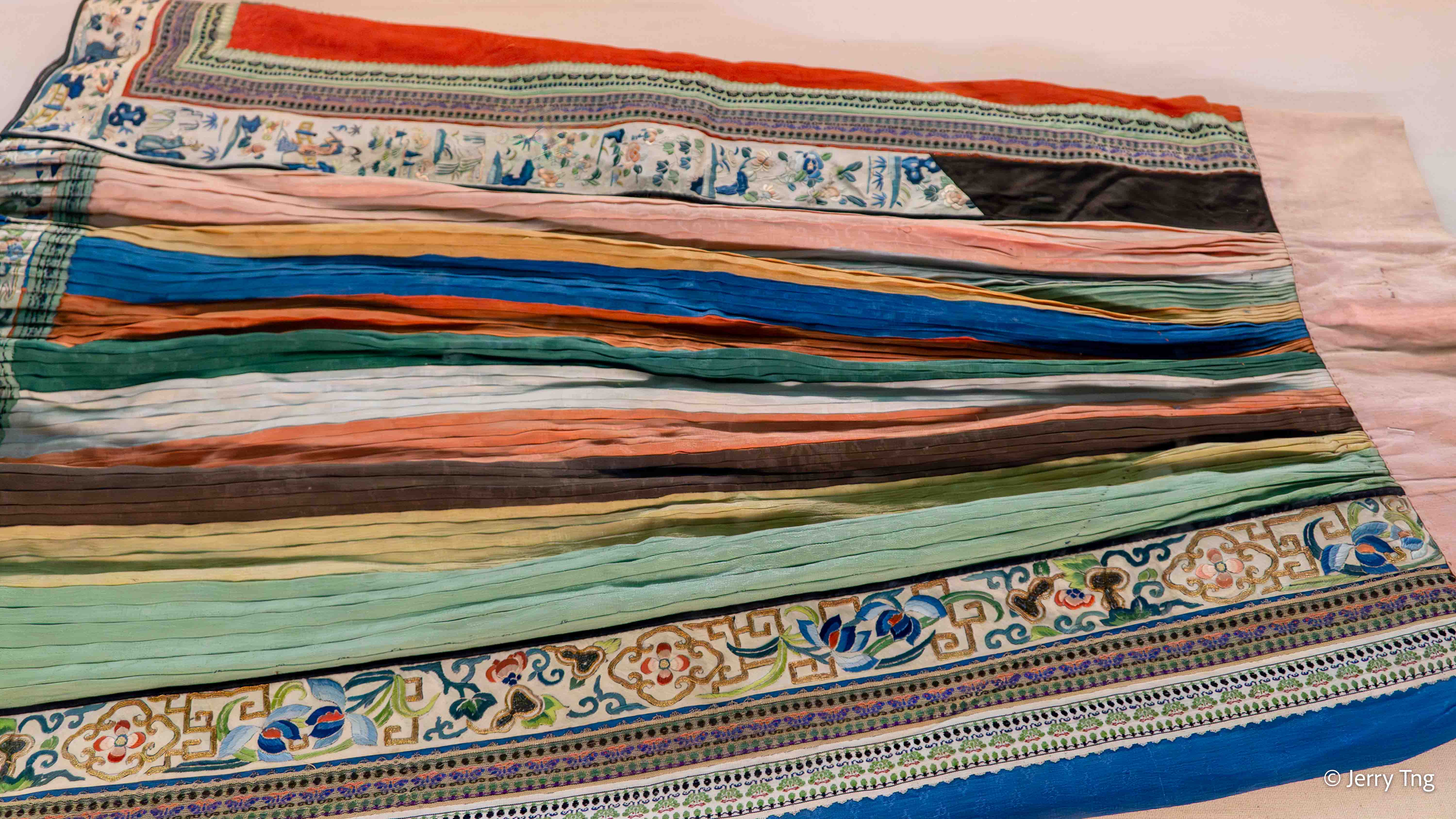
Our ancestors refined their pursuit of colour into a unique “five-colour system”—blue, red, yellow, white, and black. These colours not only represent the rhythm of the changing seasons but also the source of ancient techniques for selecting, using, matching, applying, blending, and dyeing colours.

The world is vibrant and colourful. In their contact with nature, our ancestors explored the beauty of colour in the universe, painting it on rock walls and artefacts. This special exhibition in Nanjing Museum, “The Myriad Visions: The Beauty of Traditional Chinese Colours” 《萬相 – 中国传统色彩之美》, ran from Oct 2025 to Jan 2026, and focused on the traditional colours of Chinese aesthetics, namely blue, red, yellow, white, and black.
The Myriad Visions: The Beauty of Traditional Chinese Colours
Tracing Colours 寻色

Pottery | Neolithic Age | Collection of Nanjing Museum
陶器|新石器时代 |南京博物院藏
The beauty of traditional Chinese colours lies in the philosophical and poetic fusion of history and aesthetics. Today, the application of traditional colours permeates all aspects of daily life, giving rise to many popular trends.1


The ever-changing colours were once considered a mysterious force of nature. During the Paleolithic era, the Upper Cave Man of Zhoukoudian consciously used hematite powder to dye ornaments to express symbolic meaning. The Yellow Emperor 皇帝, considered the common ancestor of Central Plains Chinese is attributed the colour of the earth as he is said to come from the earth (not dissimilar to the account in Genesis 2:73.) The Chinese race has a long-standing tradition of associating colour with different virtues and etiquette.4

Pottery | Neolithic Age | Nanjing Museum collection. 陶器|新石器时代 |南京博物院藏
In another Chinese creation myth, the goddess Nüwa is said to have mended the Heavens after a disaster destroyed the original pillars that held up the skies, using five coloured stones in the five auspicious colours to patch up the crumbling heavens, accounting for the many colours that the skies can take on. The legend demonstrates the ancient and profound understanding and imagination of colour in the creation of heaven and earth.
Painted pottery flat-bellied bowl with floral and leaf patterns 彩陶花叶纹扁腹钵

Pottery | Neolithic Age, Dawenkou Culture | Excavated from Dadunzi | Nanjing Museum collection.
陶器|新石器时代 大汶口文化|高9.4厘米,口径14厘米|江苏邳县大墩子出土 |南京博物院藏
The upper abdominal decorative band is composed of geometric patterns drawn with three mineral pigments: white, ochre, and brown. The pattern units include:
- Triangle elements arranged in a continuous manner to create a sense of rhythm
- Circular arc patterns enhanced the layering through variations in thickness
- Dotted decorations were interspersed as auxiliary elements
The pattern combination presents abstract plant and flower imagery, transforming natural objects into decorative patterns through geometric treatment, reflecting Neolithic humans’ observation and artistic refinement of the natural environment. The painted pigments are relatively well preserved, with bright color contrasts, showing a mature level of painting techniques.5
Painted octagonal star patterned pottery basin 彩绘八角星纹陶盆

Pottery | Neolithic Age, Dawenkou Culture | Excavated from Dadunzi Tomb M44:4 | Nanjing Museum collection.
陶器|新石器时代 大汶口文化|大墩子M44:4出土 |南京博物院藏
The outer surface of the pottery basin is painted with seven eight-pointed stars, resembling the sun, radiating rays in all directions. This is the most symbolic painted pottery pattern of the Dawenkou culture, often used to decorate painted pottery dou (a type of stemmed bowl) or painted pottery basins. Some researchers believe it represents the radiant sun; others believe that the radiating eight points symbolise the boundless sky, while the square in the center symbolises the earth, representing the concept of a round heaven and a square earth.6

Red pottery made of clay. The upper part of the body is covered with a red slip, around which seven eight-pointed star patterns are painted in white. The center of each star reveals a square red background, and the outline of each star is drawn in black. Two white vertical stripes are painted between each pair of stars. The lower part of the body has a white string pattern. The rim is covered with a white slip, then painted in red and black, with the painted patterns consisting of arc-shaped triangles, lines, and dots.7
Painted Pottery Stand 彩陶器座

Pottery | Neolithic Age | Nanjing Museum collection. 陶器|新石器时代 |南京博物院藏
Red pottery made of clay. The neck and below are covered with a red slip as a background, with decorations painted in black and white. There are three layers from top to bottom, each layer separated by parallel lines painted in white. The first and third layers are black stripes with geometric woven patterns painted in white; the second layer is black stripes with circles painted in white, with crescent-shaped red ground showing above and below the circles. There is a circular perforation between each pair of adjacent circles, and two straight lines painted in white between each pair of adjacent circular perforations.8


The “five-colour concept,” the “literati ink painting theory,” and the “folk colour system” derived from them represent the three major pillars of traditional colour consciousness, embodying the wisdom of harmonious unity between heaven, earth, and humanity.


These colours (blue, red, yellow, white, and black) symbolise five elements (wood, fire, earth, metal, water) and directions (east, south, centre, west, north), representing cosmic balance and imperial power. The system historically influenced Chinese art, the way we dress, and the way we live. After unifying the six kingdoms, the Qin dynasty abolished the Zhou dynasty’s six-tiered crown system, requiring only “black robes and crimson skirts.”9 The Han dynasty used the colours of the five seasons for clothing: green for spring, vermilion for summer, yellow for late summer, white for autumn, and black for winter, corresponding to the five directions.
Virtue Resides in the Middle (Yellow) 德居中央

The “Shuowen Jiezi” (a Chinese dictionary from the Han Dynasty) defines yellow as “the colour of the earth.” It states that “yellow is the colour of earth, located in the centre.” Yellow represents both possession of the land and the possession of virtue, making it the supreme primary colour among the five colours.

From the Tang dynasty onwards, “scholars and commoners” were forbidden from wearing yellow, making it the “colour of the emperor.” Before the end of Qing dynasty, yellow remained the highest colour symbolising central power in ancient China, representing imperial power, nobility, holiness, sublimity, status, authority, and auspiciousness—a symbol of the emperor’s supreme position.10
Yellow-Glazed Dragon-Patterned Glazed Tile End 黄釉龙纹琉璃瓦当

Pottery | Ming Hongwu reign (1368-1398) | Nanjing Museum collection. 陶器|明洪武 (1368-1398年)|南京博物院藏
Ming dynasty was founded by Zhu Yuanzhang (1328-1398), reign name Hongwu. Nanjing was the capital of the early Ming Dynasty, and numerous royal buildings were constructed both inside and outside the city, their roofs mostly covered with colourful glazed tiles. In these meticulously planned royal buildings, the use of glazed tile colours also reflected rank. Yellow, associated with the element of earth and representing the centre, symbolised the emperor’s central position, making it the highest-ranking colour, followed by green, and then black.

Pottery | Ming Hongwu reign (1368-1398) | Nanjing Museum collection. 陶器|明洪武 (1368-1398年)|南京博物院藏
These colourful glazed components were made from finely refined clay, moulded with dragon patterns, glazed, and fired at low temperatures. Their bright colours and imposing forms not only decorated and protected the buildings but also showcased the grandeur and solemnity of royal protocol.11
Dish with flower and dragon decoration on a yellow ground in tricolour glaze 黄地素三彩花卉云龙纹盘

Porcelain | Kangxi period (r. 1661-1722), Qing Dynasty (1644-1911) | Collection of Nanjing Museum
瓷器|清康熙(公元1661-1722) |南京博物院藏12
A yellow-ground sancai (tricolour) dish with floral and cloud dragon design, Qing Dynasty, Kangxi period. This dish has a folded rim and is decorated both inside and out with yellow ground sancai. The center of the interior features two dragons arranged in a “happy reunion” pattern, surrounded by eight floral motifs: peony, plum blossom, camellia, chrysanthemum, okra, lotus, and rose. The folded rim and outer wall are decorated with six dynamic dragons chasing a pearl.
Green Comes Out of Indigo (Blue) 青出于蓝

The East is associated with the element of Wood, and the colour of sunrise in the East is blue. The Shuowen Jiezi states, “Blue is the colour of the East. Wood generates fire, hence the characters for ‘birth’ and ‘cinnabar’.” The Shiming (another Chinese dictionary from the Han Dynasty) explains, “Blue means ‘birth,’ representing the colour of things when they are born.”

Porcelain | (Front) Tongzhi period (r. 1861-1875), (back) Daoguang period (r. 1820-1850) | Nanjing Museum collection
瓷器|(前)清同治(公元1861-1875年)、(后)清道光(公元1820-1850年)|南京博物院藏
The origin of blue is the colour of plants, which can be understood as the pale green of newly sprouting vegetation—the colour of nascent life. Blue is also the blue of the indigo plant used in Xunzi’s Exhortation to Learning (“It is extracted from indigo, yet it is bluer than indigo”), and the colour of the hair in Li Bai’s poem Drinking Alone Under the Moon (“In the morning, it is like black silk; by evening, it is like snow”). In the five-colour system, blue is not a single colour, but rather a hue with subtle variations in shade.13


Porcelain | Qianlong period (r. 1736-1795), Qing Dynasty (1644-1911) | Nanjing Museum collection
松石绿地堆花金彩串枝花卉纹菊瓣式花盆
瓷器|清乾隆(公元1736-1795年)|南京博物院藏
The sky blue (what I called Tiffany blue, but much lighter) became a colour that was sought after since the Song Emperor Huizong (1100-1126) created the Ru ware porcelain. Ru ware is perhaps the first “official ware” specifically commissioned by the imperial court and Qing emperors Yongzheng and Qianlong had tried to recreate it.

Porcelain | Qianlong period (r. 1736-1795), Qing Dynasty (1644-1911) | Nanjing Museum collection
瓷器|清乾隆(公元1736-1795年)|南京博物院藏
On display were other porcelain artefacts from the Qing Qianlong period that was really popular among the visitors. I am not a fan of Qianlong aesthetic taste as compared to his father’s. Yongzheng has a refined taste that resulted in IMHO some of the finest and most beautiful porcelain pieces produced. Qianlong inherited the techniques and made it grotesque.
White-Ground Plate With Hidden Floral Pattern And Green Dragon Design 白地暗花绿彩龙纹盘

Porcelain | Ming Zhengde reign (1506-1521) | Nanjing Museum collection.
瓷器|明正德(1506年—1521年)|高4.5厘米 口径19.9厘米 足径12.5厘米|南京博物院藏
White-glazed porcelain with incised green enamel is one of the more technically challenging mixed-glaze porcelain varieties produced by the Jingdezhen Imperial Kiln during the Hongzhi reign. The production process involves first applying a transparent glaze to the shaped body, then removing the glaze from the areas where the dragon motifs are to be decorated, and then incising details such as fins and scales onto the dragon’s body. It is then fired at high temperature to create a semi-finished product. Finally, melon-skin green enamel is applied to the dragon’s body, and it is fired again. Some pieces also feature an underglaze incised wave pattern as an embellishment. This type of white-ground green-painted conical arched sea and cloud dragon pattern plate is a traditional variety that had a great influence on the firing of imperial porcelain in the Qing Dynasty. As a variety of porcelain produced during the Qing Dynasty’s Great Yun period14, it was fired from the Kangxi reign to the Xuantong reign.15
Pastel blue ground sgraffito ball pattern plate and bowl 粉彩蓝地轧道皮球花纹盘、碗

Porcelain | Qianlong period (r. 1736-1795), Qing Dynasty (1644-1911) | Nanjing Museum collection
瓷器|清乾隆(公元1736-1795年)|南京博物院藏
The interior is glazed white with a bluish tinge, while the exterior is glazed in a pale blue glaze with a carved, famille rose ball-shaped pattern. A band of gold rim surrounds the bowl. The ball-shaped pattern evolved from patterns found on silk fabrics and became more common on porcelain after the Yongzheng period. This pattern is composed of several freely combined floral motifs and is named for its resemblance to a bouncing ball.16
Embroidered Longevity Characters in the Central Scroll 刺绣百寿字中堂

Silk, textile | Qing Jiaqing reign (1796-1821) | Nanjing Museum collection. 绣品|清嘉庆(1796-1821年)|南京博物院藏
This Qing Jiaqing period embroidered hanging scroll with a hundred longevity characters is presented in a typical Qing Dynasty hall setting, with a solemn layout and profound symbolism. It is a highly representative auspicious theme in both court and folk custom systems. Since the Ming and Qing Dynasties, the “Hundred Longevity Characters” has been regarded as the most auspicious and longevity symbol, especially valued in court birthday celebrations, official birthday greetings, and family festivals. It is truly rare to find such exquisite craftsmanship and dignified elegance in the court style still present during the Jiaqing period of the Qing Dynasty.17

A total of one hundred different calligraphic styles of the character “寿,” each with its own unique style, forming a rare calligraphic catalogue layout. The entire work centres on the character “寿” (longevity), incorporating:
- Shang and Zhou Dynasty bronze inscriptions
- Qin and Han Dynasty stone inscriptions
- Calligraphy by famous Tang and Song Dynasty masters
- Ming and Qing Dynasty rubbings
- Folk auspicious calligraphic styles
Flowers Redder than Fire (Red) 花红胜火

The Shiming states, “Red is the colour of the sun.” The Shuowen Jiezi defines it as, “Red is the colour of the south, composed of ‘big’ and ‘fire’.” Red is often used to describe the colour of the sun and a great fire. In ancient China, chi (赤) was the core term in the category of red, with related colour terms including zhu (朱), ti (缇), gan (燀), zhe (緅), dan (丹), tong (彤), jiang (绛), zhu (猪), she (赦), and fei (绯). Confucius’s argument that “purple usurps the place of zhu” indicates that zhu, as a category of red, is a primary colour among the five elements and five colours.

Paper | Qing Dynasty (1644-1911) | Nanjing Museum collection. 纸|清(1644-1911年)|南京博物院藏
“Hong” (红), on the other hand, refers to a light red, explained in the Shuowen Jiezi as “a reddish-white silk. It is composed of the radical ‘xi’ (系) and the phonetic component ‘gong’ (工).” After the Qin and Han dynasties, the use of plants like madder and safflower for dyeing became widespread, leading to frequent use of the character “hong” (红). From the Tang and Song dynasties onward, “hong” (红) gradually replaced “chi” (赤) as the general term for the red colour family.18
Red brocade cloud and dragon pattern auspicious robe 红地织锦云龙纹吉服袍

Textile | Qing Dynasty (1644-1911) | Nanjing Museum collection. 服饰|清(1644-1911年)|南京博物院藏
The robe features a round neck, right-fastening front, wide opening, and horseshoe cuffs. It is made of red satin with gold-woven dragon patterns. One dragon is embroidered on the front chest, back, and both shoulders, four dragons are embroidered on the front and back panels, and one dragon is embroidered on the hem, totalling nine dragons, representing the supreme power of the emperor. The hem of the front and back panels is decorated with gold-woven waves and cliffs, and standing water. In addition to the gold-woven dragon patterns, it also features the Eight Auspicious Symbols, longevity symbols, and auspicious bird patterns. The robe is joined to dark blue gold-woven cloud and dragon horseshoe cuffs, and the collar and edges are also trimmed with dark blue cloud and dragon brocade. Auspicious robes were worn by the emperor and empress on court festival occasions, and came in two types: a jacket and a robe. The auspicious robe is what people commonly refer to as the “dragon robe.”19
Red-faced black-ground carved lacquer box with figures, landscapes, and longevity motifs 朱面黑地雕漆人物山水寿春盒

Lacquerware | Qianlong period (r. 1736-1795), Qing Dynasty (1644-1911) | Nanjing Museum collection
漆器|清乾隆(公元1736-1795年)|高11.5厘米,腹径31.1厘米|南京博物院藏
This is a carved lacquer box with a lid of the same shape. It has a fitted lid, shallow walls, a flat bottom, and a flat-topped lid. The surface is decorated with carved polychrome enamel, and the lacquer layer is thick. The center of the lid is decorated with the character “Spring,” inside which is a circle with a longevity star in a design. On both sides are two dragons, and below is a treasure basin with radiant light. The carvings are layered with various colours. The rim of the lid and the body of the box are decorated with landscapes and figures in openwork designs. The interior walls and bottom are lacquered in black, with a six-character, three-line inscription in regular script that reads “Made in the Qianlong Reign of the Great Qing Dynasty” in gold-filled.20 This is part of the lacquerware from the Forbidden Palace and there is an identical one in collection of the National Palace Museum in Taipei.
Bright as the Moon (White) 皎若皓月

Porcelain | Five Dynasties Ten Kingdoms, Yang Wu 5th Year of Dahe (933) | Nanjing Museum collection
瓷器|五代十国 杨吴 (902年—937年) 大和五年(933年)21|南京博物院藏
The Shuowen Jiezi defines white as “the colour of the West.” White is one of the five primary colours associated with the West in traditional Chinese colour theory, corresponding to the metal element in the Five Elements theory. White and black were used by the ancients to represent Yin and Yang, forming a unique colour concept of interdependence between the two poles. “All things belonging to the category of white follow the radical ‘white’.”

Other words representing white include 素 (sù), 缟 (gāo), 银 (yín), 皎 (jiǎo), 皓 (hào), and 皞 (hāo). The Shiming states, “White is the colour of ice when it is opened,” borrowing the imagery of ice and snow to express the state of white, symbolising its purity and cleanliness. In traditional Chinese culture, white is a colour of purity, elegance, brightness, and justice.22

In the Five Elements theory, the West belongs to Metal, and its colour is white. “White” corresponds to “metal,” signifying purification and brightness. Gold is a material colour. In ancient society, the magnificence of gold was reflected in its use as currency, a reward, and an offering. The dazzling brilliance of gold was showcased in the exquisite gold-working techniques. “In that Buddha-land, heavenly music is constantly played, and the ground is made of gold.” Gold also has an inextricable connection with Buddhism.23
Golden Buddha Statue 金观音菩萨立像

Gold | Qing Dynasty (1644-1911) | Nanjing Museum collection.
金器|清(1644-1911年)|南京博物院藏
This exquisitely crafted gilded Guanyin Bodhisattva statue, formerly in the Qing imperial collection, appears to have been a tribute from a Tibetan Buddhist leader. Made of high-purity gold, the 88 cm tall statue, a Lamaist Buddhist image, used 41 jin (approximately 27.5 catties) of pure gold. Both the body and lotus pedestal are adorned with pearls and gemstones. Guanyin wears a five-leaf crown with her hair styled in a bun, and a monk’s belt hangs down to either side of the crown.


A white urna (a birthmark between the eyebrows, symbolising wisdom) is visible between her eyebrows. The Bodhisattva stands barefoot on a double-layered lotus pedestal, each petal inlaid with a crystal, and the center of the pedestal is encircled by pearls. A silver sash drapes the Bodhisattva’s shoulders. The pearls and gemstones adorning the body and pedestal give the entire statue a dazzling and resplendent appearance, representing the highest level of Qing dynasty court sculpture craftsmanship and making it a rare treasure among Qing dynasty Tibetan Buddhist sculptures.24
Cizhou ware white-glazed black-flower bamboo and chrysanthemum pattern jar 磁州窑白地黑花竹菊纹罐

Porcelain | Ming dynasty (1368-1644) | Nanjing Museum collection. 陶瓷|明(公元1368年-1644年|南京博物院藏
The jar is decorated with a white glaze and black floral designs, with bamboo and chrysanthemum motifs adorning the shoulder and belly. Cizhou ware originated from Michang in northern China. Its craftsmanship involves applying black (or brown) coloured pigments to a white slip using techniques such as painting, incising, carving, and engraving. Cizhou ware decoration is characterised by its striking black-and-white contrast, often featuring birds or flowers, rendered with bold, unpretentious brushstrokes.25
Mystical Chapter (Black) 幽玄之章

Lacquerware | Western Han dynasty(202 BC – 9 AD) | Nanjing Museum collection
漆器|西汉(公元前202年-公元9年)|南京博物院藏26
The Shiming defines black as “darkness, like the colour of the night.” Black symbolises the sombreness of light. The Shuowen Jiezi explains it as “the colour of smoke,” a colour produced by fire. Ancient texts use words like 玄 (xuán), 幽 (yōu), 漆 (qī), 皂 (zào), 乌 (wū), 冥 (míng), 墨 (mò), and 缁 (zī). Among these, 玄 refers to the dark, reddish-black sky, the colour of primordial chaos. Lao Tzu said, “The five colours blind the eye,” and “Knowing the white and guarding the black” allows the mind to be like a clear mirror, untainted by dust. Black and white constitute the “simplicity of the great way” in the universe.27
Black ceramic box with white floral pattern and grey lid 黑地白花灰陶盖盒

Pottery | Han dynasty (202 BC – 220 AD) | Nanjing Museum collection
陶器|汉(公元前202年-公元220年)|南京博物院藏
Grey pottery made of clay. The body of the vessel is covered with a black slip, while the lid and the rim of the body have white stripes. The belly of the body is decorated with white cloud patterns.28
Petal-shaped flat-bottomed lacquer tray 花瓣口平底漆盘

Lacquerware | Song dynasty(960-1279) | Nanjing Museum collection
漆器|宋(960-1279年)|南京博物院藏
The piece is shaped like equally divided, interconnected petals, with an elegant form resembling a blooming flower. It is plain and unadorned, with the interior lacquered in ochre red and the exterior in black lacquer, exhibiting a rich, lustrous sheen. One side of the plate bears a vermilion lacquer inscription: “Burned by Zhu Ren ?? of Jiangning Prefecture.”29
Colours of Craft and Life 巧色匠心

Jewellery | Qing Dynasty (1644-1911) | Nanjing Museum collection. 首饰|清(1644-1911年)|南京博物院藏
Traditional Chinese colours originate from nature’s gifts: minerals deposited by the earth over millions of years, and the ever-changing vegetation of the mountains and rivers. These, refined and crafted by skilled artisans, become vibrant pigments used to depict nature and express ideas.

Jewellery | Qing Dynasty (1644-1911) | Nanjing Museum collection. 首饰|清(1644-1911年)|南京博物院藏30
Since the Ming and Qing dynasties, the prosperity of the Jiangnan region led to the flourishing production and sale of handicrafts, and the rise of literati appreciation, resulting in the pursuit of aesthetic appeal through the application of colour in daily life, art, and crafts. From imperial wares to folk craftsmanship, from court aesthetics to literati tastes, primary and secondary colours, with advancements in manufacturing techniques and craftsmanship, have been combined and matched to create a pleasing array of colours, a breathtaking spectacle of “five variations, too numerous to behold.”31

Jewellery | Qing Dynasty (1644-1911) | Nanjing Museum collection. 首饰|清(1644-1911年)|南京博物院藏32
Jadeite is a pyroxene mineral, and its colours include green, red, purple, black, yellow, white, cyan, and mixed colours. Green jadeite is called 翠 “cui,” while red and yellow jadeite are called 翡 “fei.” Jadeite with bright and deep colours is especially valuable. Jadeite is mostly produced in northern Myanmar and is also known as “Burmese jade.” It became popular in the Yunnan-Guizhou region starting in the late Ming Dynasty. After the Qianlong Emperor of the Qing Dynasty, jadeite was favoured by the imperial family and nobility. It was either made into artefacts for appreciation or used as ornaments to adorn the wearer, leading the social fashion of the time.33
Rose Quartz Incense Burner with Dragon-shaped Handles 芙蓉石蟠螭耳盖炉

Quartz | Qing Dynasty (1644-1911) | Nanjing Museum collection. 石英|清(1644-1911年)|南京博物院藏
Rose quartz, also known as “Fuyong Stone,” is a type of quartz, ranging in colour from pale pink to rose red with a translucent pink hue. This incense burner is crafted entirely from rose quartz, its surface covered with natural veins of varying lengths. The design is simple yet robust, with exquisite carving. The belly is adorned with two symmetrical sets of coiled dragons and ring-handled handles, while the lid is also decorated with four smaller coiled dragons.


Rose quartz is relatively brittle and easily broken during polishing, and is often used to create smaller, more delicate ornaments such as jewellery. Such a large piece carved from a single block is extremely rare, and its overall colour is warm and even, its simple form concealing a unique and exquisite beauty.34
Ivory Carving of Opera “Stabbing the Tiger” 象牙雕“刺虎”摆件

Ivory | Republic of China (1912-1949) | Nanjing Museum collection. 象牙|民国|南京博物院藏
“Stabbing the Tiger” (刺虎, Cì Hǔ) is a renowned scene from the early Qing Dynasty Kunqu opera The Iron Crown (铁冠图, Tie Guan Tu), which has been interpreted in various Chinese artistic mediums, including fine carving. It is often classified as a female martial arts (“assassin dan”) role in Kun Opera. Due to the 1981 CITES ratification and 1993 bans in China, trade and carving of new elephant ivory are illegal. Historical carvings are sometimes found in museum collections, while contemporary artistic interpretations often use alternative materials.


The scene follows Fei Zhen’e, a palace maid during the fall of the Ming Dynasty. She disguises herself as a princess to assassinate the rebel leader Li Zicheng but is instead given to his fierce general, Li Gu, as a wife. On their wedding night, she kills Li Gu and then commits suicide. And here’s an excerpt of the opera performed by the legendary opera master, Mei Lanfang.
Clever and Exquisite 俏色玲珑

This section of the exhibition features a craft that was spread to China from the West, but became uniquely Chinese – snuff bottles 鼻烟壶. Chinese snuff bottles are small, highly decorative containers used during the Qing Dynasty to hold powdered tobacco, which was inhaled to relieve ailments like colds and headaches. These miniature art forms replaced European snuff boxes and became status symbols, featuring intricate designs in porcelain, glass, jade, and carved stones.35


Slim and delicate, exquisitely crafted, snuff bottles flourished during the Qing Dynasty, a period of cultural exchange between East and West. When snuff arrived in China from the Americas and Europe in the late sixteenth century, it brought with it the European snuffbox, a vessel wholly unsuited to Asia’s steamy climate. Chinese medicine bottles are also believed to have served as design inspiration. It is also possible that European traders themselves, recognizing the failings of their own boxes, introduced an alternative vessel that Chinese craftsmen then further developed.37


The Qing Dynasty book “Yanpu” records that snuff bottles are “exquisitely crafted, often made of agate, glass, tortoiseshell, or porcelain, gold, and silver.” From early glassworks to enamel on metal bodies, famille rose on porcelain bodies, and intricate carvings on various jade bodies, as well as the ingenious inside-painting technique, every aspect embodies the exquisite craftsmanship of adapting to the shape and colour of the object.38
Colours of Festivities 吉庆配色

Throughout history, the pursuit of good fortune and celebration has been a common aspiration of people. Folk arts passed down among the people are a direct reflection of their love for life and their yearning for a happy and prosperous year.

清

清末民国初

清末民国初
Whether it is New Year paintings that ward off evil and bring good luck, shadow puppet shows with colourful makeup, or vivid and colourful “hand-pinched opera characters,” the use of colour in these works all convey joy and happiness, reflecting a festive colour scheme where “every picture has a meaning, and every meaning is auspicious.”40


Chinese shadow puppetry originated in the ancient Yellow River basin. It reached its first period of prosperity in the capital city of Bianjing during the Northern Song Dynasty, and later spread throughout the country, flourishing during the Ming and Qing Dynasties. Shadow puppets are primarily made of cowhide and donkey hide, and are painted mainly with solid, flat washes of five colors: red, yellow, blue, green, and black, supplemented by outlining or shading. The patterns are characterised by saturated, bright colours and a stylised style.41
Threads of Colours 彰施

Textile | Qing Dynasty (1644-1911) | Nanjing Museum collection. 服饰|清(1644-1911年)|南京博物院藏42
The Book of Documents, in the chapter “Yi Ji,” states, “Using five colours to adorn clothing,” meaning to dye clothes with various colours.43 Clouds and rosy hues differ in colour, flowers and leaves in unique shapes. The ancients observed the beauty of the moon, stars, mountains, rivers, and vegetation, and wove them into vibrant, multicoloured tapestries. As time passed, the clouds in the sky transformed into magnificent brocade adorned with peacock feathers, and multicoloured silk threads were woven together, each inch of kesi (silk tapestry) worth its weight in gold. Alongside these legendary threads, there are also the vibrant and lively folk crafts from the streets and alleys, together painting a picture of the refined and the common, the everyday life of humanity.44
Green satin embroidered butterfly dress 绿缎绣蝶女衣

Textile | Qing Dynasty (1644-1911) | Nanjing Museum collection. 服饰|清(1644-1911年)|南京博物院藏
Straight sleeves, front opening, round neck. Green satin fabric, embroidered with nearly a hundred butterflies in various shapes. Black satin trim adorns the cuffs, collar, and hem, with a yellow silk trim added to the cuffs. The overall design is orderly, symmetrical on both sides, exquisitely crafted, elegant, and refreshing.45

Embroidery, or “fufu,” is a form of decorative art where patterns are created by threading needles through fabric. During the Ming and Qing dynasties, folk embroidery saw further development, with renowned regional styles such as Gu embroidery, Suzhou embroidery, Hunan embroidery, and Sichuan embroidery emerging. The art of embroidery was incorporated into official robes or used to adorn small garments, all with exquisite detail. Its combination with traditional literati painting and calligraphy can be termed “painting embroidery,” which was praised by the Ming dynasty painter Dong Qichang (1555-1636) as having “exquisite colours and dazzling brilliance.”46
Black satin with gold embroidery, third-rank insignia 黑缎地平金刺绣三品补子


Textile | Qing Dynasty (1644-1911), Tongzhi reign (1861-1875) | Nanjing Museum collection.
服饰|清(1644-1911年)同治(1861年-1875年)|南京博物院藏
The rank insignia (补子 buzi) is a square silk fabric decoration on the chest and back of Ming and Qing dynasty officials’ robes, used to identify their rank and status. This particular peacock badge belonged to a third-rank civil official 三品文官, equivalent to Vice Governor or Deputy Minister, or a high-ranking bureau director in modern term. It featured a background of gold-embroidered cloud and auspicious symbols, with a colourful peacock embroidered in the center, its feathers rendered in vibrant colours. The border was decorated with a double-lined gold frame containing gold-embroidered vines and flowers, all exquisitely crafted.47
Colours of the Literati 文人赋色


Chinese literati painting is a leisurely and spontaneous expression of sentiment, a natural and understated beauty, a vibrant and exquisite ink painting born from a misty atmosphere. Their brushstrokes express a deep immersion in the gentle beauty of water and mountains, a pursuit of joy in the charm of birds, flowers, and plants. Whether applying ink or color, their brushwork is always imbued with spirit, their intention preceding the brush, their paintings revealing boundless vitality, and even in emptiness, they find a wondrous realm. Since Zhang Yanyuan of the Tang Dynasty proposed that “the five colours are all present when ink is used, this is called achieving the desired effect,” the concept of “five colours of ink” has been the dominant theme in Chinese literati painting’s “ink play.” In their creations, they use the layers of ink and the various variations in ink and water to replace pigments, presenting a unique “hue” within traditional Chinese culture. Su Shi 苏轼 (1037-1101) said, “Poetry cannot fully express itself, so it overflows into calligraphy, and transforms into painting,” suggests that poetry, calligraphy, and painting share a common origin and form the foundation of literati painting.

Scroll, ink on paper (1604) | Dong Qichang (1555-1636), Ming dynasty (1368-1644) | Nanjing Museum collection.
卷 纸本 墨笔|明 董其昌(1555—1636)|南京博物院藏
After the Ming Dynasty painters such as Dong Qichang 董其昌 (1555-1636) systematised the theory of incorporating Zen into painting, Chinese paintings, characterised by their unrestrained brushstrokes, elegant and transcendent style, all construct beautiful landscapes and free ideal movements between black and white, thick and thin, and emptiness and fullness.48
Tang Yin, “Viewing the Spring and Listening to the Wind”
《看泉听风图》明 唐寅

Tang Yin 唐寅 (1470-1523), courtesy name Bohu, sobriquets Taohua Anzhu, Liuru Jushi, Taochan Xianli, etc., was a native of Suzhou, Jiangsu. While many Wu School painters built their foundations on the Southern School, Tang Yin is the painter among those who left behind the most works with Northern School influences, his brushstrokes being elegant, meticulous, and rhythmic.
This painting showcases Tang Yin’s style after the age of forty. He primarily used small axe-cut strokes for depicting rocks, occasionally employing long strip strokes. His trees are also depicted with vigorous strokes and dense foliage. The distant mountains are rendered with light ink and large axe-cut strokes, resulting in a particularly ethereal and elegant effect.49
Wen Zhengming, “Ten Thousand Valleys Competing for Flow”
《万壑争流图》明 文徵明
Wen Zhengming 文徵明 (1470-1559), originally named Bi, was known by his courtesy name and styled himself Tingyun and Hengshan Jushi. He was posthumously honored as “Zhenxian Xiansheng” and was a native of Suzhou, Jiangsu Province. He was a core figure of the Wu School of painting in the Ming Dynasty and one of the “Four Masters of the Ming Dynasty.” His Ten Thousand Valleys Flowing inherited the “incorporation of calligraphy into painting” and the method of using blue-green and coloured pigments advocated by Zhao Mengfu in the early Yuan Dynasty, exhibiting a highly distinctive use of colour.
He harmonised the hues of blue-green and ink, using azurite and malachite as the main colours, interspersed with light washes, creating a bright, elegant, and serene visual experience. The work possesses both the splendor of blue-green landscape painting and the rich brushwork and scholarly atmosphere of literati painting. This style influenced a large number of painters in the mid-to-late Ming Dynasty, promoting the development of blue-green landscape painting. It is not only his personal masterpiece and a late-life gem, but also an important representative of Ming Dynasty blue-green landscape painting, showcasing the high level of colour usage in literati painting represented by Wen Zhengming.50

Huang Gongwang, “Fuchun Mountain Landscape” (Replica)
《富春大岭图》(复制品)元 黄公望

Huang Gongwang 黄公望 (1269-1354), a native of Changshu, Jiangsu, was one of the “Four Masters of the Yuan Dynasty.” He had a profound influence on Ming and Qing landscape painting and holds an important position in the history of Chinese painting. “Light red” originally refers to a light red color. Huang Gongwang’s “light red landscape” technique involves applying ochre (reddish-brown) as the main colour on a foundation of ink outlines and washes, supplemented by washes of transparent watercolours such as indigo (light blue) and gamboge. Following the principle that “colour does not hinder ink, and ink does not hinder color,” the role of colour is to assist and enhance the charm of ink, creating an elegant and serene visual effect.
This painting was created by Huang Gongwang for his friend Shao Hengzhen, depicting the scenery of the Daling Mountain area along the Fuchun River. It was created around the same time as “Dwelling in the Fuchun Mountains” 《富春山居图》and is a work from his later years. The painting is simple, expansive, and serene.51
Qiu Ying, “Winding Stream and Floating Wine Cups”
《曲水流觞图》明 仇英

Scroll, ink and colour on silk | Attributed to Qiu Ying (1494-1552), Ming dynasty (1368-1644) | Nanjing Museum collection.
卷 绢本 设色|明仇英(款)|南京博物院藏
Qiu Ying (1494-1552), courtesy name Shifu, was born in Taicang, Jiangsu Province, into a humble family. He worked as a lacquer craftsman and also painted buildings. By the age of eighteen or nineteen, he had already become close to the literati circle of Suzhou, deeply influenced by their artistic style. He rose to prominence as one of the “Four Masters of the Ming Dynasty” through his craftsmanship, demonstrating his exceptional artistic talent. Qiu Ying rarely used ink wash; he excelled in heavy colour painting, known for his meticulous, refined, and understated use of colour. A distinctive feature was his use of blue-green hues tempered with ink to soften the harshness of the colours. He would mix light ink into blue-green (azurite and malachite) before applying the colour, or layer light ink washes after applying the colour, creating a refined and elegant effect from the rich blue-green hues. Dong Qichang, who generally admired literati painting and scholar-official style, commented in his work Painting Zen Notes, Volume Two that Qiu Ying’s vibrant colours even surpassed those of his teacher, Wen Zhengming (1470-1559).52
Dong Qichang, “Landscape Paintings in Yuanxi Mochan Studio”
《苑西墨禅室画山水图》明 董其昌

Scroll, ink on paper (1513) | Dong Qichang (1555-1636), Ming dynasty (1368-1644) | Nanjing Museum collection.
卷 纸本 墨笔|明 董其昌(1555—1636)|南京博物院藏
Dong Qichang (1555-1636), courtesy name Xuanzai, sobriquet Sibai and Xiangguang Jushi, was a native of Songjiang, Jiangsu (present-day Shanghai). “Mo Chan Shi” was his studio name. As a master of late Ming dynasty painting and calligraphy, his theoretical characteristics and artistic achievements profoundly influenced the development of Chinese literati painting, even reshaping the aesthetic concepts of art from the Ming and Qing dynasties onward, pushing the expressive power of literati painting to its extreme. He was also a powerful practitioner of the ideal of integrating poetry, calligraphy, and painting.
His work, Mo Chan Shi Sui Bi, reconstructs the history of Chinese painting within the framework of the Northern and Southern schools of Zen Buddhism, highlighting the Zen joy of “non-abiding mind” in literati ink painting.53
Beauty Beyond Compare 中国制色


A history of ceramics is also a history of the evolution of traditional colours. Proto-celadon emerged during the Shang and Zhou dynasties, followed by mature and pure celadon glaze in the Eastern Han dynasty. During the Wei, Jin, and Northern and Southern dynasties, celadon-making techniques became increasingly refined. In the Tang dynasty, famous kilns competed for brilliance, forming the pattern of “southern celadon and northern white porcelain.”

The Song dynasty is known as the era of porcelain, with the so-called five great kilns praised by later generations—Ru, Guan, Ge, Jun, and Ding—as well as the Cizhou and Yaozhou kilns in the north, and the Longquan and Jizhou kilns in the south, creating the artistic peak of ceramic colouring; during the Ming and Qing dynasties, innovative glazes for monochrome porcelain emerged endlessly, with varieties such as blue and white, wucai (five-colour), famille rose, and enamel interwoven to create a dazzling tapestry of glaze colours. From plain colours to multi-coloured, from naturally quenched colours to artificially refined colours, the exquisite beauty of ceramic glazes fully demonstrates the elegance and romance of the Chinese nation.56

Celadon-glazed gourd-shaped vase (Qing Dynasty, Yongzheng period) 冬青釉葫芦瓶(清雍正)58;
Longquan celadon-glazed tripod incense burner (Southern Song Dynasty) 龙泉窑青釉鬲式炉(南宋)59.
Celadon glaze 青釉 was China’s earliest coloured glaze. Nature’s bounty allowed the ubiquitous iron element to be refined into the vibrant colour of life—blue. In the Jin Dynasty, it was called “piao ci” (缥瓷), a pale blue-white, as light and ethereal as mist. In the Tang Dynasty, it was praised as the colour of a thousand peaks, as beautiful as both mountains and water, evoking a profound and evocative image. “After the rain, the sky clears where the clouds break, and this is the colour for the future.” In the Song Dynasty, “the sky after rain” was used to define their relentless pursuit to achieve the clear blue of the sky after the rain. A touch of blue, graceful and fleeting.60

Green-glazed ewer 绿釉执壶, Sancai (tricolour) cup 三彩盅,
Qing Qianlong Jun-glazed double-eared vase 清乾隆 炉钧釉双耳尊.
Tang Sancai 唐三彩 (Tang tricolour glaze), made with white clay as the base, incorporates different metal oxides as colorants in its glaze, resulting in a mottled and flowing array of colours including green, yellow, ochre, brown, blue, and purple. “Sancai” means multicoloured, with the most common combination being the blending of yellow, white, and green. Jun ware, which flourished in the Song Dynasty, is renowned for its sky-blue and copper-red kiln-transformed glazes. The kiln-transformed glazes, with their interplay of purple-red and red-blue, resemble flowing flames and shifting rays of light, creating a myriad of ever-changing and wondrous colours.61
Carved Dragon Pattern Plain Tricolour Auspicious Fruit Pattern Plate 雕地龙纹素三彩瑞果纹盘

Porcelain | Qing (1644-1911) Kangxi Period (1661-1722) | Nanjing Museum collection. 瓷器|清康熙(1661-1722年)|南京博物院藏
The inner wall is decorated with a carved dragon motif in plain sancai (tricolour) style, featuring pomegranates, citrons, and peaches, symbolising the achievement of passing the imperial examinations in three consecutive years. The outer wall is decorated with a carved dragon motif in plain sancai style, featuring branches of flowers, and the lower part has conical lotus petal patterns. The round foot is decorated with a white glaze and a double blue-and-white circle bearing the six-character, two-line inscription in regular script: “Made in the Kangxi Reign of the Great Qing Dynasty.”62

Porcelain | Ming Jiajing Period (1521-1567) | Nanjing Museum collection. 瓷器|明嘉靖(1521-1567年)|南京博物院藏
Blue and white porcelain 青花瓷 is a high-temperature underglaze painting technique using cobalt pigment. The Yuan Dynasty pioneered a binary formula combining porcelain stone and kaolin, and the “Sumali Blue” cobalt pigment, introduced from Central Asia, gave rise to the world-renowned Yuan blue and white porcelain.

Porcelain | Qing dynasty (1644-1911) | Nanjing Museum collection. 瓷器|清(1644-1911年)|南京博物院藏
During the Yongle and Xuande periods of the Ming Dynasty, the use of “Sumali Blue” reached its pinnacle. After the Chenghua period, domestically produced cobalt pigments such as “Pingdeng Blue” and “Hui Blue” were used, and innovative firing methods were implemented, resulting in an even clearer and brighter blue colour. During the Kangxi reign of the Qing Dynasty, the cobalt pigment achieved the effect of “five colours in one pigment,” resulting in an elegant and enduring glaze.63
Chongzhen Period Blue And White Porcelain Brush Holder With ‘Seven Sages Of The Bamboo Grove’ Design with Chenghua Mark 明崇祯 青花竹林七贤笔筒 成化款

Porcelain | Ming Chongzhen Period (1628-1644) | Nanjing Museum collection.
明崇祯 青花竹林七贤笔筒
瓷器|明崇祯(1628年-1644年)|南京博物院藏
As the last emperor of Ming dynasty, Emperor Chongzhen, aka Zhu Youjian (1611-1644), was a tragic figure. Despite the political instability of the late Ming, the technical expertise in glaze, clay preparation, and painting reached high levels of refinement in this period. Chongzhen period (1628–1644) porcelain, spanning the late Ming “Transitional” era, is characterised by high-quality, painterly blue-and-white and wucai wares produced by private kilns at Jingdezhen. Due to the decline of official kilns, these kilns prioritised creative freedom, offering innovative scenes, narrative themes, and robust forms for both domestic literati and export markets. Dated Chongzhen pieces are rare, as many potters used earlier Ming reign marks (like Chenghua, because the mark was familiar with the export market) or replaced them with thematic images or flower marks.
The Palette of Chinese Ceramics 绝色

Porcelain | Qianlong reign (r. 1736-1795), Qing dynasty (1644-1911) | Nanjing Museum collection
瓷器 | 乾隆年间(1736-1795年在位),清代(1644-1911年) | 南京博物院藏
Chinese ceramics are not merely a craft of shaping clay, but also an art of blending colours. Ancient artisans used the five basic colours—blue, red, yellow, white, and black—as their foundation, varying kiln temperatures, glaze elements, and production techniques to create a diverse array of ceramic colours that harmonised and complemented each other. The Yue and Longquan kilns pushed the subtle and exquisite beauty of blue to its extreme; the Jun kiln’s kiln transformations produced a complex interplay of colours, like a firefly in stillness; the Jingdezhen kiln, amidst the smoke and fire of Fuliang, stunned the world with a touch of ethereal blue.

Porcelain | Qianlong reign (r. 1736-1795), Qing dynasty (1644-1911) | Nanjing Museum collection
瓷器 | 乾隆年间(1736-1795年在位),清代(1644-1911年) | 南京博物院藏
Inside the Forbidden City fencai (familie rose) porcelain exhibited unparalleled variations. Whether it’s the simple and pure celadon porcelain that reflects the colours of mountains and rivers, or the magnificent and vibrant polychrome porcelain that radiates the light of a prosperous era, all depict the exquisite beauty of the five colours converging.64

Cloisonné enamel bronze censer with lotus scroll design. 铜胎掐丝珐琅缠枝莲花卉纹炉
Porcelain | Qianlong reign (r. 1736-1795), Qing dynasty (1644-1911) | Nanjing Museum collection
瓷器 | 乾隆年间(1736-1795年在位),清代(1644-1911年) | 南京博物院藏
During the Ming and Qing dynasties, the imperial tastes fuelled the development and popularity of polychrome porcelain. Ming dynasty polychrome porcelain is represented by Chenghua doucai and Jiajing and Wanli blue-and-white wucai.

Porcelain | Qing dynasty (1644-1911) | Nanjing Museum collection
瓷器 | 清代(1644-1911年) | 南京博物院藏
The Qing dynasty improved overglaze painting techniques, breaking through traditional wucai colour usage, and creating a series of varying shades and intensities of colour. These colours were applied to various coloured glazes and porcelain grounds, resulting in a vibrant and colourful effect. During the Yongzheng period, famille rose porcelain flourished, characterised by its soft, lustrous, and elegant colours, possessing a fresh yet refined, delicate charm.65
Gilded Bronze Enamel Begonia-Shaped Basin With Jade Orchid Bonsai 鎏金铜胎填珐琅海棠花形盆玉石兰花盆景

Porcelain | Qianlong period (r. 1736-1795), Qing Dynasty (1644-1911) | Nanjing Museum collection
瓷器|清乾隆(公元1736-1795年)|南京博物院藏
This bonsai is a champagne enamel vase in the shape of a rhombus, with four drooping cloud-shaped feet and lotus patterns on the exterior. The interior is filled with light green and dark blue enamel glaze. The scene depicts orchids interspersed with several small stones, remarkably lifelike. Qing Dynasty court bonsai combines horticultural techniques, painting aesthetics, and poetic sentiment; its exquisite craftsmanship, brilliant gilding, and magnificent style make it highly valuable for appreciation.66
Pastel Brocade Floral Pattern Flower Pot 粉彩锦地花卉纹花盆

Porcelain | Daoguang reign (r. 1820-1850), Qing dynasty (1644-1911) | Nanjing Museum collection.
瓷器 | 清道光年间(1820-1850年在位) | 南京博物院藏
The inner rim is decorated with a blue ground famille rose floral pattern, while the outer rim is decorated with a light green ground famille rose ruyi cloud pattern. The body is decorated with a checkered brocade pattern as a background, on which peonies, lotuses, and chrysanthemums are painted. The lower part is decorated with lotus petal patterns, and the foot is decorated with a continuous meander pattern. The bottom is covered with a lake-green glaze, and in the center is a square mark in regular script in red enamel reading “Made in Shendetang”. Shendetang was a palace building in the Yuanmingyuan Garden, located on Jiuzhou Qingyan Island, and was the main living place of Emperor Daoguang in the Yuanmingyuan Garden. Therefore, Shendetang porcelain was not only from the Daoguang imperial kiln, but also Emperor Daoguang’s private imperial porcelain.67
Conclusion 结语
The Nanjing Museum’s rich collection vividly captures the inheritance of traditional colours from their five origins. The exhibition features over one hundred treasures from the museum’s collection, inviting visitors to follow the footsteps of Chinese civilisation, explore the endless charm of colour art, and embark on a colour journey that transcends time.68
About Nanjing Museum

Nanjing Museum, one of China’s three major museums, was founded in 1933 and originally established as the National Central Museum. It houses over 400,000 cultural relics, spanning from the Paleolithic Age to modern times. Highlights include the Han Dynasty jade burial suit and Ming Dynasty underglaze red porcelain, offering a comprehensive glimpse into China’s historical and cultural heritage. Especially notable is the museum’s enormous collections of Ming and Qing imperial porcelain, which is among the largest in the world.


The Nanjing Museum has several main exhibition halls:
- The Historical Exhibition Hall shows the history of Jiangsu Province from prehistoric times to the Qing dynasty. It includes Neolithic pottery and tools, Shang and Zhou bronze vessels, Han lacquerware and jade burial suits, Tang sancai ceramics, and porcelain from the Ming and Qing dynasties.
- The Art Exhibition Hall displays Chinese painting, calligraphy, sculpture, jade, bronze, and ceramics, showing how artistic styles developed over time.
- The Republic of China Hall covers the period from 1912 to 1949, when Nanjing was the capital. It includes documents, photographs, clothing, and everyday objects from that time.
- The Intangible Cultural Heritage Hall presents traditional crafts and performing arts from Jiangsu Province, including Nanjing Cloud Brocade and paper-cutting.
- The Digital Hall uses multimedia and interactive technology to explain history and culture.
- The Special Exhibition Hall hosts temporary exhibitions on specific themes or new discoveries.
Nanjing Museum 南京博物院
No. 321 Zhongshan East Road, Xuanwu District, Nanjing
All photos taken at Nanjing Museum Nov 2025, unless otherwise noted.
Footnotes :
- 天地绚烂,万相多彩。
在与自然的接触中,先民探索着天地间的色彩之美,并将其绘于岩壁和器物之上,更将对色彩的追寻凝练成独特的“五色体系”——青、赤、黄、白、黑。它们不仅是四季更迭的流年韵律,也是古人采色、用色、配色、正色、晕色、染色等敷彩运色技法的来源。“五方正色观念”“文人士大夫的水墨理论”及二者衍生出的“民间造物色彩体系”,代表着传统色彩意识的三大板块,体现了天、地、人三者和谐统一的智慧。
↩︎ - Jade Necklace 玉项饰
Jadeite|Neolithic Age | Nanjing Museum collection. 玉器|新石器|南京博物院藏
由环、璜、蝉(鸟)形玉饰、玉坠组成。有红褐色及鸡骨白沁色。整体组合错落有致,堪称史前玉器的杰作。It consists of rings, pendants, cicada (bird) shaped jade ornaments, and jade pendants. The jade is stained with reddish-brown and chicken-bone white patina. The overall composition is well-balanced and can be considered a masterpiece of prehistoric jade artefacts.
↩︎ - Genesis 2:7 (NIV)
7 Then the Lord God formed a man[a] from the dust of the ground and breathed into his nostrils the breath of life, and the man became a living being.
↩︎ - 变幻无穷的色彩,曾被认为是大自然的一种神秘力量。旧石器时代,周口店山顶洞人用赤铁矿粉末染色有意识地使用色彩制作装饰品,并借此表达象征意义。“女娲氏炼五色石以补苍天”天地创生的色彩认知与想象亘古久远。“土德之端,土色黄故称黄帝”可知中华民族自古有“依德尚色”,“以色明礼”的传统。
↩︎ - Painted pottery flat-bellied bowl with floral and leaf patterns 彩陶花叶纹扁腹钵
Pottery | Neolithic Age, Dawenkou Culture | Excavated from Dadunzi | Nanjing Museum collection.
陶器|新石器时代 大汶口文化|高9.4厘米,口径14厘米|江苏邳县大墩子出土 |南京博物院藏
上腹部装饰带由白、赭、褐三种矿物颜料绘制几何纹样构成。纹样单元包含:三角形元素以连续排列形成律动感圆形弧线图案通过粗细变化增强层次点状装饰作为辅助元素穿插其间 [1-2]纹样组合呈现抽象化的植物花卉意象,通过几何化处理将自然物象转化为装饰图案,反映新石器时代人类对自然环境的观察与艺术提炼 [2]。彩绘颜料保存较为完整,色彩对比鲜明,显示出成熟的施彩工艺水平。https://baike.baidu.com/item/新石器时代彩陶花叶纹扁腹钵/55498589
↩︎ - Painted octagonal star patterned pottery basin 彩绘八角星纹陶盆
Pottery | Neolithic Age, Dawenkou Culture | Excavated from Dadunzi Tomb M44:4 | Nanjing Museum collection.
陶器|新石器时代 大汶口文化|大墩子M44:4出土 |南京博物院藏
陶盆外表面绘有七颗八角星,形似太阳,光芒四射照向八方,是大汶口文化最具象征意义的彩陶纹样,多装饰于彩陶豆或彩陶盆上。有研究者认为是表现光芒四射的太阳;也有学者认为四射的八角寓意无际的天空,中间的方形象征着大地,取天圆地方之意。https://www.lzmuseum.cn/jgwmg/detail.aspx?artid=4074
↩︎ - Painted octagonal star patterned pottery basin 彩绘八角星纹陶盆
Pottery | Neolithic Age, Dawenkou Culture | Excavated from Dadunzi Tomb M44:4 | Nanjing Museum collection.
陶器|新石器时代 大汶口文化|大墩子M44:4出土 |南京博物院藏
泥质红陶。腹上部施红衣为地,绕腹一周用白彩绘出七个八角星纹,八角星的中部露出方形红地,八角星的周边以黑彩描出轮廓,在每两个八角星纹之间又绘以两道白竖条纹。腹下部有一周白色弦纹。口缘部则施白衣为地,再绘以红、黑彩,彩绘以弧线三角纹、线条纹和圆点纹构成。
↩︎ - Painted pottery stand 彩陶器座
Pottery | Neolithic Age | Nanjing Museum collection.
陶器|新石器时代 |南京博物院藏
泥质红陶。颈部及以下施红衣为地,以黑彩、白彩描绘纹饰,自上而下共三层,每层以白彩描绘的平行弦纹区隔。第一、三层为黑色条带纹上用白彩描绘几何形编织纹;第二层为黑色条带纹上用白彩描绘圆圈纹,圆圈上下部露出半月形红地,相邻两个圆圈纹间皆有一圆形镂孔,相邻两个圆形镂孔间有两道白彩描绘的直线纹。
↩︎ - Qin is located in the North and therefore associated itself with the element, water, and thus with the colour black. That is why you see Qin decorations and clothings are mainly in black with crimson. https://zhuanlan.zhihu.com/p/458165667
↩︎ - 《说文》:“黄,地之色也”。“黄为土色,位在中央”。黄,代表土地的拥有与德行的兼备,是五色中至高无上的主色。秦统一六国后废周代六冕之制,只着“玄衣纁裳”;汉代以五时之色为服色,春青、夏朱、季夏黄、秋白、冬黑,与五方位相配;自唐朝开始,“士庶”不得穿黄,黄成“天子之色”,直至清王朝退出历史舞台,黄一直是中国古代中央权力的最高色征,代表着皇权、尊贵、神圣、崇高、身份、权力、祥瑞等含义,是皇帝至尊地位的象征。
↩︎ - 青出于蓝
南京是明初的都城,城内外建造了大量的皇家建筑,其屋顶多用彩色琉璃瓦铺设。在一切皆有规矩的皇家建筑中,琉璃瓦色彩的使用也分等级。黄色属土,土居中,帝王居天下之中,黄色是等级最高的色彩,绿色次之,黑色再次之。这些彩色琉璃构件使用成分匀净的陶泥精炼成坯,模印龙纹,施釉料入窑经低温烧制而成,色泽光鲜,形制威武,在装饰和庇护建筑物的同时,尽显皇家礼制威仪。
↩︎ - Dish with flower and dragon decoration on a yellow ground in tricolour glaze 黄地素三彩花卉云龙纹盘
Porcelain | Kangxi period (r. 1661-1722), Qing Dynasty (1644-1911) | Nanjing Museum collection
瓷器|清康熙(公元1661-1722)|南京博物院藏
折沿盘,内外均饰黄地素三彩,盘内底心绘两条作“喜相逢”式构图的龙纹,四周饰牡丹、梅花、茶花、菊花、秋葵、莲、月季等八种花卉纹。折沿表面与外壁饰六杀极富动感的赶珠龙。A yellow-ground sancai (tricolour) dish with floral and cloud dragon design, Qing Dynasty, Kangxi period. This dish has a folded rim and is decorated both inside and out with yellow ground sancai. The center of the interior features two dragons arranged in a “happy reunion” pattern, surrounded by eight floral motifs: peony, plum blossom, camellia, chrysanthemum, okra, lotus, and rose. The folded rim and outer wall are decorated with six dynamic dragons chasing a pearl.
↩︎ - 东方为木德,日出东方色征为青。《说文》:“青,东方色也。木生火,从生、丹。”《释名》:“青,生也,象物生时色也。”青的本源是草木的颜色,可以理解为草木初萌时浅淡的绿色,是初生之色。青,也是荀子《劝学》“取之于蓝,而青于蓝”中蓝草染色之青,还是李白《将进酒》“朝如青丝暮成雪”中青丝之色。青,在五色体系中,并非单一的色彩,而是有着深浅微妙色阶变化的色系。
↩︎ - 清代大运瓷器是指景德镇御窑厂按年例、无需皇帝特旨、依照固定样式烧造并集中运输进京交付宫廷日常使用的常规官窑瓷器。该制度确立于康熙,成熟于乾隆(固定为52件琢器和164件圆器),贯穿清代始终。其品类多样,釉色、造型、花纹规格严格,是研究清代宫廷用瓷等级与宫廷礼制的核心材料。
↩︎ - White-Ground Plate With Hidden Floral Pattern And Green Dragon Design 白地暗花绿彩龙纹盘
Porcelain | Ming Zhengde reign (1506-1521) | Nanjing Museum collection.
瓷器|明正德(1506年—1521年)|高4.5厘米 口径19.9厘米 足径12.5厘米|南京博物院藏
盘敞口、浅弧壁、圈足。内、外绿彩装饰。内底饰绿彩云龙纹一条,外壁饰绿彩龙纹两条,龙身均露胎锥拱而成,龙周边釉下锥拱海水纹。外底署青花楷体“大明正德年制”六字双行外围双圈款。
白釉刻填绿彩器系弘治朝景德镇御器厂烧造技法较为娴熟的杂釉彩瓷品种之一,其制作工艺是先在成型坯体上施透明釉,然后按设计要求将拟装饰龙纹处的透明釉剔掉,再在龙身上锥拱鳍、鳞等细部,入窑经高温烧成半成品,再于龙体上填涂瓜皮绿彩,复入彩炉焙烧而成,有的器物还在釉下锥拱海水纹作陪衬。
这种白地绿彩锥拱海水云龙纹盘属于传统品种,对清代御用瓷器的烧造影响很大,作为清代大运瓷器烧造的一个品种,从康熙朝到宣统朝一直都有烧造。
The dish has a wide mouth, shallow curved walls, and a ring foot. It is decorated with green enamels both inside and out. The interior base features a green-enamel dragon amidst clouds, while the exterior wall features two green-enamel dragons. Both dragons are formed by incised decoration on the unglazed body, surrounded by an underglaze incised wave pattern. The exterior base bears a six-character double-line mark in underglaze blue regular script, reading “Made in the Zhengde Reign of the Great Ming Dynasty,” encircled by a double circle.
White-glazed porcelain with incised green enamel is one of the more skillfully crafted mixed-glaze porcelain varieties produced by the Jingdezhen Imperial Kiln during the Hongzhi reign. The production process involves first applying a transparent glaze to the shaped body, then removing the glaze from the areas where the dragon motifs are to be decorated, and then incising details such as fins and scales onto the dragon’s body. It is then fired at high temperature to create a semi-finished product. Finally, melon-skin green enamel is applied to the dragon’s body, and it is fired again. Some pieces also feature an underglaze incised wave pattern as a embellishment.
This type of white-ground green-painted conical arched sea and cloud dragon pattern plate is a traditional variety that had a great influence on the firing of imperial porcelain in the Qing Dynasty. As a variety of porcelain produced during the Qing Dynasty’s Great Yun period, it was fired from the Kangxi reign to the Xuantong reign. http://art.people.com.cn/n1/2017/1221/c226026-29721669.html
↩︎ - Pastel blue ground sgraffito ball pattern plate and bowl 粉彩蓝地轧道皮球花纹盘、碗
Porcelain | Qianlong period (r. 1736-1795), Qing Dynasty (1644-1911) | Nanjing Museum collection
瓷器|清乾隆(公元1736-1795年)|南京博物院藏
内壁白釉泛青,外壁粉蓝釉雕地粉彩皮球花纹,碗口沿施金彩一周。皮球花纹由丝织品的图案演化而来,雍正期以后较常出现在瓷器上。这种纹样由数校团花自由组合而成,因宛如跳动的皮球而得名。
↩︎ - Embroidered Longevity Characters in the Central Scroll 刺绣百寿字中堂
Silk, textile | Qing Jiaqing reign (1796-1821) | Nanjing Museum collection.
绣品|清嘉庆(1796-1821年)|南京博物院藏
這件清嘉慶時期的 刺繡百壽字中堂,以典型的清代廳堂陳設形式呈現,格局莊重、寓意深遠,是宮廷與民間禮俗體系中極具代表性的吉祥主題。
一、主題:百壽同臻,集古今壽字於一堂
整幅作品以“百壽”為核心,匯集:
• 商周金文
• 秦漢碑刻
• 唐宋名家墨跡
• 明清碑帖書體
• 民間吉祥書式
共 一百種不同字體的“壽”字,一字一風格,形成罕見的書法譜錄式佈局。
既是 祝壽文化的視覺象徵,更是難得的 書法學、文字學的實物資料。
“百壽圖”自明清以來被視為 最具福壽寓意的禮儀物件,在宮廷壽慶、官宦賀壽、家族節慶中尤受重視。
二、工藝:清代中後期刺繡巔峰技藝的典型示範
此中堂所用刺繡技法精緻繁復:
• 細密平金繡
• 多層暈色
• 絲線光澤柔和
• 轉折處毫釐分明
• 書法線條以繡法模擬筆鋒
在清嘉慶時期仍能呈現如此 精工細繡、端凝雅致的宮廷風格,實屬難得。
This Qing Dynasty Jiaqing period embroidered hanging scroll with a hundred longevity characters is presented in a typical Qing Dynasty hall setting, with a solemn layout and profound symbolism. It is a highly representative auspicious theme in both court and folk custom systems.
I. Theme: A Hundred Longevity Characters Gathered, Gathering Ancient and Modern Longevity Characters in One Hall
The entire work centers on the character “寿” (longevity), incorporating:
> Shang and Zhou Dynasty bronze inscriptions
> Qin and Han Dynasty stone inscriptions
> Calligraphy by famous Tang and Song Dynasty masters
> Ming and Qing Dynasty rubbings
> Folk auspicious calligraphic styles
A total of one hundred different calligraphic styles of the character “寿,” each with its own unique style, forming a rare calligraphic catalogue layout.
It is not only a visual symbol of birthday celebration culture but also a valuable material resource for calligraphy and philology.
Since the Ming and Qing Dynasties, the “Hundred Longevity Characters” has been regarded as the most auspicious and longevity-symbolizing ceremonial object, especially valued in court birthday celebrations, official birthday greetings, and family festivals.
II. Craftsmanship: A Typical Example of the Pinnacle of Embroidery Techniques in the Mid-to-Late Qing Dynasty
The embroidery techniques used in this central hall are exquisite and complex:
> Dense flat gold embroidery
> Multiple layers of color gradation
> Soft luster of the silk threads
> Precise distinction at every turn
Calligraphic lines are simulated using embroidery techniques to mimic the brushstrokes
It is truly rare to find such exquisite craftsmanship and dignified elegance in the court style still present during the Jiaqing period of the Qing Dynasty. https://www.instagram.com/p/DRTWwVGDwJt/
↩︎ - 《释名》:“赤,太阳之色也。”《说文》:“赤,南方色也,从大从火。”赤色常被用来形容太阳、大火的颜色。古代中国赤是红色范畴的核心词,赤色类颜色词有朱、缇、绀、緅、丹、彤、绛、猪、赦、绯等。孔子“恶紫夺朱”论表明朱作为赤的类色,属五行五色中的正色。而“红”则指浅红,在《说文》中被解释为“帛赤白色。从系,工声”。秦汉以后,茜草、红花等植物染红普及,“红”字高频使用。唐宋以降,红逐渐取代“赤”成为红色系的统称。
↩︎ - Red brocade cloud and dragon pattern auspicious robe 红地织锦云龙纹吉服袍
Textile | Qing Dynasty (1644-1911) | Nanjing Museum collection.
服饰|清(1644-1911年)|南京博物院藏
圆领、右衽、大襟、马蹄袖。红色缎地织金龙纹,前胸后背及两肩各绣正龙一,前后襟绣行龙四,底襟绣行龙一,共织九条龙纹,体现出“九五之尊”的至高权位。前后襟下摆织金线海水江崖和立水。除织金龙纹外,还彩织有八吉祥纹、团寿纹、吉鸟纹等。袍服接石青色织金云龙马蹄袖,领缘和襟边也镶石青色云龙织锦。吉服是宫廷节庆场合帝后的服装,分褂和袍两种,吉服袍也就是人们常说的“龙袍”。
↩︎ - Red-faced black-ground carved lacquer box with figures, landscapes, and longevity motifs 朱面黑地雕漆人物山水寿春盒
Lacquerware | Qianlong period (r. 1736-1795), Qing Dynasty (1644-1911) | Nanjing Museum collection
漆器|清乾隆(公元1736-1795年)|高11.5厘米,腹径31.1厘米|南京博物院藏
雕漆盒,器蓋同形,子母口、淺壁、平底,附平頂蓋,器表以剔彩為飾,漆層厚。蓋面中央飾「春」字,內有圓圈開光一壽星,兩側為雙龍,下飾聚寶盆,霞光四出,分層剔出各樣色彩,蓋緣與器腹均開光山水人物。器內壁髹黑漆,底面黑漆,有填金刻款「大清乾隆年製」六字三行楷款。https://catalog.digitalarchives.tw/item/00/33/08/5e.html
↩︎ - Not to be confused with Wu Yue, Yang Wu is also known as Huainan. It existed from 907 to 937 with capital at Jiangdu Municipality (江都; modern-day Yangzhou, Jiangsu Province). It was usurped by Liu Bian, who founded Southern Tang kingdom. https://en.wikipedia.org/wiki/Yang_Wu
↩︎ - 《说文》:“白,西方色也。”白色是中国传统色彩配位西方的五正色之一,对应五行中的金属性。白与黑被古人用来表示阴与阳,形成了两极依存的独特色彩观。“凡白之属皆从白。”表现白色的词另有素、缟、银、皎、皓、皞等。《释名》中“白启也,如冰(同冰)启时色”,借用了冰雪来表达白的状态,象征白的纯洁、清净。在中国传统文化中,白是纯洁素雅之色、光明正义之色。
↩︎ - 五行说中,西方属金,色白。“白“与“金”对应,具有净化、光明之意。金色是一种材质色。在古代社会,金色之华贵,体现在黄金作为货币交换、赏赐、供奉之功能用途。金色之耀眼,展现在精湛绝伦的黄金加工制作技艺。“彼佛国土,常作天乐,黄金为地。”金色还与佛教有着不解之缘。
↩︎ - 这件工艺精湛的金观音菩萨立像为清宫旧藏,似为藏教首领进贡之物。金菩萨由高纯度黄金制成,通高88厘米,为喇嘛教佛像,共用去41斤纯金,佛身和莲花座上皆点缀有珍珠和宝石,观音盘发束髻,戴五叶冠,冠后僧带向两侧下垂,两眉之间有白毫(白毫为眉间痣,标志智慧)。菩萨赤足站立在双层莲花座上,每瓣莲上嵌水晶一颗,莲座中间镶嵌珍珠一周,菩萨肩披一条银质绶带。佛身与莲座镶嵌的珍珠宝石时整座金像的色彩灿烂夺目,极为雍容华贵,代表了清代宫廷造像工艺的最高水平,为清代藏传佛教造像中的珍品。https://zhuanlan.zhihu.com/p/571415469
↩︎ - Cizhou ware white-glazed black-flower bamboo and chrysanthemum pattern jar
磁州窑白地黑花竹菊纹罐
Porcelain | Ming dynasty (1368-1644) | Nanjing Museum collection.
陶瓷|明(公元1368年-1644年|南京博物院藏
罐体以白釉黑花为彩,肩腹部装饰竹菊图。磁州窑瓷器源于北方密场,其工艺是在白色化妆土上采用绘、划、剔、刻等技法施黑(褐)彩色料描绘纹饰。磁州窑瓷器的装饰以鲜明的黑白对比艺术效果为显著特点,常取材于禽鸟或花草,用笔粗放,朴实而无华。
↩︎ - Seven-piece lacquer dressing box 七子梳妆漆奁盒
Lacquerware | Western Han dynasty(202 BC – 9 AD) | Nanjing Museum collection
漆器|西汉(公元前202年-公元9年)|南京博物院藏
夹丝胎,髹黑漆,盖部绘朱色卷云纹、云气纹、双叶纹、几何云纹等。盖顶贴柿蒂形铜饰片,周围有平脱兽形银片。盒内髹朱漆,置七个大小不同,形状各异的小漆盒,其内可放置木梳、木篦、铜刷等。小滚盒外亦採黑漆,上绘花纹。整个漆奁的彩绘构图匀称,笔法流畅,是一件汉代漆艺佳品。The box is made of fine-grained lacquer, with a black lacquer finish. The lid is decorated with vermilion scroll patterns, cloud patterns, double-leaf patterns, and geometric cloud patterns. A persimmon-shaped copper ornament is attached to the top of the lid, surrounded by flat, inlaid silver animal-shaped pieces. The interior is also lacquered in vermilion and contains seven small lacquer boxes of varying sizes and shapes, which could hold items such as wooden combs, brushes, and copper brushes. The exterior of the small rolling boxes is also lacquered in black and decorated with patterns. The overall painted composition of the lacquer box is symmetrical, and the brushwork is fluid, making it a fine example of Han Dynasty lacquer art.
↩︎ - 《释名》:“黑,晦也,如晦冥时色也。”黑象征着光线的阴沉。《说文》解释为“火所熏之色也”,是一种烟火熏过的色泽。古代文献里,表现黑色的词有玄、幽、漆、皂、乌、冥、墨、缁等。其中,玄指赤黑的天色,是宇宙混沌的色彩。老子言“五色令人目盲”“知其白、守其黑”才能心如明镜,不染尘埃,黑与白构成“大道至简”的天地万物。
↩︎ - Black ceramic box with white floral pattern and grey lid 黑地白花灰陶盖盒
Pottery | Han dynasty (202 BC – 220 AD) | Nanjing Museum collection
陶器|汉(公元前202年-公元220年)|南京博物院藏
泥质灰陶。器身施黑衣为地,器盖、盒身口缘处有白色条带纹,盒身腹部饰白色卷云纹。
↩︎ - Petal-shaped flat-bottomed lacquer tray 花瓣口平底漆盘
Lacquerware | Song dynasty(960-1279) | Nanjing Museum collection
漆器|宋(960-1279年)|南京博物院藏
整体呈等分的连弧花瓣状,造型雅致,宛如盛开的花朵。光素无纹,器里髹赭红漆,器表髹黑漆,光泽肥润。盘外一边有朱漆铭文:江宁府烧朱任XX牢。
↩︎ - Tourmaline and jadeite inlaid belt buckle 镶嵌碧玺翡翠带扣
Jewellery | Qing Dynasty (1644-1911) | Nanjing Museum collection.
首饰|清(1644-1911年)|南京博物院藏
带扣采用鎏金、花丝镶嵌等技法,将银抽成细丝,以堆垒、编织等方式撑起带扣形体并焊接于底板,镶嵌碧至和翡翠而成,做工精细,用料奢华,配色夺目。The buckle employs techniques such as gilding and filigree inlay, drawing silver into fine wires and using methods such as stacking and weaving to support the shape of the buckle and welding it to the base plate. It is inlaid with jade and jasper, with exquisite workmanship, luxurious materials, and eye-catching color matching.
↩︎ - 中国传统色彩源于自然的馈赠:大地亿万年沉淀的矿石,山川中四季更替的草木。它们经巧匠琢磨与淬炼,成为描摹自然、书写观念的缤纷色料。明清以来,江南地区的富裕带来了工艺品生产与销售的发达,文人鉴赏之风盛行,追求审美意趣的色彩运用涵盖日用、艺术与工艺的各个领域。从御用制品到民间智巧,宫廷审美到文人趣味,正色与间色随着制物技术水平与工艺的进步,互相搭配组合,形成“五色之变,不可胜观”的悦目合色。
↩︎ - Jadeite court beads 翡翠朝珠
Jewellery | Qing Dynasty (1644-1911) | Nanjing Museum collection.
首饰|清(1644-1911年)|南京博物院藏7
翡翠朝珠由108颗色泽相同,大小一致的翡翠珠穿成,4颗稍大的粉红色碧玺佛头间隔其中,翠色鲜亮润泽。清代冠服制度规定,皇帝后妃以及文官五品、武官四品以上,凡穿朝服或吉服,必于胸前挂朝珠。The Jadeite Court Beads is made of 108 jadeite beads of the same color and size, interspersed with four slightly larger pink tourmaline Buddha heads, all with a bright and lustrous emerald green color. According to the Qing Dynasty’s official dress regulations, emperors, empresses, and civil officials of the fifth rank and military officials of the fourth rank and above, when wearing court robes or auspicious attire, were required to wear a court necklace on their chests.
↩︎ - 翡翠是一种辉石族矿物,其颜色有绿、红、紫、黑、黄、白、青及其混色,绿色称为翠,红、黄色称为翡,色鲜而重者尤为贵。翡翠多产于缅甸北部,又被称为“缅甸玉”,明末开始流行于云贵地区,清乾隆后翡翠为皇室贵族所青睐,或被制成器用以供赏玩,或点缀饰物佩藏于身,引领着彼时的社会风尚。
↩︎ - 芙蓉石是石英的一种,呈色由淡粉色至蔷薇红色,又称为“粉晶”,粉红晶莹剔透。整器采用芙蓉石打造,通体布满长短不一的天然纹理,造型古朴教厚,雕琢精细,腹部雕饰对称的两组蟠螭和铺首衔环耳,盖顶也雕饰有四条小蟠螭。芙蓉石打磨时较脆易碎,常用于打造首饰等比较娇小玲珑的饰品,如此大件整块雕琢成器,极为罕见,且整体色泽温润均匀,古朴造型之中又隐含了别透玲珑。
↩︎ - https://www.bonhams.com/stories/32739/collecting-101-5-things-to-know-about-snuff-bottles/
↩︎ - This item is a Chinese red overlay glass snuff bottle, dating to the Qing Dynasty (18th or 19th century). It is made using a “Peking glass” technique, where a layer of red glass is applied over a base layer—often a translucent “snowflake” or white glass—and then carved away to create decorative relief patterns.
↩︎ - https://www.snuffbottlesociety.org/snuff-bottle-history
↩︎ - 盈盈一握,玲珑俏色。鼻烟壶流行于清代东西方文化交会之下,清代《烟谱》记载鼻烟壶:“所贮之瓶备极工巧,多用玛瑙、玻璃、玳瑁或洋瓷、金银为之。”从早期的各色玻璃到金属胎画珐琅、瓷胎粉彩、不同玉石胎的精雕细刻,乃至穷尽巧思的内画技法,处处体现随势取形,顺色施艺的精妙工艺。
↩︎ - 福星、禄星和寿星,亦即福神、禄神和寿神。俗话云:“人间福禄寿,天上三吉星。”他们执掌着人的幸福、吉祥和长寿,在中国民间影响深远。
↩︎ - 古往今来,追求吉祥、古庆是人们共同的祈愿。流传于民间的民俗艺术,正是百姓热爱生活,向往古庆美满的直观写照。无论是辟邪纳福的年画、彩妆弄影的皮影戏,或是生动艳丽的“手捏戏文”,对色彩的运用皆具有喜形于色,“图必有意、意必古祥”的古庆配色风格。
↩︎ - 中国皮影起源于古代黄河流域,北宋时在都城汴京达到首个繁盛期,后传播至全国,明清时期蔚为大观。皮影制作多以牛皮、驴皮为料,敷色以红、黄、蓝、绿、黑五色纯色平涂为主,辅以勾线或晕染,图案描绘具有敷色饱和亮丽与“程式化”的风格。
↩︎ - Crimson ground with colourful clouds and gold python pattern brocade gauze robe 绛地彩云金蟒纹妆花纱袍料
Clothing | Qing Dynasty (1644-1911) | Nanjing Museum collection.
服饰|清(1644-1911年)|南京博物院藏
妆花是云锦中色彩最丰富的织物,除用彩色纬线挖花盘织外,更织入昂贵的金线和银线,或捻孔雀羽作彩线,其工艺繁复、华丽美观,被誉为“织金妆花之丽,五彩闪色之华”。妆花织物包括妆花缎、妆花绸和妆花纱等,妆花纱将妆花工艺用在组织结构比缎松散的纱地上,较妆花缎更为名贵。此袍料以绛色为地,用五彩丝线和金线织出蟒纹、云纹,织造图案通透工整。绛,从“纟”字部,原指一种丝织品。《说文解字》解释“绛”为“大赤也”。绛色由茜草的红色素重复渍染,不断加深色度而成。Zhuanghua is the most colorful fabric among Nanjing brocades. Besides using colored weft threads for intricate designs, it also incorporates expensive gold and silver threads, or twisted peacock feathers as colored threads. Its intricate and beautiful craftsmanship has earned it the reputation of “the beauty of woven gold zhuanghua, the splendor of five-colored shimmering.” Zhuanghua fabrics include zhuanghua satin, zhuanghua silk, and zhuanghua gauze. Zhuanghua gauze uses the zhuanghua technique on a looser weave than satin, making it even more precious. This robe’s fabric has a crimson background, woven with five-colored silk and gold threads to create python and cloud patterns, resulting in a clear and meticulously crafted design. The character “绛” (jiang), derived from the radical “纟” (si), originally referred to a type of silk fabric. The Shuowen Jiezi (a dictionary of Chinese characters) explains “绛” as “deep red.” Crimson is achieved by repeatedly dyeing with the red pigment of madder, gradually deepening its color.
↩︎ - 帝曰:「臣作朕股肱耳目。予欲左右有民,汝翼。予欲宣力四方,汝為。予欲觀古人之象,日、月、星辰、山、龍、華蟲作會;宗彝、藻、火、粉米、黼、黻,絺繡,以五采彰施于五色,作服,汝明。予欲聞六律五聲八音,在治忽,以出納五言,汝聽。予違,汝弼,汝無面從,退有後言。欽四鄰!庶頑讒說,若不在時,侯以明之,撻以記之,書用識哉,欲並生哉!工以納言,時而颺之,格則承之庸之,否則威之。」
The Di went on, ‘My ministers constitute my legs and arms, my ears and eyes. I wish to help and support my people – you give effect to my wishes. I wish to spread the influence (of my government) through the four quarters – you act as my agents. I wish to see the emblematic figures of the ancients – the sun, the moon, the stars, the mountain, the dragons, and the flowery fowl (the pheasant), which are depicted (on the upper garment); the temple cups, the pondweed, the flames, the grains of rice, the hatchet, and the symbol of distinction, which are embroidered (on the lower Garment) – (I wish to see all these) fully displayed in the five colours, so as to form the (ceremonial) robes – it is yours to see them clearly (for me). I wish to hear the six pitch-tubes, the five notes (determined by them), and the eight kinds of musical instruments (regulated again by these), examining thereby the virtues and defects of government, according as (the odes that) go forth (from the court, set to music), and come in (from the people), are ordered by those five notes – it is yours to hear them (for me). When I am doing wrong, it is yours to correct me; do not follow me to my face, and, when you have retired, have other remarks to make. Be reverent, ye associates, who are before and behind and on each side of me! As to all the obstinately stupid and calumniating talkers, who are found not to be doing what is right, are there not the target to exhibit (their true character), the scourge to make them recollect, and the book of remembrance? Do we not wish them to live along with us? There are also the masters (of music) to receive their compositions, (set them to music), and continually publish them (as corrected by themselves). If they become reformed they are to be received and employed; if they do not, let the terrors (of punishment) overtake them.’ https://ctext.org/dictionary.pl?if=en&id=21102
https://ctext.org/shang-shu/yi-and-ji
↩︎ - 《尚书•益稷》:“以五采彰施于五色作服”,意指用各种颜色染在衣服上。云霞异色,花叶殊形。古人观目月星辰、山川草木之美,染织出五彩彰施的斑斓颜色。斗转星移,天上云霞幻化成孔翠装花的灿烂云锦,五彩的蚕丝一色一梭穿绕成一寸缂丝一寸金。与一丝一缕传奇共赏的,还有来自市井巷陌、浓烈鲜活的民间制器,共同绘就雅俗相映的烟火人间。
↩︎ - Green satin embroidered butterfly dress 绿缎绣蝶女衣
Clothing | Qing Dynasty (1644-1911) | Nanjing Museum collection.
服饰|清(1644-1911年)|南京博物院藏
直袖、对襟、圆领。绿缎面料,上绣近百只形态各异的蝴蝶。袖口、领边及衣襟下摆镶黑缎边,袖口又接一段黄绸边。整体纹饰排列有序,左右襟对称,工致典雅且清新。
↩︎ - 黼黻绣色
黼黻(fǔ fú)为章,衣画而裳绣,以针引线在织物上穿绕成图案,是为绣。明清时民间刺绣得到进一步发展,顾绣、苏绣、湘绣、蜀绣等地方名绣迭出。刺绣之艺或融于章服,或饰于衣装小品,无不精妙入微。与传统文人书画的结合可称“画绣”,被明代画家董其昌(1555—1636)惊叹:“设色精妙、光彩射目。”
↩︎ - Black satin with gold embroidery, third-rank insignia 黑缎地平金刺绣三品补子
Textile | Qing Dynasty (1644-1911), Tongzhi reign (1861-1875) | Nanjing Museum collection.
服饰|清(1644-1911年)同治(1861年-1875年)|南京博物院藏
补子是明清官员服装上,位于胸前和背后的有识别官员等级身份的方形丝织物装饰。此为三品文官的孔雀补子,满地盘金绣云纹、八吉祥纹,中间彩绣五彩孔雀,孔雀羽用色鲜艳。边饰金线双勾线方框,内有盘金蔓草花卉,绣制精致。
↩︎ - 文人赋色
中国文人的绘画是闲情的偶记,是古淡天然,是氤氲而成的生色墨妙,其笔底表达是陶醉于水光山色的温润,求悦于禽花草木的情韵。无论粉黛丹青、运笔用墨施色时必神气若涌,意在笔先,画尽而生意无限,空自处皆是妙境。自唐代张彦远提出“运墨而五色具,谓之得意”以来,“墨分五色”就是中国文人画“墨戏”的主宰,创作中以墨色层次及墨与水的各种变化代替颜料,呈现出中国传统文化中独特的“色相”。苏轼所谓“诗不能尽,溢而为书,变而为画”诗、书、画同源一律即为文人绘画的根基,至明代画家董其昌(1555—1636)等人以禅入画理论体系化后,笔思纵横、幽秀超逸的中国绘画无不于黑与白、浓与淡、虚与实之间,构写着美妙的景观和自由的理想乐章。
↩︎ - Tang Yin, “Viewing the Spring and Listening to the Wind” 《看泉听风图》明 唐寅
Hanging scroll, ink and colour on silk | Ming Dynasty, Tang Yin (1470-1523) | Nanjing Museum collection.
轴 绢本 设色|明 唐寅(1470-1523)|南京博物院藏
唐寅(1470-1523),字伯虎,号桃花庵主、六如居士、逃禅仙吏等,江苏苏州人。吴门画家多以“南宗”筑基,而他是吴门画派中留有北派风格作品最多的画家,行笔秀润缜密而有韵度。此幅是唐寅四十岁以后画风的呈现。绘山石多用小斧劈皴,间用长条皴,画树亦劲健,树叶细密,远山用淡墨大斧劈皴法写出,尤显空灵俊雅。
↩︎ - Wen Zhengming, “Ten Thousand Valleys Competing for Flow”《万壑争流图》明 文徵明
Hanging scroll, ink and colour on paper | Ming Dynasty, Wen Zhengming (1470-559) | Nanjing Museum collection.
轴 纸本 设色|明 文徵明(1470-1559)|南京博物院藏
文徵明(1470—1559),初名壁,以字行,号停云、衡山居士,私谥“贞献先生”,江苏苏州人。他是明代“吴门画派”的核心人物,“明四家”之一。《万壑争流图》继承了元初赵孟頫倡导的“以书入画”和青绿与设色的方法,在色彩运用上极具特色。调和了青绿与水墨的色相,主色调以石青、石绿为主,间施“浅绎”,形成了明媚清雅、优幽古穆的视觉感受,使作品既具青绿山水的绚丽,又富含文人画的笔墨韵味和书卷气。这种风格影响了明代中后期一大批画家,推动了青绿山水的发展。不仅是其个人的巅峰之作,晚年精品,也是明代青绿山水画的重要代表,展现了以文徵明为代表的文人绘画用色的高度。
↩︎ - Huang Gongwang, “Fuchun Mountain Landscape” (Replica)《富春大岭图》(复制品)元 黄公望
Hanging scroll, ink on paper | Yuan Dynasty (1271-1368) Huang Gongwang (1269-1354) | Nanjing Museum collection.
轴 纸本 墨笔|元 (1271年—1368年)黄公望(1269—1354)|南京博物院藏
黄公望(1269—1354),江苏常熟人,“元四家”之一,他对明清山水画影响深远,是中国绘画史上具有重要地位的画家。“浅绛”原指浅红色。黄公望的“浅绛山水”画法是在水墨勾勒皴染基础上,敷设以赭石(红褐色)为主,辅以花青(淡蓝色)、藤黄等透明水色的晕染。遵循“色不碍墨,墨不碍色”的原则,色彩的作用是辅助和衬托水墨的韵味,形成雅致清淡的视觉效果。本幅是黄公望为友人邵亨贞所作,所绘为富春江大岭山一带景致,创作时间与《富春山居图》同时,为其晚年之作。画面简淡阔远、虚和从容。
↩︎ - Qiu Ying, “Winding Stream and Floating Wine Cups”《曲水流觞图》仇英
Scroll, ink and colour on silk | Attributed to Qiu Ying, Ming dynasty (1368-1644) | Nanjing Museum collection.
卷 绢本 设色|明仇英(款)|南京博物院藏
仇英,宇实父,江苏太仓籍,出身寒微,“以漆工为业,兼为人彩绘栋宇”,十八九岁时就与苏州的文人圈相濡以沫,受“南风”熏习颇深,凭匠师身份跻身“明四家”之列,其绘画天才可见一斑。仇英很少以水墨晕色,他更擅长重彩画法,用色以工整精艳、清雅含蓄著称。特点是青绿设色中和以墨色,以消画面“火气”,在青绿(石青、石绿)中调入淡墨再上色,或上色后用淡墨层层烘染,使浓艳的青绿色呈现文秀雅致的色感。董其昌历来青眼文人画、士气画,但在其著作《画禅室随笔•卷二》评价说仇英的五彩鲜艳连他的老师文徵明(1470-1559)都有逊色。
↩︎ - Dong Qichang, “Landscape Paintings in Yuanxi Mochan Studio” 《苑西墨禅室画山水图》明 董其昌
Scroll, ink on paper | Dong Qichang (1555-1636), Ming dynasty (1368-1644) | Nanjing Museum collection.
卷 纸本 墨笔|明 董其昌(1555—1636)|南京博物院藏
董其昌(1555—1636),字玄宰,号思白、香光居士,江苏松江人(今上海人),“墨禅室”是其斋号。作为晚明书画艺术的集大成者,其理论特色与绘画成就深刻影响了中国文人画的发展方向,甚至重塑了明清以降艺术审美的观念,将文人画的笔墨意趣推向极致;也是诗书画一体理想的有力实践者。著有《墨禅室随笔》,以禅宗的南北分宗为框架重建中国的绘画史,突出了文人水墨画“无住生心”的禅悦。
↩︎ - Celadon Lotus Pattern Chicken-Head Ewer 青釉莲花纹鸡首壶
Celadon | Southern Dynasties (420-589) | Nanjing Museum collection
陶瓷|南朝(公元420年-589年)|南京博物院藏
灰胎,青釉,釉质薄亮,釉面开片。肩部一侧塑鸡首,鸡冠高挺,另一侧有龙首形柄,龙头俯衔盘口边沿。肩部刻划弦纹两周,腹部刻划莲纹环绕腹壁一周。The vessel has a gray body and a celadon glaze that is thin and glossy with crackles. One side of the shoulder is adorned with a sculpted rooster head with a prominent comb, while the other side features a dragon-head shaped handle with the dragon’s head lowered to hold the rim of the dish. Two incised lines encircle the shoulder, and a lotus pattern encircles the belly.
↩︎ - Jun-style red kiln-transformed glaze seven-stringed vase 仿钧红窑变釉七弦瓶(清雍正)
Porcelain | Yongzheng period (r. 1722-1735), Qing Dynasty (1644-1911) | Nanjing Museum collection
瓷器|清雍正(公元1722-1735年)|南京博物院藏
口沿、肩部、腹部共饰有七道弦纹,称“七弦瓶”。外壁饰红、蓝、紫三色交驳的仿钧红窑变釉。内壁罩天蓝釉。圈足内施酱色护胎亮釉。宋元钧瓷窑变袖以其“入密一色,出窑万彩”的自然窑变艺术而著称。清雍正、乾隆时期景德镇密在仿烧钧瓷基础上不断创新,烧造出窑变釉、炉钧釉瓷等新品种。因其釉料中同时含有铜、铁、锰、钴、钛等金属元素,故在高温下同时发色、相互交融,呈现出斑驳陆离的奇幻色彩。The rim, shoulder, and belly are decorated with seven string patterns, hence the name “Seven-String Vase.” The exterior is adorned with a kiln-transformed glaze in imitation of Jun ware, featuring alternating red, blue, and purple colors. The interior is covered with a sky-blue glaze. The foot rim is finished with a brown protective glaze. Song and Yuan dynasty Jun ware kiln-transformed porcelain is renowned for its natural kiln-transformation art, characterized by “one color entering the kiln, myriad colors emerging from the kiln.” During the Yongzheng and Qianlong periods of the Qing dynasty, Jingdezhen porcelain makers continuously innovated upon the imitation of Jun ware, creating new varieties such as kiln-transformed glaze and furnace-fired Jun glaze porcelain. Because the glaze contains copper, iron, manganese, cobalt, titanium, and other metallic elements, they simultaneously develop and blend at high temperatures, presenting a mottled and fantastical array of colors.
↩︎ - 一部陶瓷史,也是一部传统色彩演化史。商周时期,原始青瓷萌发;东汉时期,成熟纯正的青釉出现;魏晋南北朝,青瓷制作工艺日益精进;唐代名窑争奇斗艳,形成了“南青北白”的格局;宋代被称为瓷的时代,后世称赞的所谓五大名窑—汝、官、哥、钧、定,以及北方磁州窑、耀州窑,南方龙泉窑、吉州密,开创了陶瓷制色的艺术巅峰;明清时期,单色瓷创新釉色层出不穷,青花、五彩、粉彩、珐琅彩等品种交织出五光十色的釉彩诗篇。从素色到多彩,从自然淬色到人工炼色,琳琅缤纷的陶瓷釉彩以制色之美尽显华夏民族的风雅与浪漫。
↩︎ - Celadon-glazed pillow with impressed lion and ball design 青白釉印花狮子戏球纹枕(宋)
Porcelain | Song Dynasty (960-1279) | Nanjing Museum collection.
瓷器|宋(960-1279年)|南京博物院藏
白色胎,胎质坚硬致密,立面依枕形饰线框,框内印海子戏绣球纹。通体施青白釉,釉层均匀薄透。青白釉是宋代盛行的陶瓷品种,以景德镇窑最具代表。其釉色青中带白或白中显青,加之胎质极薄,所刻印花纹迎光照内外皆可映见,因此也被称为“影青”“映青”“隐青”。The body is white, hard, and dense. The surface is decorated with a pillow-shaped border, within which is a printed pattern of children playing with embroidered balls. The entire piece is covered in a thin, even, and translucent bluish-white glaze. Bluish-white glaze was a popular ceramic variety during the Song Dynasty, with the Jingdezhen kilns being the most representative. Its glaze color is bluish-white or white with a hint of bluish hue. Because the body is extremely thin, the printed patterns are visible both inside and out when held up to the light, hence the names “shadow blue,” “reflected blue,” and “hidden blue.”
↩︎ - Celadon-glazed gourd-shaped vase 冬青釉葫芦瓶(清雍正)
Porcelain | Yongzheng reign (r. 1723-1735), Qing dynasty (1644-1911) | Nanjing Museum collection
瓷器 | 雍正年间(1723-1735年在位),清代(1644-1911年) | 南京博物院藏
内壁颈部、外壁和圈足皆施冬青釉,釉质清亮匀净。瓶口沿及棱角处的釉因为薄而釉色极淡。圈足内亦罩冬青釉,有青花“大清雍正年制”篆书印章款。明清之际景德镇窑继承龙泉青瓷的传统,烧造出各式青釉瓷器,以翠青、冬青,粉青、豆青等色最具代表。The inner neck, outer wall, and foot rim are all covered with a celadon glaze, which is clear and even. The glaze is very thin and pale at the rim and corners. The inside of the foot rim is also covered with a celadon glaze and bears a blue-and-white seal mark reading “Made in the Yongzheng Reign of the Great Qing Dynasty” in seal script. During the Ming and Qing dynasties, the Jingdezhen kilns inherited the tradition of Longquan celadon and produced various celadon porcelains, with emerald green, winter green, powder blue, and bean green being the most representative colors.
↩︎ - Longquan celadon-glazed tripod incense burner 龙泉窑青釉鬲式炉(南宋)
Porcelain | Southern Song Dynasty (1127-1279) | Nanjing Museum collection.
瓷器|南宋(1127-1279年)|南京博物院藏
胎质洁白坚硬,种星桶子青色,凸起处釉薄成白色,称为“出筋”,展现出南宋龙泉窑高超的制瓷技艺。龙泉窑是宋代以龙泉为中心的南方青瓷产区。龙泉窑瓷釉厚润,釉色葱翠,以粉青色、梅子青最具特色,器皿边缘和凸花部分多露胎骨白痕,色泽与质感之美堪称青瓷柚色的崩峰。The porcelain body is pure white and hard, with a celadon hue resembling a barrel. The glaze is thin and white at the raised areas, a feature known as “exposed veins,” showcasing the superb porcelain-making techniques of the Southern Song Dynasty Longquan kilns. Longquan kilns were the southern celadon production area centered around Longquan during the Song Dynasty. Longquan porcelain is characterized by its thick, lustrous glaze and vibrant green color, with powder blue and plum green being the most distinctive. The edges and raised areas of the vessels often reveal traces of the white body, making its color and texture a pinnacle of celadon beauty.
↩︎ - 雨过天青
青釉,中国最早的颜色釉。自然的馈赠使随处可见的铁元素淬炼出万物生机之色——青。晋代它是缥瓷,淡青白皙,如雾色轻薄缥缈。唐代美誉千峰翠色,如山色亦如水色意境深远。“雨过天青云破处,者般颜色做将来。”宋日雨过天青,犹如雨后初霁澄蓝的天色。一抹青色,翩若惊鸿。
↩︎ - 斑彩流光
唐三彩,以白土作胎,釉料中添加了不同金属的氧化物作为呈色剂,呈现出绿、黄、赭、褐、蓝、紫等变幻斑驳的流动色彩。“三彩”即多彩之意,以黄、白、绿三色交融最为常见。兴盛于宋代的钧瓷釉,以天蓝釉、铜红窑变釉瓷器为著。窑变釉紫红、红蓝交织,犹如火焰垂流、霞光游动,勾绘出变幻莫测的奇光异色。
↩︎ - Carved dragon pattern plain tricolor auspicious fruit pattern plate 雕地龙纹素三彩瑞果纹盘
Porcelain | Qing (1644-1911) Kangxi Period (1661-1722) | Nanjing Museum collection.
瓷器|清康熙(1661-1722年)|南京博物院藏
内壁饰雕地龙纹素三彩瑞果纹,所绘瑞果为石榴、香擞、桃纹,寓意连中三元。外壁饰雕地龙纹素三彩折枝花卉纹,胫部锥刘莲瓣纹。團足内饰白釉,有青花双圈“大清康𤏁年制”六字两行楷书款。
↩︎ - 白地蓝花
青花,以钴料绘画的高温釉下彩。元代首创瓷石加高岭土二元配方,从西亚地区传入的“苏麻离青”钴料催生出举世闻名的元青花。明永宣时期“苏麻离青”运用至臻,成化后改用“平等青” “回青”等国产青料,并创新煅烧法,青花呈色愈加清朗亮丽。清康熙朝青料达到 “料分五色”的效果,釉色幽雅隽永。
↩︎ - The Palette of Chinese Ceramics 绝色
中国陶瓷,不仅是凝土为器的技艺,更是色彩交融的艺术。古代工匠以青、赤、黄、白、黑五色为本源,以窑火温度、釉料元素与制作工艺的不同,烧造出五色相宜、间色相配,门类繁多的陶瓷颜色。越窑、龙泉窑将青色之幽微精妙推向极致;钧窑窑变的诸色错综仿佛肃静之中的一团萤火;浮梁烟火里景德镇窑用一抹幽蓝惊艳世界;紫禁城内彩瓷变化不可方物。无论是染尽山川江水之色、素简至纯的青釉瓷,抑或焕发盛世之光、华贵鲜妍的绮丽彩瓷,无一不勾画出五色交汇的绝美瓷色。
↩︎ - 明清时期,皇室趣味的推波助澜,使彩瓷得到发展和流行。明代彩瓷以成化斗彩和嘉靖、万历青花五彩为代表。清代改进釉上彩工艺,突破传统五彩用色,调配出系列深浅浓淡不一的色阶,并在各色颜色釉器及瓷地上施彩,形成五彩缤纷的用色效果。雍正时期粉彩盛行,其色粉润柔和、艳丽清逸,具有鲜而雅、粉而柔的韵味。
↩︎ - Gilded Bronze Enamel Begonia-Shaped Basin With Jade Orchid Bonsai
鎏金铜胎填珐琅海棠花形盆玉石兰花盆景
Porcelain | Qianlong period (r. 1736-1795), Qing Dynasty (1644-1911) | Nanjing Museum collection
瓷器|清乾隆(公元1736-1795年)|南京博物院藏
此盆为錾胎珐琅菱花式,垂云四足,壁外饰莲花纹。内填浅绿、深蓝色珐琅釉。景物饰兰花,间配数块小石,颇肖真花。清代宫廷工艺盆景集园艺技巧、绘画美学及诗意于一身,制作精巧,镀金灿烂,风格富丽堂皇,具有较高的观赏价值。
↩︎ - Pastel Brocade Floral Pattern Flower Pot 粉彩锦地花卉纹花盆
Porcelain | Daoguang reign (r. 1820-1850), Qing dynasty (1644-1911) | Nanjing Museum collection.
瓷器 | 清道光年间(1820-1850年在位) | 南京博物院藏
内口沿绘蓝地粉彩花卉纹装饰带,外壁口沿饰淡绿地粉彩如意云纹。腹部纹饰以方格锦纹为地,上绘牡丹、莲花和菊花。胫部为莲瓣纹,圈足绘连续回纹。底部罩湖绿釉,中心有红彩“慎德堂制”楷书方款。“慎德堂”为圆明园内的一座宫殿建筑,位于圆明园九州清晏岛,是道光皇帝在圆明园中主要生活场所。故而,慎德堂瓷器不仅是道光御窑,更是道光皇帝私人御用瓷器。
↩︎ - 中国传统色彩之美,是历史与美学交融的哲性诗思。如今,传统色的运用渗透到大众生活的各个方面,形成了诸多为人们所喜爱的国潮风尚。南京博物院丰富的藏品,鲜活可感,凝固了五色源流下传统色彩的传承。展览挑选院藏珍品百余件,邀请观众循着中华文明的足迹,探寻色彩艺术的无尽魅力,共赴一场跨越古今的色彩之旅。
南京博物院, 2025年9月
↩︎
0 comments on “The Myriad Visions : The Beauty of Traditional Chinese Colours”