
Our first reservation at Sho was cancelled due to Typhoon Bavi (downgraded from Super Typhoon grade on the last day though). We were lucky to be able to get another reservation the following Wednesday.

Sho 承 is the Kaohisung outing for the Shibuya restaurant Den 傳 (Michelin 2 Stars). Put together, it means “Inheritance” or “Succession” (傳承). Fun fact, put their names together and you get “Densho” (伝承) which can also mean legend. This place is much more bookable than Den though, partially due to its location. Although both restaurants specialise in Japanese Kaiseki cuisine, Sho adds a Taiwanese twist to its dishes.

Rooted in Japanese sensibilities and guided by the seasons, Sho prioritises ingredients from Japan and Taiwan, using diverse techniques to craft dishes rich in subtle layers of flavour – like the signature salad of local veg, grilled, smoked, fried or air-dried, then dressed in white sesame oil and kombu salt. The satisfying savoury courses offer two variations of kamameshi featuring glossy Taitung rice and seasonal seafood. The elegant yet relaxed interior sports a white colour scheme, shoji screens and a wooden counter around the open kitchen.

Sho’s head chef, Jason Lu 盧霆瑋, has shaped his understanding of flavour and structure through a journey across diverse culinary traditions. Beginning in Western cuisine and later moving into Japanese culinary practice,
he works between technique and intuition,
which explains why some of the courses were not exactly traditional Japanese. Since joining Sho,
he has grown alongside the restaurant through its evolving stages under the watchful eyes of Head Chef Shoichi Fujimoto, who left in Mar 2026 and handed over to Chef Jason to
lead the competent team.

As one of Kaohsiung’s longest-standing Michelin one-star restaurants (and was recently renewed in the 2026 edition announced a week after we visited), the restaurant offers a refined dining experience. The space itself is beautiful, spacious, and comfortable, allowing guests to enjoy their meal at a relaxed pace without feeling crowded.


A kaiseki 会席 is not only meal. It is a sensory experience. Every step of the way, the tastes and ingredients are complemented by the choice of utensils. Sho has an open kitchen so we could see everything going on with the cooking staff. They worked quietly, efficiently, and their cooperation was seamless. It was like watching poetry in motion.


Special care were also taken in the interior design and details like the napkins used. We were offered dinner napkins made with handmade Furoshiki fabrics from Kyoto. Both sides share the same pattern, but with different colours, displaying outstanding craftsmanship.
御品書き Menu (Jul 2026)

You can order drinks by the bottle or get their affordable wine or tea pairing for the meal. We opted for both, 5 pairings sprinkled throughout the meal.
先付 Sakizuke – 干貝/白玉苦瓜/番茄 Scallop / Bitter Squash / Tomato

Like the amuse bouche of the French fine dining, the sakizuke attempt to set the tone of the meal, to demonstrate the technique and direction the following courses will be coming from.

Sashimi-grade Hokkaido scallops with white bitter gourd (白玉苦瓜) from Chiayi paired seafood umami with a natural bitterness from the melon. The dressing is made from the locular gel of the fruit tomato. You can see Chef Jason’s culinary ideas that include the freshest ingredients from Japan, when the restaurant first came from, and the ingredients from Taiwan, where the restaurant is rooted in. Experimenting with all parts of the ingredients to extract the maximum flavours and texture is also evident in this one simple cup.
海風士 Sparkling Sake – 台東 蜜香烏龍

The first pairing came just before the saizuke was served. The alcoholic pairing was a sparkling sake from Fukucho in Hiroshima. Fukucho Seafood Junmai Sparkling (富久長 海風土 Seafood 純米スパークリング) is one of their innovative offering that has a refreshing lemon-like flavour that spreads in your mouth with a delightful fizz. This sparkling wine is made by continuing fermentation in the bottle, trapping the gas inside just like a champagne. The tea pairing was a Taitung organic honey black oolong tea, cold brewed with a subtle fruity fragrance and slightly honey aftertaste.
冷菜 Zensai – 櫻花蝦 /蘆筍 /蒔蘿 Sakura Shrimp / Asparagus / Dill

Taiwan is one of only two places in the entire world—alongside Suruga Bay in Japan—where valuable sakura shrimps 桜海老 are naturally found. Locally known as the “ruby of the ocean,” production in Taiwan centers heavily off the southwestern coast, particularly Donggang Township in Pingtung County.

前菜 Zensai is the first official course of the kaiseki, and usually consists of several little appetisers. I was disappointed that there was only one. The sakura prawns were not exactly the best eats in terms of texture as they can be quite prickly. It’s fine if they are used as accompaniments but not as the main feature, even if it was just a zensai.

There wasn’t enough asparagus or dill to really mention them on the name of the dish. Instead, one other main ingredient was not even mentioned. Hidden inside the stack were some pink taro balls. The texture was quite chewy and dry, not exactly the best eats in the world.
造り Otsukuri – 鰤魚/ 海苔/海葡萄 Yellowtail / Seaweed / Sea Grapes

Otsukuri お造り course in a kaseiki is the sashimi course. I was quite disappointed when there was only one type of fish on offer given that Kaohsiung is closest to the fishing grounds around Taiwan. Buri 鰤 (Japanese amberjack), or 青甘 in Taiwan, has been favoured as a sushi ingredient since the Edo period for its delicious fattiness during winter. Hamachi 魬 and buri are the same species of fish—Japanese amberjack—but refer to different ages and growth stages, with buri being the mature, larger fish and hamachi being the younger, medium-sized fish. We were having the hamachi that evening as this was the summer fish.

The hamachi was spot-on in terms of sweetness and fattiness. Instead of the usual sashimi shoyu, the fish came with a dollop of homemade sauce (seaweed vinegar sauce with a touch of sweetness) with some freshly grated wasabi. I was only disappointed that there was only one type of fish presented for a sashimi course.
鶴齡 春陽 若綠色 – 恆春 港口茶

Kakurei Wakamidori-iro (Young Green) 2025 from Minamiuonuma City, Niigata Prefecture, is a sake designed specifically for those seeking a light and refreshing taste. Brewed with specially selected low-gluten rice, “Shunyo” (春陽), it imparts a fresh and juicy aroma reminiscent of herbs and green grapes. Hengchun Gangkou Village Tea (恆春港口茶) is a specialty organic green tea from Pingtung. It is said that the earliest tea originated from tea seedlings and tea-making techniques brought by immigrants from southern Fujian and Chaoshan, which took root in the local area. No wonder this tea tasted familiar.
煮物 Nimono – 牡蠣/地瓜葉/牛蒡 Oyster / Sweet Potato Leaves / Burdock

The simmered course or nimono 煮物 is the first of a series of hot courses. Iwagaki oysters from Japan are massive rock oysters usually harvested in summer, and are prized for their creaminess and size. Sweet potato leaves are commonly consumed in Taiwan and only the buds are harvested.


Sweet potato leaves are seldom used in fine dining as they are considered a cheap vegetable. But when you ask any Taiwanese overseas, they would always say they miss this green leafy vegetable not found in Western markets. They were poached in stock and the delicately covered over smoked oysters. The oyster was so big that they had to cut it into two bites to successfully hide it beneath the greens. Julienne strips of burdock were deep fried and added to provide crunch. My favourite dish so far.
揚物 Agemono – 香魚/無花果/茗荷 Sweetfish / Fig / Japanese Ginger

The next course is a deep fried item known as the Agemono 揚物. This is not to be confused with tempura, which is also deep fried food. Tempura is a type of agemono, but agemono can include croquettes, karaage, etc. This dish is typically a highlight of the meal, offering a textural and flavour contrast to the other courses. Originally I thought I was getting a tempura version of the Ayu sweetfish, oh boy, was I so wrong.

When ayu 鮎 (sweetfish) arrives on dining tables, it’s the sweet signal of summer. The deliciousness of the fish depends not only on the freshness of the ayu but also on the skill and experience of the chef. Salt-grilled ayu is regarded as the king of ayu dishes. The grill fully draws out the flavour and rich taste of ayu. Skilfully grilled ayu captivates those who eat it with its soft meat and savoury aroma. Sometimes, the fish is also served as a tempura, but this is the first time I was served the fish in a taco.


Originating in Baja California, Mexico, the classic Ensenada-style fish taco uses beer-battered white fish that is deep-fried to a golden crisp. Here, the taco shell was made using maize flour with nori seaweed, and the filling was a salsa made with fresh figs, sweet corns, perilla leaf and myoga 茗荷. The ayu fish was lightly battered and deep fried. While the construction was similar, the taste was definitely Japanese.
強肴 Shiizakana – 梅花豬/鳳梨/羽衣甘藍 Pork / Pineapple / Kale

The main course is called the “strong” course or shiizakana 強肴, and is usually a showcase of the season’s main ingredient. The main feature tonight was the pork sirloin from the local black pig. The Taiwanese black pig is a traditional local swine breed known for its rich flavour, high collagen, and sweet fat. Heavily raised in agricultural regions like Pingtung County, these pigs have been selectively bred and purified through modern genetic programs—such as the Pinpu black pig—to revive authentic local tastes.

The texture of this cut of pork was as tender as beef tenderloin without the heaviness of the marbling. The taste was clean, and for someone not keen of pork chops, Princess approved this meat. It was served with roasted kale and a pineapple sauce.
Gerard Julien et Fils Cote de Nuits Villages 2023 – 台東紅烏龍 雲南普洱茶

Domaine Gérard Julien & Fils Côte de Nuits-Villages 2023 is an expressive, elegant red Burgundy made from 100% Pinot Noir by fifth-generation winemaker Étienne Julien in Comblanchien. Unlike the Californian ones, these French vintage has lesser tannin and a more defined minerality and berries. The tea pairing was a Yunnan Pu’er tea to cut through the greasiness of the pork.
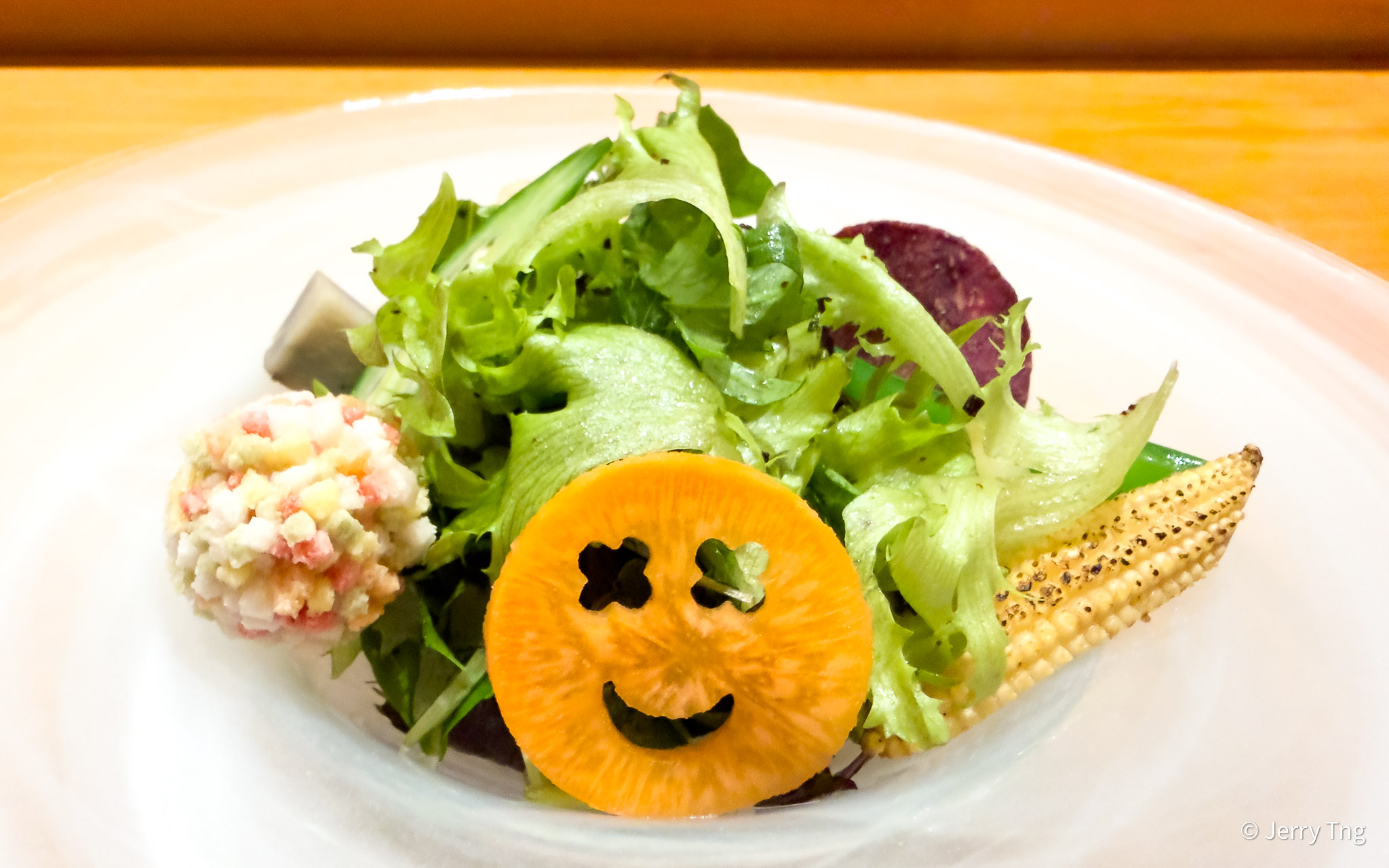
野菜沙拉 Yasai Salad

This is the dish that placed Den on the culinary map – a salad with over twenty ingredients each contributing texture, taste and temperature to the overall mix. It was very difficult to describe what we were eating as there’s only one of everything. The salad often includes playful and unusual ingredients like edible ants, reflecting the chef’s innovative and heartwarming approach to kaiseki cuisine. Tonight, we didn’t have any edible ants.
碗物 Wanmono – 白蘿蔔/蟲草花/水菜 White Radish / Cordyceps Flower / Mustard Greens


椀物 Wanmono, or 蓋物 Futamono (lidded course), is served in a beautifully decorated lacquerware with lid. It is commonly a soup or simmered dish.

Mizuna (水菜) tasted like chrysanthemum lettuce without the bitterness. Cordyceps flower (Cordyceps militaris) is not exactly cordyceps, but it is believed to boost immunity when you take it in moderation. The soup is made from dashi stock. The radish was quite bland, with the centre hollowed out and filled with squid paste. It takes some skills to keep the squid in place as different cooking temperature meant that the centre will drop off. Overall, a rather bland and forgettable soup.
釜飯 Kamameshi – 海瓜子/九層塔/芹菜 Short Necked Clam / Thai Basil / Celery

Shokuji 食事 in a kaiseki refers to the traditional trinity of Gohan, Konomono and Tomewan (御飯・香の物・止椀), signaling the end of the meal. This is usually a special kamameshi 釜飯 made by Chef Jason using local ingredients. The last round was local black pig pork belly rice, tonight’s short-neck clams rice.

The kamameshi was made with Chishang rice (池上米) cultivated in Chishang, Taitung. Renowned for its natural sweetness, plump texture, and distinct fragrance, it was historically served as a tribute to the Japanese Imperial Family. Short-necked clams, aka Manila clams (海瓜子) is widely distributed along the western and northern coastal sandy-mud flats of Taiwan. It is a prized ingredient in Taiwanese cuisine, celebrated for its sweet, briny flavour and tender meat. The stock from boiling the clams was used to cook the rice and finally all the ingredients, including shredded conpoy (dried scallops) and julienned Thai basil and chopped celery were combined together for a delicious bowl of rice. The photo of Chef Jason above showed him hard at work combining the ingredients with special celery oil for that special fragrance.

The short-neck clams rice hit all the right spots, even Ozempic couldn’t prevent me from having two bowls of it. It had all the umami that shellfish provided, and the fragrance from the aromatics. The clams were very fresh, of course, and the rice was full of it.


And with rice, there’s always konomono 香の物 (pickles) and misoshiru 味噌汁 (miso soup), or else it would not be considered as washoku 和食. Sometimes, depending on the type of main course served, the tomewan 止椀 can also be a clear soup.
彩色人 純米大吟酸 – 酸梅湯

They have saved the best for last – Irootoko Junmai Daiginjo by Watanabe Sake Brewery. The legend has it, a top male host at a host club said to the brewery owner, “Mr. Watanabe, we have the best champagne and cocktails, but not the best sake. What kind of sake would be the best? Please brew a wonderful sake that can captivate the ladies.” This was the brewery’s original intention in developing this product. As a result, this sake, with its sweet and smooth taste and refreshing fruity aroma, will deeply attract even women who once avoided sake and said, “I don’t like sake.” The tea pairing was not a tea but a traditional sour plum juice made made from smoked plums and a host of ingredients to mellow the sourness. This is a drink that we often order with our hotpot meals to ease digestions.
甘味 Kanmi


Finally, the dessert 甘味. The after-dinner dessert is mostly wagashi 和菓子 (Japanese sweets), but sometimes fruits or sorbets are served, which was what I was hoping for given that Taiwanese fruits can be as good as the Japanese ones.
腐皮/白芝麻/ 核桃 Tofu Skin / White Sesame / Walnut


The first dessert was a yogashi 洋菓子. BTW, 腐皮 is actually rotten skin in Japanese, the correct term in Japanese for tofu skin should be Yuba ゆば (湯葉). Yuba is the byproduct of boiled soy milk. It is almost tasteless, and very often we would just blanched it in hotpot to soak up the taste of the broth. This dessert used sweetened Yuba that has been toasted to a crisp and plated with ball of white sesame ice cream to resemble a Star Wars Jawa Sandcrawler on a bed of crushed walnut. The sandy ice cream was slightly salty, which was really nice for a dessert.
抹茶/紅豆/芒果 Matcha / Red beans / Mango

The bottom layer is matcha yōkan (抹茶羊羹), a traditional Japanese sweet (wagashi) made from sweetened bean paste, sugar, and agar-agar (kanten), flavoured with green tea powder. It was topped with a sakura shaped Azuki bean paste and decorated with two butterflies made with fresh Aiwen mango from Taiwan, which was nearly the end of its run. The flavours were harmonious together. I would love to have more of the fresh mango though.
SLOWAVE 窨香粟酒 – 文山青茶

SLOWAVE Aroma (窨香粟酒) is a specialty millet wine that uses Taiwanese aboriginal millet as its core ingredient, blending Michelia figo flower extract with the original millet wine to present a light, slightly sweet contemporary fermented flavour with aromas of spring flowers and fruits. It reminded me of those sweet wine drank during the harvest festivals with a lingering note of sweet grain and a soft fermented character; very festive but too sweet for me. Wenshan oolong tea (文山青茶), aka Pouchong, is produced in the Wenshan tea region in New Taipei City. It is a semi-fermented tea (oolong tea) characterised by its tightly rolled, emerald-green leaves, a bright honey-green tea liquor, an elegant natural floral aroma, and a mellow, refreshing taste. This tea is often used in boba tea, so Princess was quite intrigue by it.

And at the end of the meal, Chef Jason came over to say hi and asked the customary “How the meal?” Then we were each given an onigiri made from the kamameshi for breakfast to continue the memory of the great meal. They were great snacks for watching the World Cup that evening. PS: clams do not keep well outside the fridge, and we felt it the next day.

Some cities are better for Michelin star gazing, like Paris and Tokyo where you will never go wrong. And then there’s the overrated ones like Bangkok and Singapore. This was my first Kaohsiung star, and we were off to a good start. There wasn’t any course that I didn’t like particularly. The pace and the service were spot-on. The Taiwanese twist to the taste was quite obvious in a good way, but not entirely acceptable if you are want a scholastic interpretation of traditional Kaiseki. Recommended if you are in town.
Sho 承
2F, 806 Zhonghua 5th Road, Cianjhen District, Kaohsiung, Taiwan
(Reservations)
Visited Jul 2026
Michelin Kaohsiung Guide 1 Star 2022-2026
Pingback: Michelin Taiwan 2022 – live2makan