
I have heard about this restaurant from my Shanghainese friends but I always mistaken it to be a branch of another famous Shaoxing restaurant. I finally get to try it for the first time.

As the saying goes, 酒香不怕巷子深 (The dark alley is no deterrent to the fragrant wine). Kong Yiji Tavern is exactly that. It has been part of the Shanghainese memories since a century ago. The restaurant is located next to the Temple of Confucius, and the area is popular with parents bringing their children, who will come and pray for examination success.

The name of the restaurant came from a main character 孔乙己 Kong Yiji in one of 鲁迅 Lu Xun’s novel. In the story, he frequented Xianheng Tavern 咸亨酒店, a real restaurant in the author’s hometown of Shaoxing. This restaurant is modelled after that famous Shaoxing restaurant.

Tastes of Shaoxing can be characterised into four main types – 霉 Mouldy taste from beneficial moulds breaking down the sugar and proteins in food; 酒 Wine taste from alcoholic fermentation of grains; 酱 Sauce taste from fermentation of sauces; and 鲜 Umami taste from the freshness of the ingredients. Tonight’s dinner featured all four of these Shaoxing tastes.
Our Dinner for Three
二十年花雕王 20 Year Old Yellow Wine

One cannot come to Kong Yiji and not order their famous Shaoxing yellow wine. The vintage we had was twenty years old, very smooth and had a distinct plum aftertaste. No plum in added in the fermentation, but dried salted plum is commonly added as you warm the wine to remove the musky taste of young Shaoxing wine.

酱白萝卜Pickled Radish (L) and 花生苔条 Peanuts with Seaweed came as a snack to go with the wine. The peanuts were fried daily in the restaurant, and were perfect with the wine. I reserved the pickled radish for a later dish.
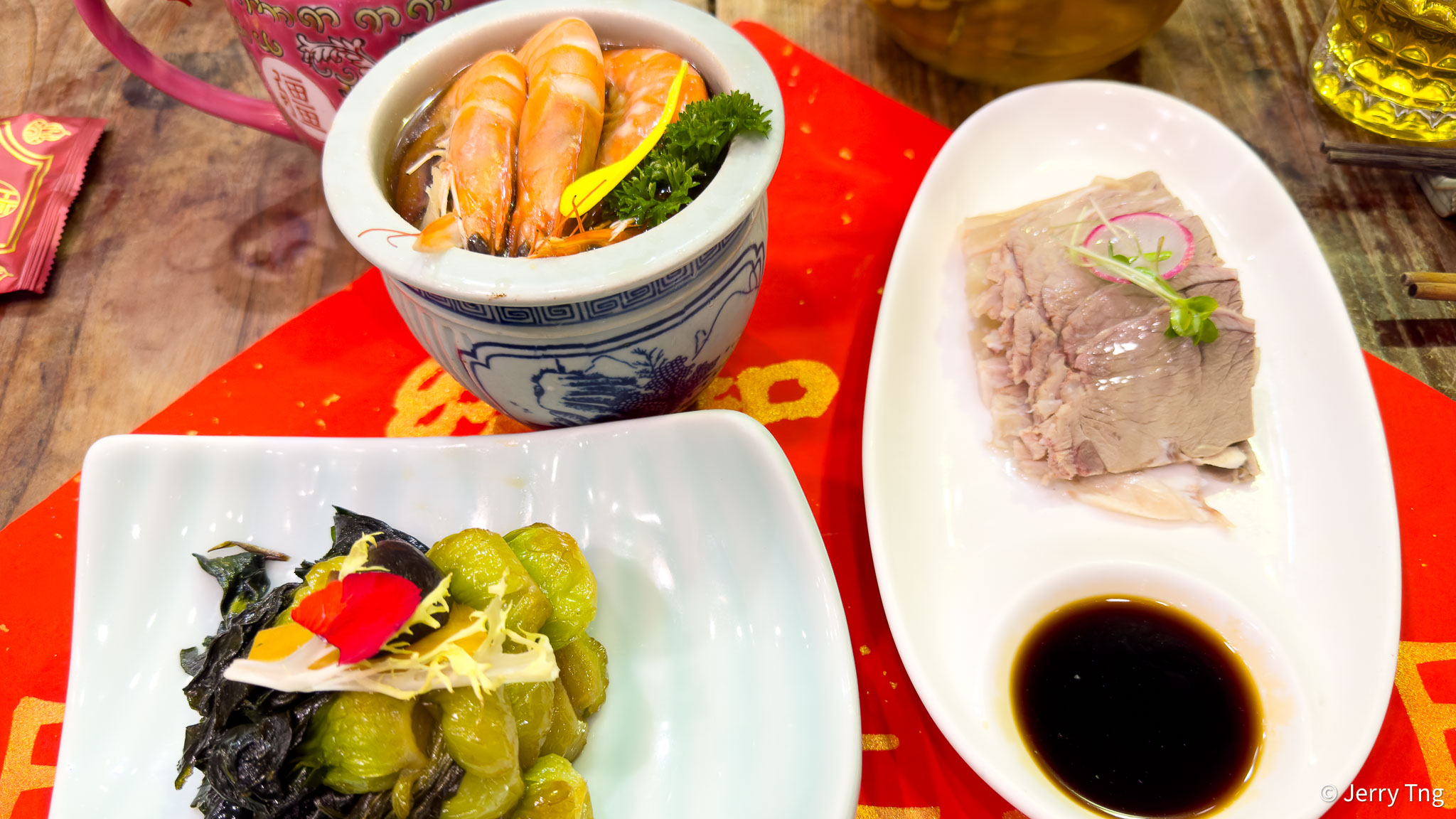
白切崇明岛羊肉 Boiled Chongming Island Mutton

崇明岛 Chongming Island is a large alluvial island at the mouth of Yangtze River. 80% of the island belongs to the administration of Shanghai, which the local joking called the “developed” part. The other 20% is quite rural and belong to Suzhou. The rural section produces some of the best organic ingredients for the palate of the wealthy Shanghainese. And this mutton was raised there amidst the clean air and clear water.
糟味三拼 Prawns, Pig Stomach and Edamame in Wine Lee

Cooked food marinated in rice wine 糟货 has a long history and is regarded as an ancient technique in Chinese cuisine that can be traced to pre-Qin dynasty period. It was first mentioned in the “Prose of Chu” 楚辞 more than 2,000 years ago. In the “Dream of Red Mansions” written by Cao Xueqin in the Qing dynasty, exquisite tastes such as wine marinated goose paw and quail were mentioned. Tonight we had pig stomach, prawns and edamame all served marinated in yellow wine.
宁波烤菜 Ningbo Grilled Vegetables

“烤” (grill) in Ningbo dialect is to add soy sauce and sugar to the ingredients and braise them over low heat. The vegetable of choice is usually bokchoy as it can be cooked for a long time and still retain some bulk. This dish is very savoury and usually eaten with rice or plain porridge.
蟹粉河虾仁 River Shrimps with Crab Roe

Two of my favourites in one dish, but it was not as exciting as I thought it would be. Eaten with a dash of sweet vinegar, the river shrimps were quite bland and depended on the crab roe to carry the flavours.
千里飘香 Deep Fried Stinky Tofu

Deep fried stinky tofu has been a Shaoxing special since a thousand years ago. Think of it as the Chinese blue cheese, except that it is made from tofu instead of diary. And the bacteria that caused the stink, lactic acid bacteria (LAB), is actually beneficial for you. This one wasn’t so stinky but it was definitely fluffy and well fried with a crispy crust. I broke one in half and stuffed it with the chilli and sweet sauce that came with it, and the half with the pickled radish. A delightful one bite.
清炒豆苗 Sautéed Pea Sprouts

This is one of their classic dish, more Shanghainese than Shaoxing. The pea shoots were sautéed with oil and a dash of Chinese white wine. The trick is to get really fresh and young shoots.
双臭蒸黄鱼 Double Stinky Steamed Yellow Croaker

Shaoxing is famous for its stinky cuisine. If you think stinky tofu is bad, think again. Try steaming vegetable that has gone off with tofu. Not for the faint-hearted, but it gave the yellow croaker another dimension in terms of flavours. This wasn’t as disgusting as the stinky meal I had in Shaoxing.
红烧鳝筒 Braised Eel

Salted pork belly was used to provide the grease and additional flavours to this braised river eel. Unlike unagi, which is sliced along the bones, this style called for the eel to be chopped into pieces. The crunchy skin with the delicate meat required some skills to eat as you avoid the backbone of the eel. Perfect with rice, so we ordered some. We could not finish the portion as it was really rich.
蹬鸡 Poached Chicken

The chicken used is a capon or castrated cock. to improve the quality of its flesh for food. The capon is then poached in aromatic spiced boiling water to the right doneness, not unlike to our Hainanese chicken. The chicken was served warm with an accompany slight sweet soy sauce infused with scallions. Delicious eat.


And that’s a lot of food for three persons, but we finished everything except the eel. The service was excellent, friendly and not pushy. The atmosphere on the ground floor was like tavern, rowdy and energetic. The food was above average and comparatively not so expensive – the rest of Shanghai has succumbed to inflation. Recommended but reservation is a must to avoid disappointment.
Kong Yiji Restaurant 孔乙己酒家 (文庙店)
上海市黄浦区文庙路学宫街36号
Tel : +86 21 6376 7979
Visited Mar 2024
0 comments on “Kong Yiji 孔乙己 @ Shanghai”