
I am one that enjoy going to wet markets where fresh produce is sold. And even better if the markets offer a delicious meal and unique experience at the same time. This time I went to Noryangjin Fisheries Wholesale Market in Seoul.

Noryangjin Fisheries Wholesale Market (or commonly referred as Noryangjin Fish Market) is Korea’s largest seafood markets. There are plenty of places around Seoul where tourists and visitors can go on their own, but the old Noryangjin was not one of them unless you have a good handle on Korea and haggling in Korean. So in 2016, the local government moved the vendors to the modern market next door and the situation improved. The transition from the old building to the new has taken a few years.


It’s like an aquarium where you can eat the exhibits. Unlike a lot of fish markets around the world, many of the fish are still alive in tanks. Because of that, it doesn’t smell as rank as other markets.
Vendors are helpful and interested, and highly motivated (and competitive) to help you get what you want whether it be abalone or lobster or something else. They will grab a trusty calculator to help with the bargaining when they think you can’t speak Korean so use that if you need.


The narrow aisles are often wet down with water to wash away the blood and guts of seafood cleaned on the spot from the many stalls of fish, shellfish and other ocean edibles. The seafood are perched up on Styrofoam shelves or in tanks that seem to be overflowing constantly. To the uninitiated, choosing live seafood can be a daunting task but I’ve learned through experience to choose what is still alive and traditional market like these always have the best produce.


In Korean sashimi is called 회 “hoe”; the vendors will say “sashimi” because that’s the word they know tourists know. Unlike Japanese sashimi and sushi, Korean hoe uses fish that is not aged, i.e it’s freshly served from tank to plate. It much firmer than sashimi and has a clean ocean taste.

After selecting and paying for the live seafood, we proceeded to the restaurant Toesun 또순이회양념 (Stall 11) that worked closely with the fishmonger. The sous chef was at the store where I was buying the seafood from. The last time I ate at Emperor’s Sikdang, but I felt they didn’t do justice to the seafood. Like the previous time, you would be charged a “preparation” fees.
Our Seafood Dinner
Hoe 회 Korean Sashimi

The most common hoe are flounder, rockfish, salmon and tuna. But for tonight’s dinner we picked the white fish – flounder (hirame), striped beakfish (ishidai), rockfish (mebaru), sea bream (madai). This is prepared at the fish store and not at the restaurant.
Sannakji 산낙지 Live Octopus Tentacles

Octopus tentacles are chopped and seasoned with sesame oil and soy sauce, served raw in a dish called Sannakji 산낙지. The oil keeps the powerful suckers from holding on to the diner’s throat, but chewing thoroughly is a must to avoid choking.
Gae-bul 개불 Sea Worms | Munge 멍게 Sea Pineapple

The first time I tried the Gae-bul 개불 sea worms was in Yantai but it was sautéed with chives. Here, they simply served them sashimi with a sesame oil and salt dip. Crunchy and tasted like blanched goose intestines. Munge 멍게 (the yellow looking pieces) is called ‘Pineapple of the Sea’ 바다의 파인애플 because of its hard body that resembled the tropical fruit. The cooked version tasted like a chewy piece of gummy bear with gasoline smell. The sashimi was so much tastier.

The Korean hoe is usually dipped in a red sauce called chojang 초장 made with gochujang, plum sauce and minced garlic. The sashimi is then wrapped in different leaves like ssam 쌈 Korean lettuce or kkaenip 깻잎 perilla leaves.
구운 야생 호랑이 새우 Grilled Wild-Caught Tiger Prawns

Due to difficulty in communication, the range of cooking techniques on our seafood was limited. Many times the shellfish will be steamed (jjim 찜) or grilled (gwee 구이). But if you want a really delicious shrimp, ask for them to be salt-grilled (sae-u sogeum gwee 새우소금구이).
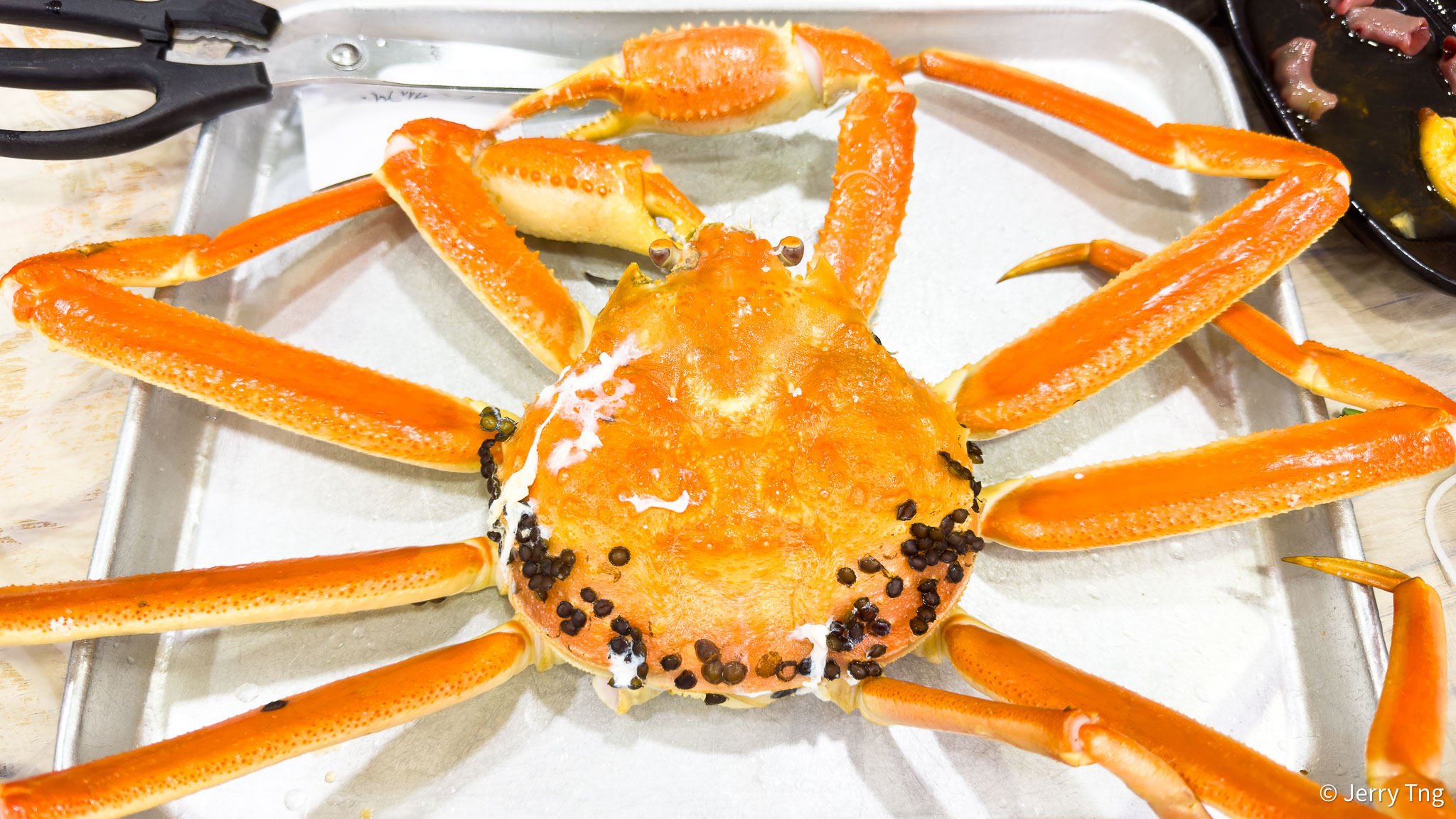
Jjim Nunge 찐 눈게 Steamed Snow Crab

Everyone comes to Noryangjin for their giant king and snow crabs. The vendors will offer their Wang-ge 왕게 kings crabs anywhere from 35,000 KRW (~SGD 35 at time of writing) per kg, to 80,000 KRW or more. All of them are caught off the coast from Alaska and. But if you have a smaller group, I would recommend for the more economical and equally sweet tasting Nunge 눈게 snow crabs. Because of its longer harvesting season, the price is also more affordable, which can start from 15,000 KRW to 50,000 KRW. Everything is based on availability and market rates, so don’t hold me to these prices.

King crab legs are thicker and lined with spikes that require a crab cracker tool for best results. Snow crabs, on the other hand, have legs that are soft enough to crack open with your bare hands.

Snow crab, because of its more savoury taste, is excellent for hors d’oeuvres, and often used in salads, dips, spreads, or even in soup, although snow crab is also wonderful on its own.
Kijogae Bokkeum 키조개 볶음 Pen Shell Sautéed with Gochujang

We bought a kijogae 키조개 pen shell and had it prepared in the style of nakji-bokkeum 낙지볶음 stir-fried octopus. It was executed perfectly, right doneness and sweetness of the shellfish came through beautifully.
Maeuntang 매운탕 Spicy Seafood Stew

After all the seafood and sashimi, we needed something warm in our tummy. The fishmonger kindly included a “soup package” with mussels, clams, baby octopuses and other shellfish, together with complimentary fish bones for the stock that went into the maeuntang 매운탕 spicy seafood stew.

Everyone knows Tsukuji in Tokyo but Noryangjin is not so famous, but it should be. It is a vast fish market with tons of choices. The dinner worked out to be 55,000 won for the cooking and drinks, while the seafood cost 135,000 won. The sashimi was from another store and cost 110,000 won (not worth it, even though it was very fresh – felt I was fleeced). Worth a visit for the experience.
Noryangjin Fisheries Wholesale Market 노량진수산시장
674, Nodeul-ro, Dongjak-gu, Seoul 서울특별시 동작구 노들로 674 (노량진동)
Tel:02-2254-8000
Visited Jul 2024
Pingback: Fresh Seafood Market in Anyang – live2makan