
The first Japanese food that most Singaporeans are introduced to is tempura. This was usually one of the set in washoku restaurants in Japanese supermarkets like Yaohan (the first in Singapore) in the 70s. So a tempura-ya like Funabashiya whom has been doing only tempura since 1886 would be mind-boggling.

It was the 19th year of Meiji period (1886), Kanjiro Takahashi (b. 1858 – ?) established a shop called 『焼き芋 船橋屋』”Yakiimo Funabashiya” on the current location of Kadozumi 1 chome (present: Shinjuku Sanchome). The rest, as they always say, is history. The first generation of Takahashi came to Shinjuku from Funabashi Village (now Setagaya Ward, Funabashi). Initially, Kanjiro started business in his family home along the thoroughfare of Shinjuku selling grilled sweet potato to passing traffic – rickshaw, dealers and cigarette pushers.


Fast forward to 130+ years later, Funabashiya now specialises in tempura. The characteristic of their tempura is in the use of its fragrant sesame oil 胡麻油. made by the “ball tightening” method 「玉締め絞り」from Sekine Industrial Co., Ltd., a traditional flavour that has been passed down since they started selling tempura.

The craftsmanship of frying tempura is passed down from master to apprentice over the years. This cannot be a fixed formula, but a slow impart of the technique and experience over time, from the preparation of the batter, to control the oil temperature, to determine when an ingredient is properly fried.
夏の味覚コース Taste of Summer Course

While eating tempura in these tempuraya 天麩羅屋 can be an expensive affair, one can still find a bargain during lunchtime. These set lunches usually consist of plain rice or “Gohan” ごはん, a miso soup “Misoshiru” みそ汁, pickles “konomono” 香物 and depending on price, sashimi and a dessert.
しまあじ刺身 Shimaji sashimi

The fish for summer, the horse mackerel or shimaji しまあじ served as sashimi. Since the last time I came, this sashimi was so much better.
天ぷら Tempura

This method of frying food was introduced in the 1600s by Portuguese missionaries. The original dish has disappeared, but it was a meal meant for Lent, when many Christian denominations are forbidden to eat meat. In fact, the name tempura comes from the Latin ad tempora cuaresme, which means ‘in the time of Lent.
巻海老(頭付き)Maki-ebi or medium sized Kuruma shrimp (with head)

Kuruma shrimp 車海老 is a shusse ebi 出世エビ or “succession shrimp” whose name changes as it grows; those that < 10 cm are saimaki 細巻 or komaki 小巻, about 15 cm are maki 巻 or chumaki 中巻. Only those that are > 15cm can be called Kuruma shrimp, and the big ones are called ooguruma 大車, literally “big cars” .

The prawn tempuras that I ate in supermarkets were without heads. The shrimp heads are only available in the best tempuraya to show off the freshness of the shrimp used. The proper way to eat these tempura shrimps is with salt only as the sweetness of the crustacean will highlight itself.

For the tempura with stronger taste profile, like ebi, anago, etc., salt is the preferred condiment. They serve a special type of salt of high iodine content that is made from a technique thought to be lost but revived by Mr. Hiroshi Sato, a craftsman in Yamakita-cho, Niigata Prefecture. Tentsuyu is provided too, if you prefer, and can be used with the grated radish provided.


Following the manufacturing method from the Manyo period (7th-8th Century), the special salt is a mineral-rich brown salt made over time by boiling down seawater in a traditional flat kettle and then removing the bitterness with dried Hondawara seaweed. Funabashiya also provides a rich seasoning salt with black pepper and garlic blended in herbs such as oregano, marjoram, sage, thyme, rosemary and so on.
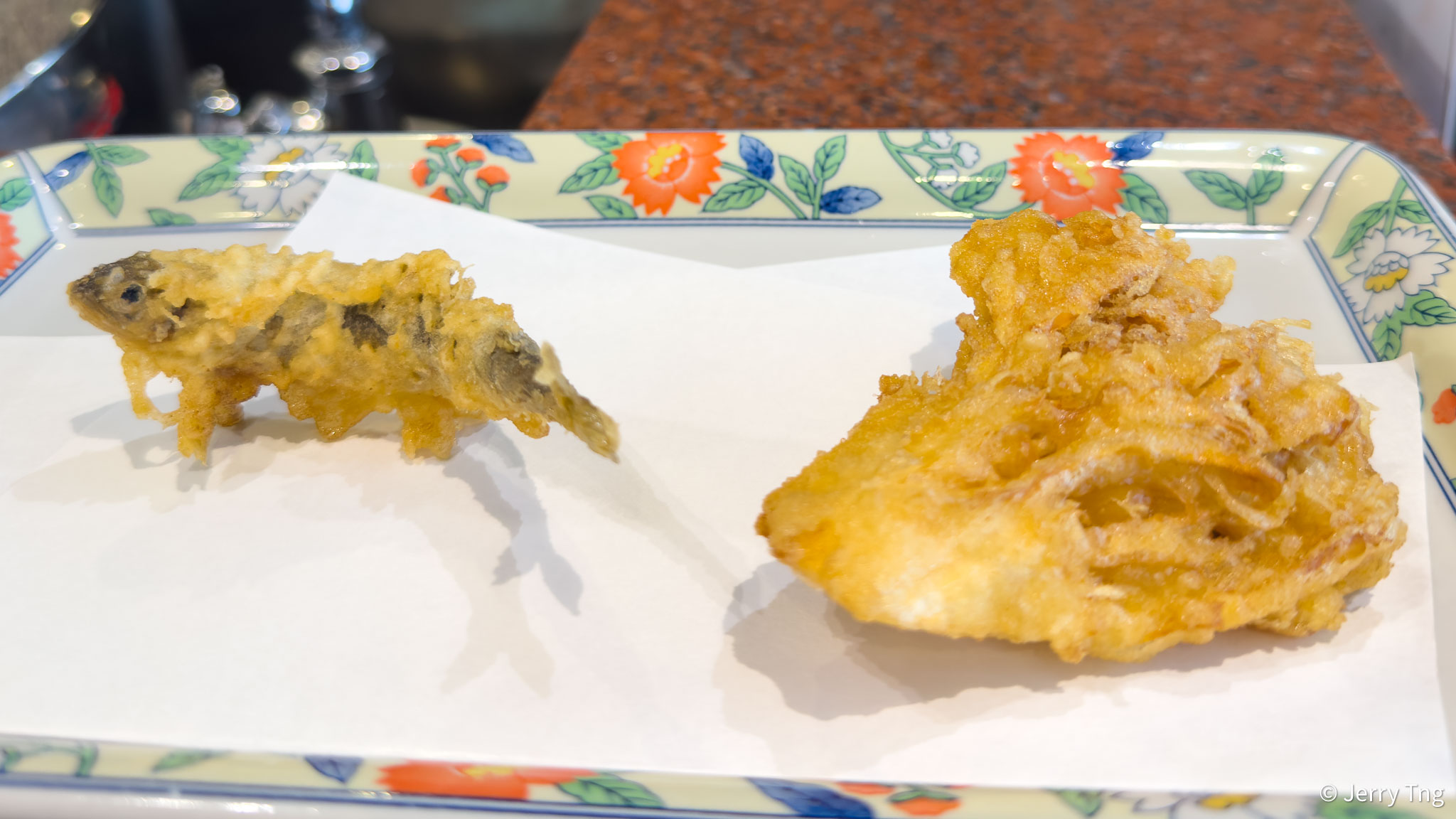
若あゅ Young ayu

Ayu 鮎 or sweetfish caught from June to July are called young ayu 「若あゅ」 and grow to be around 15cm in length. As their bones are still soft, this is the perfect time to tempura them and eat them whole, bones included.
白舞茸 Maitake mushroom

The tempura process, contrary to what it seems (deep-frying), is actually steaming the food. The batter that coated the ingredients creates an insulation layer and the high heat vaporise the moisture of the ingredient and creates a steaming action. This retains the original flavour of the ingredient. For example the maitake mushroom, which is tender and delicious despite the crunchy shell.
ゴーヤ Bitter gourd

Bitter gourd is a summer food, and deep frying makes it less bitter than it should be.
グリーンアスパラ Green asparagus

And just like the mushroom, the asparagus was cooked perfectly.
きす Kisu

Next up, the whiting “kisu” fish. I have not seen other fish served for tempura in Japan, unless they are a la carte orders or “Shun” seasonal specials like the next item.
穴子 Conger eel

The conger eel or anago 穴子 came across to be really like the battered fish in English fish and chips. Pass me the salt and vinegar, old boy.
小海老かき揚げ Koebi kaki age

Final item served after all the ala carte items were served, the kakiage of shrimps and vegetable. It was made with tiny shrimps and vegetables held together with batter and fried. Despite the size and seemingly amount of batter, it was not oily and rather delightful to eat. If only I can put it on top of some more rice and pour the dashi stock over it, it would be the perfect ending.
一品料理

Besides the tempura items, the meal comes complete with a cooked item, and usually it is chawanmushi, or Japanese steamed egg custard.
ごはん みそ汁 香物 Rice, miso soup, konomono

And to complete the meal, there is the rice (ごはん) which comes with the Japanese pickles or konomono 香物, a must when steamed rice is served. And a bowl of red miso soup (みそ汁) rounds up the main course.
デザート Dessert

And the dessert was a mango jelly with bits of the fruit.
アラカルト天ぷら Ala carte tempura
I order a couple of a la carte items, how could I not! It took me such while before I could come here and pay homage to one of the oldest tempuraya in the world. I cannot go away without ordering a couple more specialties from their repertoire.
伏見とうがらし Fushimi pepper

These peppers are long green chilli that we pickle in Singapore as a condiment. They are quite delicious when tempuraed.
帆立天 Tempura of Scallops

And finally, tempura of Hokkaido scallops. Delicate seafood like these is the most difficult to deep-fry, a minute longer the mollusc is overcooked. These scallops were done perfectly.


If you are there at lunch, be a good sport, order, eat and be done. Don’t hog the seat. English is almost not spoken, but they have an English menu for the set lunches and dinners. It also means that the specials are not in there as they are written on the board. Reservation is allowed for dinner, but you have to join the queue for lunch.
天ぷら 船橋屋 本店 Tempura Funabashiya Honten
〒160-0022 東京都新宿区新宿3-28-14
Tel : +81 (03) 3354-2751
Visited Aug 2024
0 comments on “Funabashiya 船橋屋 @ Shinjuku (2024)”