
The hardest post to write is about yakitori. Every stick is different and yet not enough material to write a whole paragraph. But it remains one of my favourite cuisine from Japan.


Hui Kappou 輝 炭火割烹 is positioned as a fine dining omakase restaurant in Beijing that features yakitori 焼鳥 and kappo 割烹 cuisine. It has received many local awards, everything except from the tyre company. But many were pay-to-play so I have my doubts when I see this wall of fame.

The extensive menu at Hui is a showcase of seasonal ingredients, prepared either as a yakitori or small eats kappo-style. They do set menus, not so much omakase. I hate it when the term is used so loosely. Everything that is on the omakase comes from the standard menu.

Kappou’s dining philosophy of ritual meets art is evident everywhere you look. Bamboo dragonflies, Zen pieces with bonsai, it was a deliberate effort to scream Japanese at every corner. Every little detail from tableware to glassware has been considered to bring out the unique culinary narrative of the chef, “I am selling authentic Japanese food, just look at the utensils.”. And they spoil it all by tell you it’s 甲辰年 (2024), the Chinese calendar system not used by the Japanese since the Meiji restoration.


We came really late so omakase was not available (we came at 10pm). After placing our orders (put everything in so the kitchen can prepare as they close at 1 am), it took another 5 mins before the grilled stingray fins were served. The beer took a while too. And there were only 6 of us at the yakitori counter.

Kind of strange but their otoshi was a slice of Japanese musk melon. The Chinese has managed to plant these delicious melons from Japanese lineage in China, allowing many more to enjoy the sweet, intense flavours of the husk melons that once was the privilege of rich.

I ordered a shellfish for a sashimi, kind of a gamble in China. 赤貝 Akagai or Japanese cockle has the crunchy, satisfying umami of shellfish because of the blood (and iron) that invokes that feeling in people. Yep, scientifically proven, just watched “Grand Maison Tokyo” on Netflix.

The first stick was the chicken liver, a yardstick of how good a yakitori-ya is. It was a promising start. The technique was spot on although the quality of the chicken was not the same as the Japanese variety.

It was translated as white bamboo shoot, but the correct name is Manchurian wild rice 菰米. Both the stem and grain are edible. And when harvested young, the stem has the texture and sweetness of bamboo shoots and is known as makomotake 茭白筍.

Kappo 割烹 simply means ‘to cut and to cook’, an all-encompassing word for a less formal cuisine that emphasises the proximity between the diner and the chef who is cutting and cooking the food. The stewed beef tendons were so soft and tender and so flavourful, I would need a bowl of steamed rice.

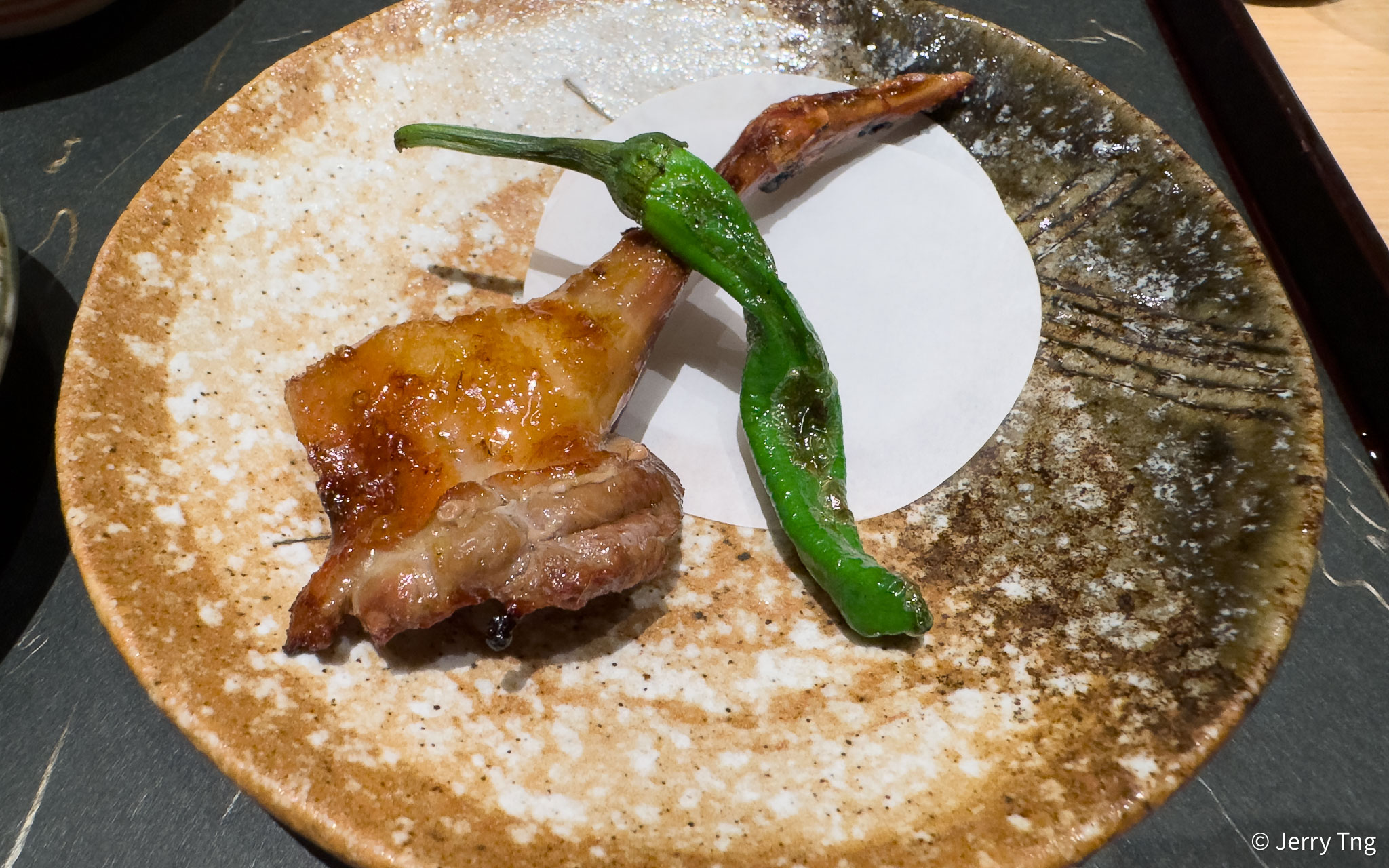
Roast pigeon leg is not something commonly served in a yakitori in Japan, but for some reason, yakitori-ya in China always feature this dish. But the dish is totally dependent on the quality of the supply of these birds, which can be quite pathetic in some places. This pigeon wasn’t really suited for grilling, too small, not fleshy. But the technique and flavours were spot on.

The gyutan (beef tongue) was slow cooked in a tomato braise. Very soft and delicious. Comparing it with the beef tendons, I prefer the tendons because the flavours were harmoniously blended. This one I wasn’t sure, but still a nice eat with cold beer.


After those starters, we continued with the first seven sticks of yakitori – gyutan (beef tongue), sunagimo (gizzard), reba (liver), momo (breast), negitori (thigh with leeks), hatsu (heart) and cochin (lantern). They were expertly done, with the right level of smokiness and seasoning.

Their signature negima ねぎま and other chicken skewer uses 清遠雞 Qingyuan chicken thigh. Qingyuan chicken has golden skin, tender meat, crisp skin, soft bones and unique flavour, and is the chicken of choice in Hong Kong cuisine.

My favourite was their 手羽先 mid-joint, which they had skilfully removed the bones. Delicious and convenient .

Then, I got the other half of the mid-joint, which they called the tebasaki “dumpling”, The mid-joint was deboned and then stuffed with sushi rice and grilled to a crisp. Delicious and innovative.


The grilled asparagus and okra were really dried out and not wonderful. At this point, they were fumbling. Perhaps it getting closer to closing time.

These gingko nuts were supposed to come with the beer, and it came almost the end of the meal. These lapses were quite frequent and there were only 6 of us at the counter and another group of 4 in a private room at the back.

This was complimentary from the restaurant, a palate cleanser. Roasted pineapple would definitely be on my BBQ menu, so simple and yet satisfying.

I always end my yakitori journey with the onigiri grilled with shoyu (soy sauce). The crust was crunchy with the smokiness that can only come from burnt rice. But they made it in an elaborate way with sprinkling of furikake.

They were grilled to a crisp on the outside but still moist and hot inside. Served with a nori (seaweed) sheet for you to hold the scotching rice ball, but it would be perfect if they had grilled the nori sheet as well.

Also a highlight of a yakitori meal, the chicken consommé. Given the amount of chicken carcasses that they would have, the stock will always be amazing. Nothing to fault here, it was a soothing cup of chicken consommé.

And since they did not have a dessert menu, they gave me a ball of lime sorbet instead. Quite refreshing after all the food.

The curse of the wall of awards hits again. I should have trusted my instinct of not going to any Black Diamonds. These awards in China are often bought, not earned. The food was OK to good, but nothing worth a mention or special trip. The reason why it remains here is for the long business hours. If you need to entertain late in the evening or have a really late night meal after you get off the plane, this is the only choice around China World Hotel.
Hui Kappou 辉烧鸟·炭火割烹 Omakase (国贸中海广场店)
金桐路光华东里8号中海广场商业楼F3层01-A号
Tel : +86 1850138185
Visited Oct 2024
0 comments on “Hui Kappou 輝 炭火割烹 @ Beijing”