
Because of the pandemic, I have not returned to Hong Kong as the business trips to the ex-colony dwindled. And I took this opportunity to revisit Ta Vie and celebrate Darling’s birthday at her favourite restaurant.
“Pure, Simple and Seasonal” and Chef Hideaki Sato

Ta Vie 旅 is about ingredients, simple cooking and letting the ingredients speak for themselves. No, this is not a Japanese kaiseki restaurant. What is on offer is meticulous French haute-gourmet techniques that are applied to the seasonal picks from Japan.

Chef Hideaki Sato 佐藤秀明 was born in Nagano prefecture and started cooking in French restaurants before switching over to Japanese cuisine. He worked at the three-Michelin-star Nihonryori RyuGin in Tokyo, then moved to Hong Kong to open the two-star Tenku RyuGin, the Hong Kong outpost of the Nihonryori RyuGin, and then started his own restaurant in 2015.


Even though situated inside a hotel, Ta Vie doesn’t feel much like a typical hotel restaurant. The host stand is next to the elevator on the second floor, and from there we were led though a long, narrow dining room. Tables were spaced out along this corridor, which ended with two tables (one of them semi-private) next to the windows overlooking Queen’s Road. These two are probably the best tables in the house, with a view of the busy street below. The dominant colour of the interior is black, which – with the mostly closed blinds – might suggest a somewhat subdued atmosphere.
Taste of Asian Ingredients

In the 7-course “Winter Special Tasting Menu 2024” degustation menu that we have chosen, the ingredients were picked from the freshest of the season from around Japan.
Winter Special Tasting Menu 2024

Throughout our dinner, we enjoyed three types of bread made from Japanese wheat, accompanied by a house-made, airy whipped butter and ricotta cheese drizzled with olive oil. Ta Vie churned their own butter and ricotta, which is made from the whey from making the butter. All breads use wheat flour “Kitanokaori”, and dark rye flour from Hokkaido.


The restaurant is proud of its bread and butter, as demonstrated by a descriptive card placed on the table. The breads are fermented with Nukazuke, which is a variety of vegetables marinated in lactic acid fermented rice bran. The result is a similar bread to traditional French Pain au levain as both utilise the wild yeast found on grain brans, vegetables and fruits.

The first bread was their in-house nukazuke (糠漬け) bread, a simple, crusty dinner roll served piping hot. It was delicious, crunchy with a slightly chewy crust, and it was a great match for the ricotta/olive oil spread. Darling and I couldn’t stop munching through them.
Crispy paella with Kegani crab, fresh tomato salad

The degustation course began without any fanfare or any amuse bouche. This was the first course, and we mistook them for amuse bouche. The last time we came, they served 2-3 small bites before the first course, so we were quite disappointed that stop that since they got their third star,

The first appetiser divided into two bites was a reinterpretation of paella. Crispy paella usually describes the layer of caramelised rice on the bottom of the pan, called socarrat. This layer is a key part of paella sought after for its taste and texture. Chef Sato created a crispy rice casing like a monaka wafers to hold shredded Kegani crab meat and paella inside, and a whole leg of Kani placed on top of the crust.

The second bite is actually a tomato aspic made up of chopped heirloom tomatoes cast into a flavoured gelatine case, topped with mint, cucumber and more tomato. A very refreshing bite with a little bit of spice, almost reminded me of Bloody Mary.

That’s it for appetisers. While they were delicious and well-thought out, we have been utterly spoiled by other fine dining restaurants with quite a few amuse bouche before the appetiser. It is not the style at Ta Vie to do that as I observed that it was the same in my last two experiences.
2022 Patrick Puize Chablis Premier Cru Vaillons “Les Minots”

Aromas of pear, honeycomb and dried white flowers introduce Piuze’s 2022 Chablis 1er Cru Vaillons Les Minots, a medium to full-bodied, fleshy and charming wine that’s seamless and enveloping, offering considerable early appeal.
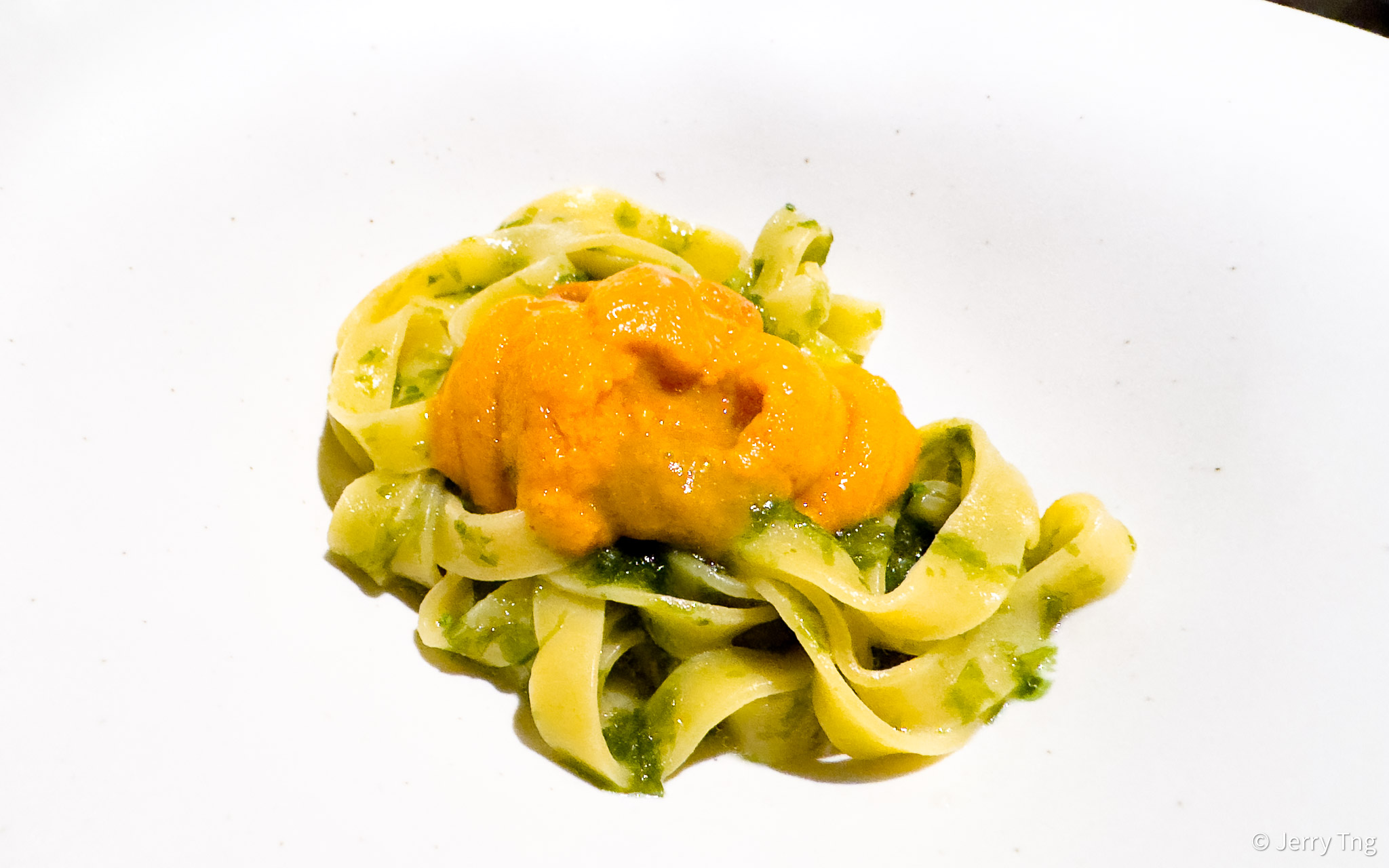
Homemade pasta with “Aonori” seaweed sauce topped with premium Hokkaido uni

This is the piece de resistance that launched Ta Vie. The Aonori seaweed provided the umami to the al dente pasta that reminded me of mee pok, and the Bafun uni just nailed it with its creaminess and intensity in flavours.

“Pot-au-feu” Bresse chicken clear consommé with seasonal vegetables

Bresse chicken is a French breed of chicken known for its white feathers, gamey flavour, and succulent skin. Different parts of the chicken is deboned and made into a coarsely assembled tsukune (chicken meatball) and slow cooked in a chicken consommé with Swiss chard, Brussel sprouts, carrots and radish. The bouillon is then poured onto the bouilli at table side and then black truffle is then shaved onto the pot-au-feu.

The origin of pot-au-feu traces back to the Middle Ages when families would keep a pot over the fire, continuously simmering, and ingredients would be added or taken out over several days. Over time, this evolved into the refined, yet hearty dish that is now cherished across French households. The long slow cooking resulted in 2 dishes: a clear nourishing broth and a rich meal of beef and vegetables. In this course, Bresse chicken is used instead of the beef.

This was my favourite course for the evening. The soup was heartwarming, something that your mother would cook but Chef Sato has perfected that memory. The chicken meatball was perfectly cooked wrapped with bacon and cabbage, Brussel sprout and Swiss chard, with all the ingredients amalgamated together. The radish absorbed all the flavours from the broth.
Pan-seared Brittany blue-lobster with Chanterelle mushroom, “Tubu” Japanese whelk, and Japanese “gobo” burdock

The next course is a theatric of sorts. The rich sauce was placed in a beautiful couch and served table side with the pan-seared Brittany blue lobster, accompanied with Chanterelle mushroom and slices of Japanese whelk (真つぶ貝 matsubugai) and a sauce made with Japanese burdock (gobo) for a balance of flavours.

The sauce was served in the matsubugai shell and was made from the shellfish liver, lobster stock and thickened with burdock. The burdock, to me, tastes similar to artichoke except that it is a bit more sharp and piquant.
Chef Sato himself came to serve the sauce and explained the dish to us, the chef’s twist as he called it.

This is a masterpiece of flavours from the mountain and the sea. Pieces of lobster tail and whelk were served with chanterelle mushroom which has a delicate balance of earthiness, nuttiness, and a slight hint of fruity apricot, and mushroom shaped burdock chips.

The last type of bread used a higher ratio of water than the first two, resulting in a really light and moist sourdough. The bread was my least favourite because I don’t like sourdough, but I had to agree it was perfect to mop up all the sauce.
2020 Manns Wines Solaris La Croix

Japan has been developing its own wine production, many of which IMHO have been quite subtle and light compared to its cousins in France or the New World. 2020 Manns Wines Solaris La Croix is a blend of Cabernet Sauvignon and Merlot, with bold tannin but subtle taste, it started adventurously with scent of the forest and morning dew, which quickly descended into a wet towel. The taste of tannin was smooth, however the overall blend was lighter than the “traditional” blends from Australia or the New World.
Roasted Noir de Bigorre black pork with “chou-fleur-croute” cauliflower sauerkraut, smoked beetroot mustard

The main course of this degustation menu features Le Noir de Bigorre or Black Pork of Bigorre. The loin of the pig offers particularly tasty meat and is used to make this Sunday roast, or what I reckoned to be Sunday roasts that my landlady used to make when I was in UK. You can add a white truffle supplement, but we were not in the mood.

The Black Pig of Bigorre is an indigenous pig species found in the Central Pyrenees region of France and is recognisable by its black coat and horizontal ears. They live in freedom at the foot of the mountains, and in this gentle and peaceful landscape of meadows and underwood, these small herds of swine move around to feed, enjoying a healthy diet based on the grass, acorn, chestnut, triticale cultivated on the geographical area.

I have tasted Kurobuta, Iberico and Berkshire, however this was the first time I had Bigorre pork and didn’t know what to expect. Perhaps it was the style of cooking, I didn’t find the meat that wonderful other than the melt-in-mouth texture and mild flavours. However, Noir de Bigorre produces a very good quality fat due to a significant amount of oleic and linoleic fatty acid. And this tiny piece of pork belly, little brined and cooked to a crisp was absolutely scrumptious.

The sides were equally exceptional. Cauliflower was presented in three ways – charred cauliflower, pickled cauliflower and cauliflower puree. The pork was accompanied by beetroot puree spiced with mustard. These accompaniments helped to reduce the greasiness of the pork.

And then a palate cleanser made from hibiscus tea and dried lemon. Very refreshing.
Sake lees flavoured mousse, coconuts sorbet, and fresh mangosteen served with raspberry and rose consommé

First up, a fruity dessert shaped like a gunkan 軍艦. A coconut sorbet beneath a puffy quenelle of sake lees flavoured mousse, topped with fresh mangosteen and heart-shaped raspberry candies and frozen raspberries. The gunkan was then set “afloat” with a rose consommé which was both sweet and tart at the same time.

The mangosteen had been carefully selected for that few slices that had no seed. The sugar hearts were quite sharp so I don’t suggest you put the dessert sushi in one mouthful. The coconut sorbet and sake lee mousse worked well together and balanced the sourness of the raspberries with a Piña Colada effect.
Fresh Japanese pear and Bergamot tarte, Bergamot cheese cream, pear sorbet

The final dessert was an open face tarte made with Bergamot cheese and wafer thin slices of sweet, crunchy Japanese pear accompanied with a quenelle of pear sorbet and a dollop of cream cheese. This combination was tried before by Chef Sato as a palate cleanser, but he took away the tartness and upgraded this to a full dessert.

After dinner you get a choice of Monkey Picked Tea, White Tea or their house blended coffee. We picked their original house blended coffee curated by the World Barista Champion Mr Berg Wu of Simple Kaffa, Taipei.

If you choose coffee, it came with a sidekick – chocolate mousse with kaffir lime leaves. And if you choose tea, it will come with something else. Unfortunately all three times, we picked coffee so we could not show you what comes with the tea.

Smooth, rich and dense chocolate mousse that was not overtly sweet. It was so nice that I ate mine and Darling’s too.

And like all fancy 3 Stars Michelin restaurants, there’s a parting gift for you to extend the experience. In Ta Vie’s case, it was a couple of sachet of drip-coffee which they sell in packs of five.
Afterwards

When we went Ta Vie in 2018, they were newly minted 2-Star Micheline restaurant. Fast forward to 2023, they finally got the elusive third star, which places tremendous pressure for all to make this detour worthwhile.

It was a delightful dinner than managed to seamlessly meld French haute dining techniques with Japanese ingredients and influences. Chef Sato’s presence was felt in the dining hall as he presented some of the newer creations, asked our feedback, and socialised with everyone – a departure from the chill black-and-white interior decor.
About Ta Vie 旅

Ta vie means “Your Life” in French and 旅 means “Journey” in Japanese. The basis of this name was for us to enjoy a chef’s life journey using different ingredients and seasonal produce through faultless execution and delicious creations.

Shortly after their opening in 2015, Ta Vie got the Michelin nod in 2016 with a lonely star, but quickly that was upgraded to two in 2017. And then they debuted #50 in 2016 on the Top 50 list, and it just got better each year. They got their third star in 2023 and have kept it there since.


You can only get a reservation through messaging them using the WhatsApp account or by email. They don’t take phone reservations and the waiting list is open 3 months in advance.
Ta Vie 旅
Entrance at 21 Stanley St, Central, Hong Kong
2/F, The Pottinger, 74 Queen’s Road Central, Central, Hong Kong
Tel : +852 2668 6488
Reservations by +852 66279856 (WhatsApp only) or email: info@tavie.com.hk
Visited Jan 2025
Michelin Hong Kong Guide 1 Star – 2016, 2 Stars – 2017-22, 3 Stars – 2023-24
Also came in #16 for 2018 Asian Top 50 Restaurants by S.Pellgirino & Acqua Panna
0 comments on “Ta Vie 旅 @ Hong Kong (2025)”