
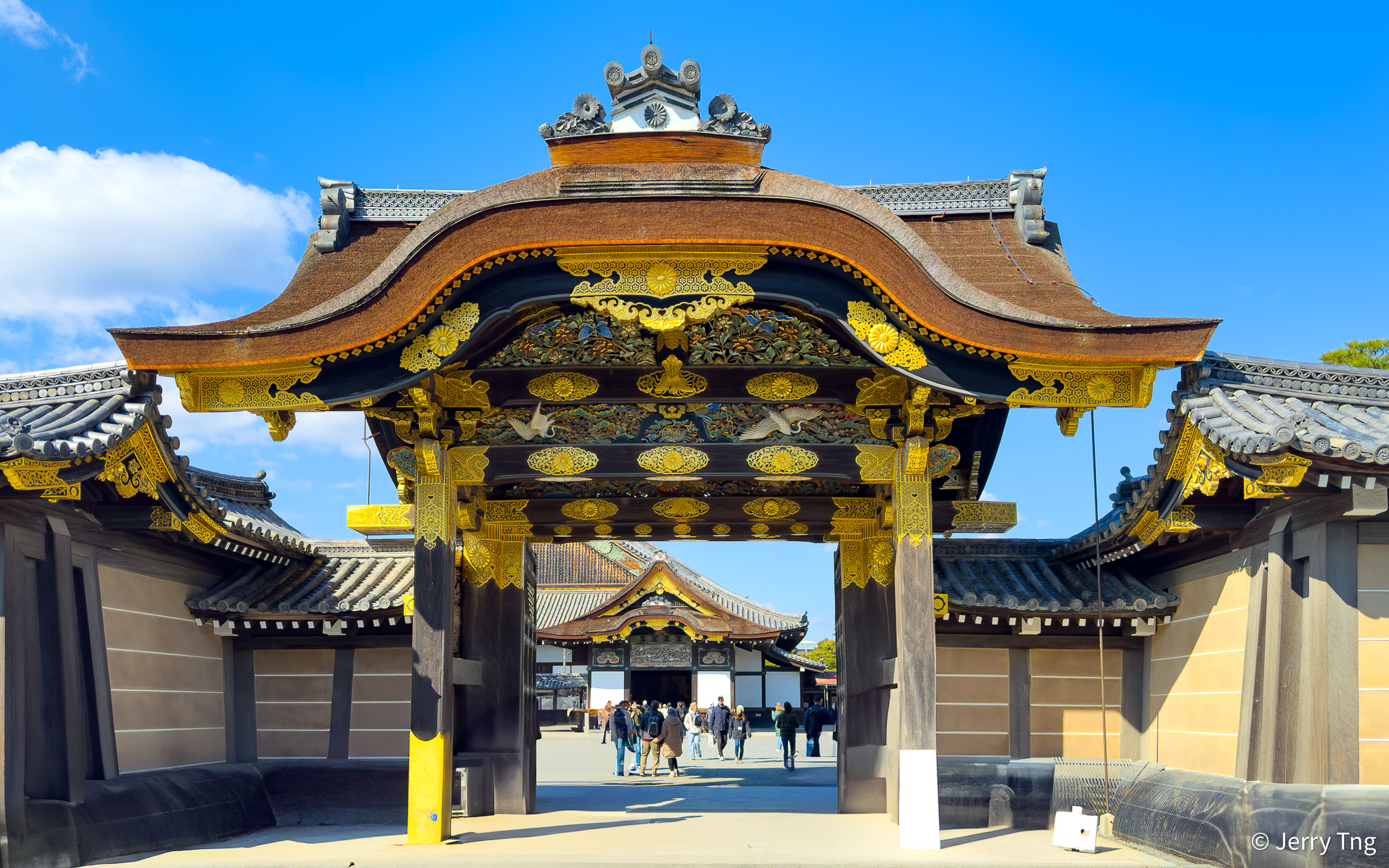
Nijo Castle, or Nijōjō 二条城, was built in 1603 as the Kyoto residence of Tokugawa Ieyasu 徳川家康, the first shogun of the Edo Period (1603-1868). His grandson Iemitsu completed the castle’s palace buildings 23 years later and expanded the castle by adding a five storey castle keep1.

After the Tokugawa Shogunate ended in 1867, Nijo Castle was used as an imperial palace for a while before being donated to the city and opened up to the public as a historic site. Its palace buildings are arguably the best surviving examples of castle palace architecture of Japan’s feudal era, and the castle was designated a UNESCO world heritage site in 1994.

Nijo Castle can be divided into three areas: the Honmaru 本丸 (main circle of defence), the Ninomaru 二の丸 (secondary circle of defence) and some gardens around them. The entire castle grounds and the Honmaru are surrounded by stone walls and moats.


Sites and Sights of Nijo Castle 二条城
Higashi Ote-mon 東大手門 | Main Gate

Higashi Ote-mon 東大手門 is the main gate of the former Imperial Palace Nijo Castle. At the time of construction, it was the same two-story building (tower gate) as it is today. During the trip to Nijo Castle by Emperor Gomizuo 後水尾天皇 in 1626 (Kanei 3 | 寛永3年), it is believed that it was rebuilt into a single-layer gate out of consideration not to look down on the emperor from the second floor. The current gate was built in 1662 (Kanbun 2 |寛文2年).
Bansho 番所 | Guardhouse

The guardhouse is drawn in this position of the Kanei Gyoko 『寛永行幸記』picture depicting the Emperor’s visit of 1626 (Kanei 3), but it is known that the current building was built in 1663 (Kanbun 3). In peacetime, Nijo Castle was guarded by samurai called “Nijo Zaiban” 「二条在番」2 dispatched by the Bakufu 幕府 (Shogunate).
Tonan Sumi-yagura 東南隅櫓 | Southeast Corner Tower


In the past, each corner tower was built in the four corners of the inner moat. The corner tower was used as a watchtower and an armoury. The two buildings on the north side were lost due to the great fire of 1788 (Tenmei 8 | 天明8年), so now only the southeast corner tower and the southwest corner tower remain.
Karamon 唐門 | Kara-mon Gate


Karamon 唐門 is the main gate (four-legged gate) of the Ninomaru Palace. The roof is made of cypress bark with a gable, and there is a kara-hafu 唐破風 before and after it.


The inside of this gate is decorated with gorgeous ultra-coloured carvings, such as “Pine, Bamboo, Plum and Crane”「松竹梅に鶴」, which means longevity, and “Karashi”「唐獅子」, a fantasy animal that protects the sanctuary.
Ninomaru-goten 二の丸御殿 | Ninomaru Palace
[国宝 National Treasure]

The Ninomaru-goten Palace was built at the beginning of the Edo period in 1603 (慶長8年) by the Shogun Tokugawa leyasu 德川家康, who brought 130 years of civil war to an end. The Palace served as the shogunal residence during visits to the Imperial capital of Kyoto.

The present form of the Palace dates from the renovations that were carried out by the third Shogun 3代将軍, Tokugawa lemitsu 徳川秀忠, in preparation for an Imperial visit by the Emperor Go-Mizuno-o in 1626.

In 1867 (慶応3年), the fifteenth Shogun 15代将軍, Tokugawa Yoshinobu 徳川慶喜, announced to senior vassals of the feudal lords gathered here at Nijo Castle the handing back of his authority to rule to the Emperor, known as Taiseihokan 大政奉還 (Restoration of Imperial Rule).3 This brought to a close 265 years of rule by the Tokugawa Shoguns, and almost 700 years of samurai rule.

Consisting of six structures, the Palace is archetypical of the shoin-zukuri 書院造domestic architectural style that was perfected at the beginning of the Edo period, and as such is a highly important part of Japan’s architectural heritage. The Ninomaru-goten Palace is designated as a National Treasure, as the only surviving example of a fortified palace complex.

The wall paintings decorating the interior of the Palace were created by members of the Kano School 狩野派, the largest school of painting in Japan for 400 years until the end of the 19th century, and official painters to the Tokugawa Shoguns.4 Highly recommend that you buy the extra admission ticket when you are paying for the castle admission ticket, and enter via the Kurumayose 車寄.

The official audience hall, the Ohiroma 大広間, expresses the power and authority of the Shogun. At the far end of the Palace is the inner sanctum, the Shiro-shoin 白書院, which was the private quarters of the Shogun and to which only a very few were allowed to enter. The rooms here are much smaller, not as imposing and less intimidating, in harmony with their function.
Kurumayose 車寄 | Carriage Entrance

The sumptuous entrance porch (kurumayose in Japanese) of the Ninomaru Palace in Nijō castle, Kyoto, is a symbol of high-ranking social status. It had solid flanking walls, a paved floor and a flight of steps at the far end giving access to the room beyond. This type of architecture was reserved for aristocrats, religious leaders and the top members of the samurai class. Today, it is the paid entrance to the Ninomaru palace, where you have to take off your shoes and walk around in their provided slippers. Must-see when you come to Nijo Castle, so remember to wear socks.
Ninomaru Teien 二の丸庭園 | Imperial Garden

The Ninomaru Garden was renovated by Kobori Enshu 小堀遠州 (a prominent tea master and gardener in the Edo Period) in 1626 in preparation for receiving Emperor Gomizuno. It is recognised as one of the most outstanding examples of existing castle garden works.5

It is located between the two main rings of fortifications, next to the palace of the same name. The garden has a large pond with three islands and features numerous carefully placed stones and topiary pine trees.

Imagine that you are the Shogun and sitting in one of the rooms facing the landscape, it’s like staring at a beautiful landscape painting, which BTW is on the painted sliding walls called Fusuma 襖 in the palace.
Tsurigane 釣鐘 | Hanging Bells

These bells were used to inform the surrounding populace of fires and other emergencies and were hung at the villas housing the Kyoto Shoshidai 京都所司代6, which kind of like a Mayor of Kyoto appointed by the Shogun. The Kyoto Shoshidai was a branch office of the Edo Shogunate chiefly responsible for policing the Imperial Court and the lords of Japan’s feudal domains.

The Kyoto Shoshidai had three villas, the Kamiyashiki to the north side of Nijo-jo Castle, the Horikawa Yashiki, and the Shimoyashiki (also known as the Senbon Yashiki. These bells originate from the Shimoyashiki villa, and are believed to have been transferred to Nijo-jo Castle after the post of Kyoto Shoshidai was abolished in 1867.
Honmaru-goten 本丸御殿 | Honmaru-goten Palace

Honmaru-goten 本丸御殿, located at the centre of Nijo Castle, was built in 1626 (Kanei 3 | 寛永3年) by expanding the site of the castle to the west side of Emperor Gomizuo’s imperial visit during the time of the third shogun Tokugawa Iemitsu.

Unfortunately, the palace built during that time was destroyed by a great fire in 1788 (Tenmei 8 | 天明8年). At the end of the Edo period, the 15th shogun Yoshinobu Tokugawa built a temporary palace on the north side of Honmaru, but it was removed around 1881 (Meiji 14 | 明治14年).7

At the end of the Edo period, the facilities of the new Meiji government and the Kyoto Prefectural Government Office were located in Nijo Castle, and in 1884 (Meiji 17), it became the imperial palace “Nijo Rikyu”.
Otsunegoden 御常御殿 | Gotsune Palace

From 1893 (Meiji 26) to the following year, as part of the redevelopment around the devastated Kyoto Imperial Palace, part of the Katsura Palace Palace in the north of the Imperial Palace (inside the Imadegawa National Gate) was moved to Honmaru, and the current Honmaru Palace was maintained.

After that, the Honmaru Palace played an important role as a facility for the imperial palaces visited by Emperor Meiji 明治天皇 (1867-1912) and his Empress, Emperor Taisho 大正天皇 (1879-1926) and Emperor Showa 昭和天皇 (1901-1989) when they were Crown Princes.
Honmaru Yagura-mon 本丸櫓門 | Honmaru Tower Gate

Honmaru Yagura-mon 本丸櫓門 was built around 1626 (Kanei 3 | 寛永3年), and it is an important gate that defends Honmaru along with the Honmaru West Tower Gate (burned). During the war, a wooden bridge was dropped to prevent the enemy from crossing, and the door covered with copper plates was closed to prepare firearms.

There are also wells and rice warehouses in Honmaru, so they are also prepared for siege. The hole that can be seen in the inner earthen wall is for attacking with guns, and it is truly the posture of the fortress.
Honmaru Teien 本丸庭園 | Honmaru-goten Garden


Tenshukaku 天守閣跡 | Ruins of Tenshu Castle Tower


In the southwest corner of the Honmaru Palace, there was a five-layer keep (5 floors above ground and 1 floor below ground) that was once transferred from Fushimi Castle 伏見城. This keep was destroyed by lightning in 1750 (Kanen 3 | 寛延3年) and was never rebuilt after that. Currently, only the stone walls of the keep remain. From the keep, you can see the Honmaru Palace, the Honmaru Garden, and the city centre of Kyoto.
Seiryu-en 清流園 | Seiryu-en Garden

Seiryu-en 清流園 was established in 1965 (Showa 40 | 昭和40年). During the Edo period, there was a part of the living quarters of Nijo Zaiban 二条在番, which was responsible for guarding Nijo Castle, on the site.

Seiryuen Garden reused the building materials, garden stones, and trees from the remains of the Suminokura 角倉 family residence (now the Bank of Japan Kyoto Branch). The western side of the Shoin, Kountei, the tea room, and the Waraku-an are built, and the west side is a Japanese garden, and the east side is a Western-style lawn garden. It is a Japanese and Western eclectic structure.
Kountei 香雲亭 | Pavilion of Fragrant Clouds

Kountei 香雲亭 was relocated from the former residence of the Father of Japanese Shipping, Ryoi Suminokura 角倉了以 (1554-1614), and usually it is not open to the public. You can only see the exterior from the south side, but in summer and winter, in addition to providing meals in Kountei for a limited time, it is also used as a wedding venue.
Warakuan 和楽庵 | Cabin of Peace and Harmony

Warakuan 和楽庵 was moved here from the former residence of Ryoi Suminokura 角倉了以 (1554-1614) at Takase River 高瀨川 called “Ichinofunairi”「一之船入」8.


The tearoom was donated by Omotesenke 表千家9 and is used as a resting place for visitors to the castle, as well as for holding traditional events such as the Autumn Tea Ceremony.


The teahouse, called Sukiya 数寄屋, was modelled after Zangetsu-tei 残月亭, named so by Toyotomi Hideyoshi 豊臣秀吉, who gazed upon the lingering moon on the upper floor of the two story teahouse.


Princess and I came and rest our feet, enjoying our coffee, hot chocolate and matcha cake with azuki beans.
About Nijo Castle 二条城

Castle opening hours : 8:45 a.m. – 4:00 p.m. (castle closes at 5:00 p.m.)
Reservations required for Honmaru-goten Palace (Reservations)
Here’s a wonderful video with beautiful overhead shots of the site.
Nijo Castle 二条城
541 Nijojo-cho, Horikawa-nishi-iru, Nijo-tori, Nakagyo-ku, Kyoto-shi, Kyoto
Visited Mar 2025 Spring and Dec 2017 Autumn
Footnotes
- A castle keep is the innermost, most strongly fortified part of a castle, often serving as a last line of defense and the lord’s residence. It was typically a large, strong tower or complex of buildings, designed to withstand sieges and attacks. ↩︎
- There were two groups of 50 people per group, and this guard office was one of their stations. In addition to this, there were a total of 9 guardhouses in the castle, including in front of Karamon, around Kita Otemon, and around West Gate, but this is the only one left so far. There are only a few castles in the country that still have guardhouses, such as Edo Castle and Marugame Castle, and they are valuable buildings. ↩︎
- https://livinghistory-nijojo.com/taisei-houkan-nijoujou ↩︎
- There are over 2,000 wall paintings in the Palace, 1,016 of which are designated as Important Cultural Properties by the Japanese government. Differences in architecture and decoration were used to great effect to demarcate the different areas within the Ninomaru-goten Palace. The magnificent Tozamurai suite of rooms at the entrance to the Palace was designed to impress visitors. ↩︎
- https://nijo-jocastle.city.kyoto.lg.jp/introduction/highlights/ninomaru/ ↩︎
- https://en.wikipedia.org/wiki/Kyoto_Shoshidai ↩︎
- https://nijo-jocastle.city.kyoto.lg.jp/introduction/highlights/honmaru/ ↩︎
- https://vocus.cc/article/609ab236fd89780001e8c079 ↩︎
- https://www.omotesenke.jp/initiatives/ ↩︎
0 comments on “Kyoto Nijo Castle 二条城”