
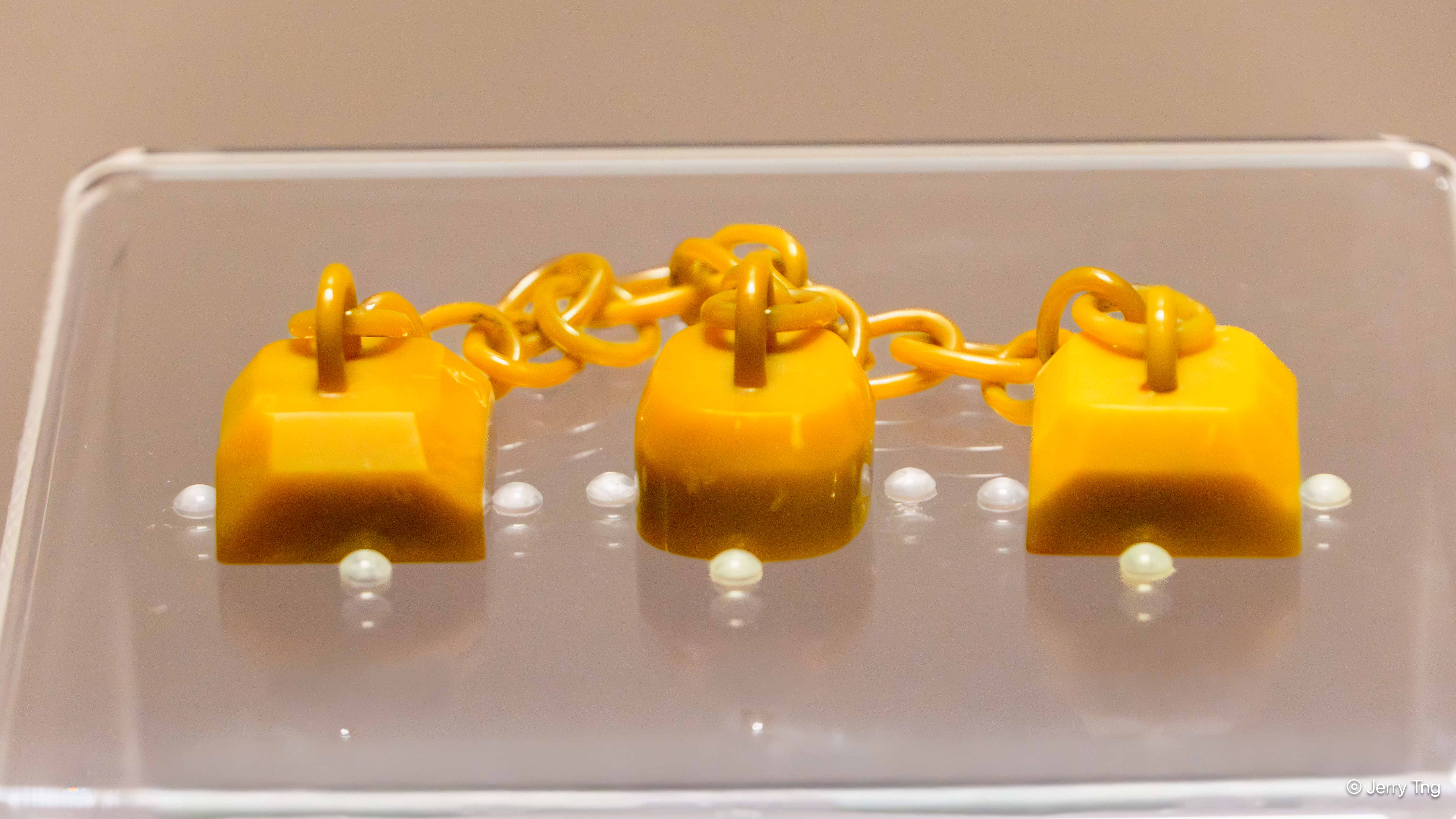
Emperor Qianlong’s Three Connected Stone Seals 三联印 are an exquisite set of imperial seals carved from a single, rare piece of Tianhuang stone (aka “field-yellow” stone 田黃石). The seals are considered among the most treasured and iconic artefacts from his reign and are currently held in the collection of the Palace Museum in Beijing.
Three Connected Stone Seals 三联印
Jade | Qing Qianlong period (r. 1736-1795) | The Palace Museum collection. 玉器|清乾隆(1736-1795年)|(右)“乾隆宸翰”,正方形,高1厘米,边长2.6厘米;(中)“乐天”,椭圆形,高1厘米,长径3厘米,短径2.3厘米;(左)“惟精惟一”,正方形,高1厘米,边长2.6厘米 | 北京故宮博物院藏1

One of the most valuable type of Shoushan stones 壽山石 is the Tianhuang stone because of its rarity. The Tianhuang stone is widely acknowledged as the “Emperor of Stones” and is regarded as being more valuable than gold.2

The triple seal was made by Emperor Qianlong 乾隆皇帝 (1711-1799, temple name Gaozong 高宗, r. 1736-1795) of the Qing Dynasty during his reign. A whole piece of stone is carved into three interconnected chains, and three seals are linked to the chains. The seals feature inscriptions rooted in Confucian philosophy.4

- “乾隆宸翰” (Qianlong’s Imperial Calligraphy) : This seal is the personal seal of Qianlong
- “乐天” (Letian, or Contentment with the will of Heaven)6 : Embodies finding joy in aligning with the natural order. 《周易•系辞》:“乐天知命,故不忧。”
- “惟精惟一” (Only Perfection and Unity)7 : Reflects his approach to governance and the concept of holding the middle way.《尚书•大禹谟》:“人心惟危,道心惟微,惟精惟一,允执厥中”

Abdicated Emperor Xuantong 宣統皇帝 (r. 1908-1912), the last emperor of Qing dynasty, took this treasure out when he left the palace on 23 Oct 1924. In 1950, the now civilian Pu Yi 溥仪 handed it over to the state which was then later entered into the collection of the Palace Museum.8
Yellow Chalcedony Tri-Seal Set 黃玉髓三連章
Jade | Qing dynasty (1644-1912) | National Palace Museum collection. 玉器|清乾隆(1736-1795年)|二方印長2.6公分 寬2.6公分 高2.35公分;橢圓形印長3.4公分 寬2.3公分 高2.9公分|國立故宮博物院藏

In Taipei’s National Palace Museum is a set of uncarved tri-seal set made from the same Tianhuang stone as the Emperor Qianlong’s seals. The size and shapes are identical to the Qianlong’s seals, but slight taller perhaps because they were brand new and uncarved.
Yellow fabric box with clouds and Shou medallions 裱黃地朵雲團壽紋錦方盒
Cardboard, Silk, Cotton | Qing dynasty (1644-1912) | National Palace Museum collection. 紙、絲、棉|清乾隆(1736-1795年)|盒長10.7公分 寬8.7公分 高5.9公分|國立故宮博物院藏

It was found together with a beautiful box, and both were taken to Taiwan with the retreating Nationalist forces.
The Qianlong seals were part of the 100th anniversary exhibition in Beijing’s Palace Museum. The uncarved seals and box are part of the permanent exhibition of National Palace Museum.
About Chinese Treasure Series


中華國寶系列 Chinese Treasure series feature specific artefacts and relics from museums all around the world that are historically significant to be considered a National Treasure. The series covers the 5,000 years of Chinese civilisation from Neolithic periods before the Xia dynasty (c. 2070-1600 BC) to modern day.

Footnotes :
- 田黄石乾隆帝三联印,左“乾隆宸翰”,正方形,高1厘米,边长2.6厘米;中“乐天”,椭圆形,高1厘米,长径3厘米,短径2.3厘米;右“惟精惟一”,正方形,高1厘米,边长2.6厘米。
此玺是清高宗乾隆皇帝做太上皇时所镌。系由一块相当大的田黄石雕刻而成。三方印链连在一起。
玺文“惟精惟一”、“乐天”皆出于儒家经典。以“惟精惟一”为文之玺在乾隆早期即有多方,常与“奉三无私”、“乾隆宸翰”一同使用。“惟精惟一”出自《尚书·大禹漠》:“人心惟危,道心惟微,惟精惟一,允执厥中。”即危则难安,微则难明,故戒以精一,信执其中。乾隆以此表明其施政思想。“乐天”之义取自《周易·系辞》:“乐天知命,故不忧。”义即“顺天施化是欢乐于天,识物始终是自知性命,顺天道之常数,知性命之始终,自然之理,故不忧也。”
这三玺的篆刻方式与玺文布局均有不同。“乾隆宸翰”为阳文篆刻,布局章法为传统标准格式。“乐天”亦为阳文,两字居中,左右饰以螭纹,使玺面富有动感。这种字、画结合的形式是汉印的遗风。“惟精惟一”为阴文篆刻,印文用汉代私印形式,采取回文法排列,错开相同的两个“惟”字与延长两字上端一笔都是为取得整个印面饱满匀称、和谐美观的效果。
此三联玺在乾隆帝上千方的小玺中备受青睐,以后各帝亦十分珍视。清末代宣统皇帝溥仪被逐出宫时携出此印,且随身不离,至1950年方将其交出,经有关机构移交北京故宫博物院收藏。https://www.dpm.org.cn/collection/seal/234698.html, accessed 20 Nov 2025 ↩︎ - https://www.lyonandturnbull.com/stories/qing-dynasty-tianhuang-seal, accessed 20 Nov 2025 ↩︎
- Qianlong, a stamp aficionado, wrote this. The characters in the seal are 乾隆宸翰.
乾隆 is his era name. 宸翰 means calligraphy and handwritten works by emperors. https://www.reddit.com/r/translator/comments/1d6b1ys/chinese_script_to_english/, accessed 20 Nov 2025 ↩︎ - 三联印为清高宗乾隆皇帝在位时所制私印。由一整块石料经镂雕成为三条活链,井连缀三枚印章。印文分别为“乾隆宸翰”“乐天”以及“惟精惟一”。“乐天”语出《周易•系辞》:“乐天知命,故不忧。”“惟精惟一”语出《尚书•大禹谟》:“人心惟危,道心惟微,惟精惟一,允执厥中” Museum information card, Nov 2025 ↩︎
- Qianlong, a stamp aficionado, wrote this. The characters in the seal are 乾隆宸翰.
乾隆 is his era name. 宸翰 means calligraphy and handwritten works by emperors. https://www.reddit.com/r/translator/comments/1d6b1ys/chinese_script_to_english/, accessed 20 Nov 2025 ↩︎ - 《周易•系辞》:“乐天知命,故不忧。” 意思是乐于顺应天道、明白天命的安排,所以不会忧愁。这是一种人生修养的境界,强调接受命运的安排,不因祸福得失而烦恼,保持心境的坦然与平和。https://zhuanlan.zhihu.com/p/28762476, accessed 20 Nov 2025 ↩︎
- 《尚书•大禹谟》:“人心惟危,道心惟微,惟精惟一,允执厥中” 意思是人心险恶难测,道心幽微难明,只有一心一意地(惟精惟一),诚信地(允执)坚守中正之道(厥中),才能治理好国家。这句话是舜帝告诫大禹的箴言,强调了修身、治国需要保持内心纯正和恪守中庸之道。https://www.guwendao.net/mingju/juv_789ec90ef52e.aspx, accessed 20 Nov 2025 ↩︎
- 1924年,逊帝溥仅出宫时将此宝携出。1950年,溥仪将其上缴国家,后入藏故宫博物院。Museum information card, 20 Nov 2025 ↩︎
0 comments on “Treasures – Emperor Qianlong’s Three Connected Stone Seals (Qing Dynasty)”