
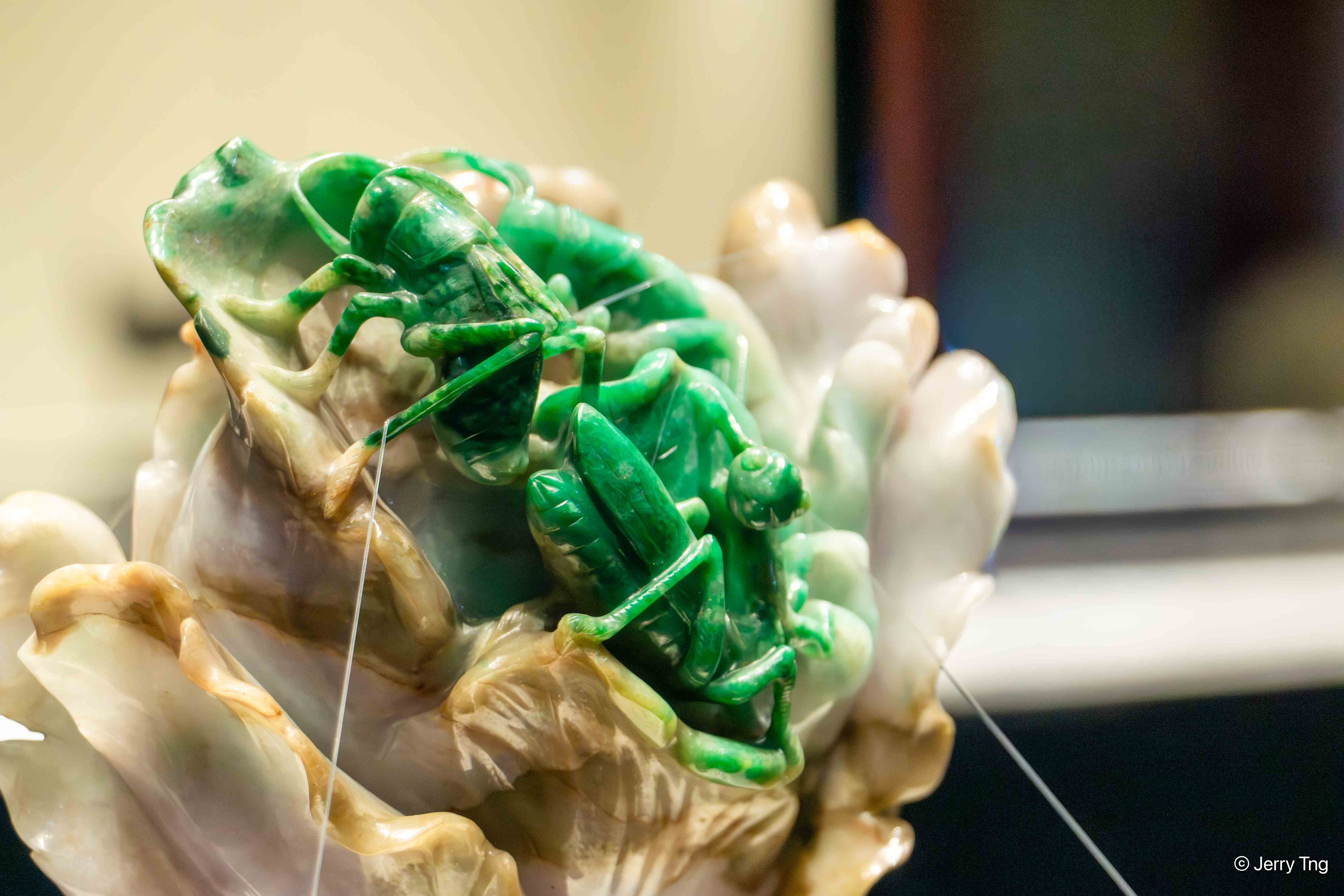
While everyone is infatuated with the jadeite cabbage in National Palace Museum in Taipei, there’s one in Tianjin Museum that has been largely ignored and underrated until recently.
Jadeite Cabbage with Katydids 翡翠蝈蝈白菜
Jade | Qing dynasty (1644-1912) | Tianjin Museum collection. 玉器|清(公元1644年-1922年)|天津博物館藏


This Jadeite Cabbage with Katydids 翡翠蝈蝈白菜 is the biggest amongst the five Qing jade sculpture in the collection of public museums. It is skilfully carved by using the natural colour differences of the material. The lower part of the cabbage is greyish-yellow, accompanied by brown spots. The leaves on it have distinct veins and are curled. The conception is ingenious, the skills are superb, and the whole sculpture is lively, realistic, and full of interest. It is considered one of the best jade carving in the Qing Dynasty.1


The sculptor did not reject the flaws of material, a half-green and half-white jadeite, given to him. He saw through the blemishes and carved a cabbage that has been defrosted, with whites the purity of the bride, and blessed her with children and grandchildren through the insects.2


The sculptor uses the emerald green material at the centre of the vegetable to carve a pair of katydids 蝈蝈 and a praying mantis 螳螂 that seem to crawl and gnaw on vegetable leaves. The painter does not hide the traces of insects, but let them stand on the leaves, eat, fly and jump between the leaves, so as to show the rhythm of life and the harmonious coexistence of all things in nature.

Although it is said that the association between the material of jadeite and the form of cabbage only began to become popular in the middle and late Qing dynasty, the theme relating cabbage and insects actually can be traced back to Yuan to early Ming dynasty (13th-15th c.), when they were quite common and a popular subject for its auspiciousness.3

According to records from Eastern Han dynasty, the word jadeite 翡翠 comes from the name of a bird. The male bird’s feathers are red, also known as “Fei” 翡, and the female bird’s feathers are emerald green, so it is called “Cui” 翠.4
In the field of Chinese art, the Chinese cabbage has been the subject of paintings since the Song Dynasty because of its associated with the commoner. The cabbage theme has its own meaning in the eyes of different status of people. Emperors seek to be humble and simple, and to provide for the people. The bureaucrats associate it with humility and void worldly needs.


Burmese jadeite 缅甸玉 were sent to the palace as a tribute and became popular at the late Ming Dynasty, early Qing Dynasty. They were the favourite material of Qing Emperor Qianlong and loved by Empress Dowager Cixi, and was known as “royal jade”5, hence the number of artefacts made from jadeite in the Qing royal collections.
About Chinese Treasure Series


中華國寶系列 Chinese Treasure series feature specific artefacts and relics from museums all around the world that are historically significant to be considered a National Treasure. The series covers the 5,000 years of Chinese civilisation from Neolithic periods before the Xia dynasty (c. 2070-1600 BC) to modern day.

Footnotes :
- 利用材质的天然色彩差异巧作雕成。白菜的下部分为灰黄色相间,伴有褐色斑,其上的叶脉分明,叶片翻卷,形象逼真,刀法简约。作者利用菜心处材质的翠绿色,圆雕一对大腹蝈蝈和一只好像边爬边啃菜叶的螳螂,构思巧妙,工艺技巧高超,整体鲜活灵动,生趣盎然,在清代玉雕中堪称冠绝。Museum information card, Nov 2025 ↩︎
- 展覽概述 人生真滋味—玉白菜
大、小白菜均原產於亞洲,是最尋常的食物。而在中國藝術領域,白菜自宋代開始入畫。畫家不掩蟲跡,讓它們在菜葉停佇、囓食,畦間飛翔、跳躍,以現生命律動及自然萬物和諧共存的理念。而後,白菜主題在不同人的眼中各有意義!君王以白菜自省,享天下供奉,理當讓子民食衣飽足、面無菜色。文人則以白菜明志,不受虛榮利祿,知足常樂。而最圓滿的是,巧匠不嫌棄玉材有瑕有璺、半綠半白,只想它一如經霜雪的白菜,正似新娘的純潔清白,並祝福她子孫綿延。國立故宮博物院著作權所有 https://theme.npm.edu.tw/exh105/NorthandSouth-3/ch/index.html, accessed 21 Nov 2025 ↩︎ - https://web.archive.org/web/20081201033441/http://www.npm.gov.tw/en/collection/selections_02.htm?docno=867&catno=16&pageno=2, accessed 21 Nov 2025 ↩︎
- 翡翠的名称来自鸟名,这种鸟的羽毛非常鲜艳,雄性的羽毛呈红色,名翡鸟,雌性的羽毛呈绿色,名翠鸟,合称翡翠,十四世紀時,緬甸玉傳入大明後,在漢語世界就冠以「翡翠」之名。https://zh.wikipedia.org/wiki/翡翠, accessed 21 Nov 2025 ↩︎
- 这件展品是充分地利用材料的天然成色差异巧做雕工而成的,做工非常精细。翡翠一词来源于一种鸟名。东汉时《说文解字》中对翡翠的解释是这样的:“翡,赤羽雀也,翠,青羽雀也”,这种鸟身姿玲珑,叫声清脆,雄鸟的羽毛是红色的,也称“翡”鸟,雌鸟的羽毛是翠绿色的,故称“翠鸟”,”,它们的毛色鲜艳美丽,人们常以翡翠鸟的羽毛做装饰。到了明末清初,缅甸的一种玉石作为贡品被送入皇宫,因这种玉石兼有红绿两色,恰与翡翠鸟的羽毛颜色相似,因此,人们便将这种缅甸玉称为翡翠。翡翠在清代时受到乾隆皇帝的推崇和慈禧太后的喜爱,被称为“皇家玉”,自此,它身价百倍,成为玉中极品。这件展品用翡翠雕刻的是一件白菜,上面攀附着两只蝈蝈和一只螳螂,形象生动。制造者技艺高超,设计精妙,把最好的绿色都集中表现在三只昆虫上,我们称之为“巧雕”。而作者又巧妙的把原石的绺裂回避到器物的后面,构思之精,令人感叹。Museum information card, Nov 2025 ↩︎
Pingback: Treasures – Jadeite Cabbage (Qing Dynasty) – live2makan