
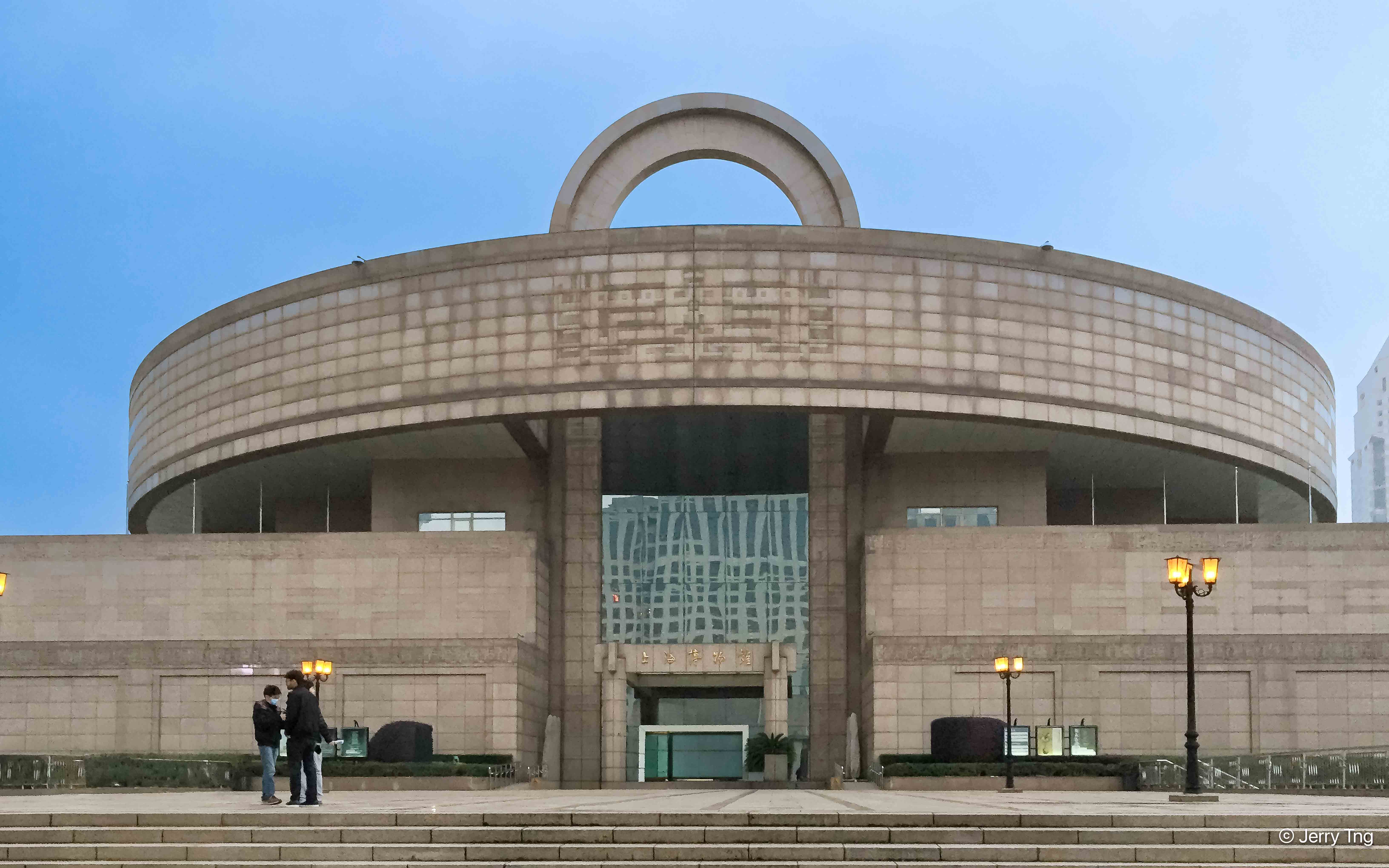
It used to host the best Shang and Zhou bronzeware collection which has since been moved to the Shanghai Museum East in Pudong.

The Shanghai Museum has a lot of sentimental value for me as this was the first Chinese museum I visited and launched my immense interest in Chinese bronzes and other artefacts. The Museum is open in 1996 with 29.5 meters high and 39.200m² with five floors. It was designed by Xing Tonghe 邢同和 in the shape of a bronze tripod known as the ding 鼎 with the modern interpretation of “round sky, square earth” 天圆地方.


Located in the People’s Square in Huangpu district, it had to move from the old location because of an ever-increasing collection of artefacts and artworks from public donations.

The museum’s facade, featuring artful sculptures and stone lions from the Han (206 BC-AD 220) and Tang (AD 618-907) dynasties, showcases the splendour of Chinese culture.


More than just a repository of treasures, Shanghai Museum also plays a vital educational role. Between 2010 and 2012 alone, the museum hosted an average 200 public lectures a year. Due to its recent expansion to Pudong, currently only two permanent exhibitions remain in the museum:
- Chinese Minority Nationalities’ Art Gallery
- Chinese Ming and Qing Furniture Gallery
Chinese Minority Nationalities’ Art Gallery

The Kadoorie Gallery of Chinese Minority Nationalities’ Art at the Shanghai Museum showcases over 600 pieces of art and craft from China’s diverse ethnic groups, offering an immersive look into regional cultures. Located on the fourth floor, this 700 m2 space features six sections, including textiles, metalwork, and costumes representing regions like Yunnan, Xinjiang, and Inner Mongolia. Items include a wooden dragon head from the Miao ethnic group, traditional musical instruments like the Kazak dombra and Mongolian morin khuur, and intricate textiles.

The Kadoorie family (owner of the Peninsula hospitality chain) is a wealthy Hong Kong-based family, originally Jews from Baghdad in Iraq. From the mid-18th century, the family was established in Bombay, becoming one of the wealthiest families in Asia. Their businesses were subsequently centred in Shanghai from the mid-19th century, and then in Hong Kong from the 20th century onwards. The Kadoorie family donated US$500,000 for the construction of the new Shanghai Museum.2
Chinese Ming and Qing Furniture Gallery
The Shanghai museum is extremely famous for their Chinese furniture collection, many of which were donated by Wang Shixiang (1914-2009), one of the greatest scholars of Ming and Qing furniture. Most of the displays resembles room settings.

The Chinese Ming and Qing Furniture Gallery is set with more than 100 masterpieces of Ming and Qing furniture in a space of 700 m2, which shows the artistic style and heyday of Chinese furniture-making during Ming (1368 – 1644) and Qing (1644 – 1911) dynasties. Meanwhile, two scenarios of a reception room and a study room of the Ming-Qing period reconstructed in the gallery demonstrate how the traditional furniture was used and arranged.

Ming furniture is treasured for its precious wood, comfortable design, simple decoration and superb craftsmanship. Often completely unornamented (although the complete range of decorative degree does exist), they obtain their stunning effect principally through their perfection of line, and their magnificent hardwood material (left on view through a clear finish, not covered in lacquer as with so much Chinese furniture, then and especially later).

In addition, their joinery represents the most elaborate development of the miter, mortise and tenon ever developed anywhere. They hold pieces together without the use of any glue, enabling the pieces to be disassembled at will, important in a setting where the owners (mostly mandarins) needed to relocate on a regular basis, and where most transport was via animal.

Lacquerware, Collection of Shanghai Museum
There were 3 stages of Qing furniture (1644-1911). The first was similar to the Ming style. The second stage concentrated on oversized furniture made of various types of wood. The third state was marked by a decrease in the quality of workmanship. The museum attributes this change to the influence of western culture.
Temporary Exhibitions

These days, the museum is used to host temporary thematic exhibitions that included this recent super-popular exhibition of Egyptian relics.
Boar-Shaped Bronze Zun ( Wine Vessel ) 商豕形铜尊
Bronzeware | Shang Dynasty ( ca.1300-1046 BC) | H: 40cm, L: 72cm, Wt: 30kg | Collection of Hunan Provincial Museum. 铜器 | 晚商(约公元前1300-10146年)| 高40cm、全长72cm 、重3公斤|湖南省博物馆藏3

Shi zun 豕尊 is an ancient Chinese ritual bronze zun vessel, shaped like a boar, from the late Shang dynasty (1600–1046 BC). It was excavated in 1981 from Chuanxingshan, Xiangtan County, Hunan and now is preserved in the Hunan Museum. It is shaped like a wild boar with two tusks. It has an oval opening on the top and a hollow interior. Its whole body is decorated with patterns of scutes, clouds, dragons and animal faces.
Elephant-Shaped Bronze Zun Vessel 商铜象尊 (Shang Dynasty)
Bronzeware | Shang Dynasty ( ca.1600-ca.1050 B.C.) | H: 22.8 cm, W: 14.4 cm, L: 26.5 cm | Unearthed in 1975 from Shixing Mountain, Liling City | Collection of Hunan Provincial Museum. 铜器 | 商(约公元前1600-约1050年)| 1975年出土于湖南省醴陵市狮形山|湖南省博物馆藏4

This elephant-shaped bronze zun vessel was in its day a wine container, with the trunk serving as a spout. Through the oval-shaped opening on its back, wine can be poured in. Dating back to the Shang Dynasty (c.16th century-11th century BC), it was of artistic and practical value. A phoenix and a tiger are cast at the very tip of the trunk, while the elephant’s forehead features a pair of spiral snake patterns. Dragon and beast mask patterns adorn the whole vessel, reflecting the magnificent and unique craftsmanship of that time. Unearthed from Liling county, Zhuzhou city, Hunan province, in 1975, the vessel is believed to have been essential to sacrificial rituals more than 3,000 years ago. It is now in the permanent collection of the Hunan Museum.
Highlights of the Exhibits
Before the bronzes were moved to Shanghai Museum East, the museum housed one of the most comprehensive collection of Chinese bronzes, thanks to the ex-Museum Director, the late Ma Chengyuan 马承源.
Narra Wood Screen, Throne Chair and Rectangular Table With Engraved Cloud And Dragon Design 紫檀木雕云龙纹宝座、长方桌 (Qing Dynasty)
Wood | Qing Dynasty (1644-1912) | Shanghai Museum Collection. 木|清(1644年-1912年)|上海博物馆藏

This is an 18th Century imperial setting with a painting table, throne chair, and five-panel screen, all made of zitan (purple sandalwood). The scene is flanked by a pair of large 18th Century cloisonné enamel cranes that were used as candle prickets. The screen is made of red lacquered wood with an inlaid design featuring jade and other materials, typical of the luxurious style of the mid-Qing period. The table and chair feature intricate carvings, including dragon and cloud motifs, a more baroque influence compared to the simpler Ming dynasty style.
About Shanghai Museum People’s Square

Shanghai Museum started in 1952 at Nanjing Road.5 After several decades of political and social upheavals6, the collections increased steadily and the old building couldn’t house all the artefacts. The last director Ma moved the museum to its current location and raised funds to rebuilt the Shanghai Museum.
Shanghai Museum People’s Square
Opening Hours:
- Tuesday to Sunday, 09:00 – 17:00 (last entry at 16:00)
- Closed on Mondays (except national holidays)
- Reservation for individual visitors is not required.
Address:
No. 201 Ren Min Da Dao, Huangpu District, Shanghai
All photo taken at Shanghai Museum Jan 2016 and Apr 2018, unless otherwise noted.
Footnotes :
- https://iscc.marinersmuseum.org/watercraft/tatara/. The tatara, as well as the larger ipanitika, is regarded as an extension of a man’s body. Boat making is a sacred mission for the Yami. The traditional colors of the canoes are red, from lateritic soil; black from soot on the bottom of cooking pots; and, white from lime.
Every piece of wood used in the construction of the canoe is fresh cut from live trees. It is taboo to use any dead wood in boat construction.
– James Davidson, 1903
The Island of Formosa Past and Present ↩︎ - https://en.wikipedia.org/wiki/Kadoorie_family, accessed 27 January 2026 ↩︎
- The Boar-shaped Bronze Zun unearthed in Chuanxing Mountain of Jiuhua Village in Xiangtan County in 1981 is in vivid boar shape with strong legs, round buttocks and belly, 40cm high and 72cm long. The boar is standing up, with an oval hole on its back. A lid is arranged on the hole, with a standing bird as its lifting handle. On the head the beast mask is cut in intaglio; the surface of belly, back and cover is decorated with scale and shell pattern; inverted Kui pattern is cast on the limbs and buttocks. The vessel with an empty tubular belly has the capacity of thirteen liters.
It is the only relics in the existing bronzes of Shang Dynasty that is in the shape of a boar. Apart from its vividness, what’s more distinctive of the vessel is that the holes on the front and rear elbow are in alignment and there are circular tubes in the diameter of 1.4cm therein. It is speculated that ropes can thread through the circular tubes, thereby facilitating the moving of the bronze, from which we can see the full consideration into the shape design. https://artsandculture.google.com/asset/boar-shaped-bronze-zun-wine-vessel/oAFDHYp_yUKgGA?hl=en, accessed 27 January 2026 ↩︎ - This Zun is a kind of wine vessel in the shap of an elephant. The nose of the elephant connected with its belly could be used as a flowing mouth. It can be filled with wine from an oval opening on the back of the elephant. It is a bronze vessel with both artistic and practical value. Among several Elephant-shaped Bronze Zuns we found, this is the only one for which we know the exact unearthed place. Although the Elephant-shaped Bronze Zuns collected by the Freer Gallery of Art in the USA and National Museum of Asian Art-Guimet in France are unearthed from Hunan province, we don’t know clearly where they were unearthed. While the body of this vivid Elephant-shaped Bronze Zun is shorter than a real elephant since craftsmen intentionally shortened the body when making it, the artwork still looks vivid and lively, reflecting the skill of the craftsmen. The body of the elephant is covered with designs of dragon, phoenix, tiger and beast masks. The most remarkable part are the designs of a phoenix and tiger on the nose of elephant, which not only resulted in elegant phoenix and tiger designs but also kept the original feature of the elephant’s nose. So its decorative art is really special and unique.
At the top of the design, two small elephants with curled noses stand on the two sides of the bronze Nao. The left, middle and right sides are decorated with six tigers, six fishes and eleven nails. The design of the elephants is abstract and mysterious, but looks very vivid and realistic. With complicated and breathtaking design, this is a masterpiece of bronzes of Shang Dynasty. https://artsandculture.google.com/asset/elephant-shaped-bronze-zun-wine-vessel/OwEyafU0AVT-Ng?hl=en, accessed 27 January 2026 ↩︎ - Zhang Kun, Pudong expansion of museum continues apace. Published: 16:24, July 5, 2024, China Daily.
The Shanghai Museum was founded in 1952 and had its first home at 325 Nanjing Road West, the location of the Shanghai Race Club in the 1930s. In 1959, the museum moved to 16 Henan Road South, another historical building dating to 1934. https://www.chinadailyhk.com/hk/article/587478, accessed 27 January 2026 ↩︎ - Zhang Kun, Pudong expansion of museum continues apace. Published: 16:24, July 5, 2024, China Daily.
A total of 2,853 artifacts collected by the People’s Liberation Army during the war to liberate Shanghai were also given to the museum. The museum’s collection swelled in the postwar period with donations that included precious artifacts from the family of late Qing Dynasty (1644-1911) art collector Pan Zuyin. https://www.chinadailyhk.com/hk/article/587478, accessed 27 January 2026 ↩︎
0 comments on “Shanghai Museum People’s Square”