
If you have only one hour to spare, do not miss this permanent exhibition in the Tianjin Museum. The items are placed in chronological order.
Selected Rare Relics 耀世奇珍
Jade Pig-Loong 玉猪龙

Jadeite | Hongshan Culture, Neolithic Age (c.6,000-5,000 years ago) | Tianjin Museum collection
玉器 | 红山文化,新石器时代(约6000-5000年前) | 天津博物馆藏
The jade pig-headed dragon has a tall, prominent head with large, wide-open eyes, multiple wrinkles on its nose, and protruding, closed lips that face the tail. There is a notch between the head and tail, and a pair of drilled holes in the neck. Its style is simple and robust, possessing a strong spiritual quality. This mythical beast with a pig-headed dragon body was likely a deity worshipped by the Hongshan Culture people. The jade pig-dragon is a representative jade artifact of the Neolithic Hongshan Culture. This piece is plump, with a warm, lustrous jade texture and exquisite carving; it is one of the largest and most beautiful pieces of its kind.1
Bronze Jue (Wine Vessel) 铜爵

Bronzeware|Erlitou Culture (c.1750-1530 BC) | Tianjin Museum collection.
铜器|二里头文化时期(约公元前1750-1530年)|天津博物馆藏
Flat-bottomed, thin-walled, with a long spout and short tail, and perforated lower belly, it was cast entirely from a single mold. Its form is primitive and its style simple; it is one of the earliest bronze vessels found in China. In the 1960s, cultural relics workers collected it from scrap copper at the Tianjin Electrolytic Copper Plant.2 (My theory is that the artefact was rescued from the scraps during the Great Leap Forward, but no further information was given so it remains a theory.)
Oracle bone with inscription meaning “The parturition of the woman named Jing” 商武丁帚(婦)姘(娩)卜骨

Bones | Wuding period of Shang Dynasty (1250-1192 BC) | Tianjin Museum collection.
骨|商 武丁(公元前1250-1192年)|天津博物馆藏
The oracle bone inscription on this piece is quite complete, containing a preface, a divination statement, a prophecy statement, and a verification statement. The verification statement records that a woman gave birth to a male infant on a Xin day in the second month of a certain year. The word “(女力)” is interpreted as “auspicious.” The fact that giving birth to a boy was considered auspicious reveals the Shang royal family’s preference for sons over daughters at that time.3
释文:正:(1)壬成卜,亘,真受⋯二三小告[四]二告口口告。(2)口口卜,爭,貞帚姘罷(娩),(女力)?[王曰:其]佳庚露(娩),(女力)。旬辛【口帚姘】 (娩),允(女力)。二月。反:⋯佳庚(娩),(女力)。
Note: According to research, King Wu Ding of the Shang Dynasty had three queens: Fu Pin (also known as Bi Wu), Fu Hao (also known as Bi Xin), and Bi Gui, collectively referred to as the “Three Consorts of Wu Ding.” Fu Pin held a very high position in the Shang royal family. She was likely the biological mother of Zu Ji, Zu Geng, and Zu Jia. The famous Simuwu Ding (also known as the Houmuwu Ding, now in the National Museum of China) was cast to commemorate her.4
Oracle shell with inscription meaning “Sacrifice of 300 Qiang people to the Lord Ding” 三百羌用于丁卜甲

Bones | Wuding period of Shang Dynasty (1250-1192 BC) | Tianjin Museum collection.
骨|商 武丁(公元前1250-1192年)|天津博物馆藏
The using of human sacrifice in ritual performance in Shang China is one of the critic questions in the studies of the history of Shang Dynasty. It has been long that the experts of the oracle bone inscriptions usually focus on understanding the worshiping terminologies and the ways of killing in the context of writing information, field archaeologists on the other hand, pay more attention to the descriptions of the skeleton remains unearthed in sacrificial pits.5
释文:
(1)口⋯H⋯牢⋯(2)三百羌用于丁。二(3)[癸]卯卜,[貞]翌丁未⋯畓⋯•(4)[乙]已卜,貞束于[大]甲,亦于[丁,羌]卅,卯十]宰,用。
Note: The inscription on this oracle bone records the sacrifice of three hundred Qiang slaves to the former King Ding of the Shang Dynasty, and the inquiry as to whether to use thirty Qiang slaves and ten sheep, specially prepared for sacrifice, to sacrifice to the former King Da Jia and King Ding. Formerly in the collection of Wang Xiang.6
Bone Jue (Wine Vessel) 骨爵

Bone, turquoise | Shang Dynasty (c.1600-1046 BC) | Tianjin Museum collection
骨器、绿松石 | 商代(约公元前1600-1046年) | 天津博物馆藏
Made of animal bone, the entire body is stained with soil. It has a spout at the front and a tail at the back, with an everted rim. Near the spout are symmetrical pillars. The round belly is slightly deep, with a handle on one side and three conical feet underneath. The belly has ridges on three sides, and animal face patterns are carved on both sides, with turquoise inlaid around the eyes.7
Bronze “Ke” Ding (Cooking Vessel) 克鼎

Bronzeware | Western Zhou Dynasty (1046-771 BC) | Tianjin Museum collection
铜器|西周(公元前1046-771年)|天津博物馆藏
It has two upright ears, a flat lip, six short flanges on the neck, a slightly bulging and drooping belly, and three animal hoof-shaped feet. The ears are decorated with kui dragon patterns, the neck with interlaced patterns, the belly with ring patterns, and the upper part of the hooves has short flanges decorated with animal face patterns. An inscription of seventy-two characters in eight lines is cast inside the belly wall, recording that in the ninth month of the twenty-third year of King Li of Zhou, the king ordered Ke, a close minister in charge of military affairs, to inspect and reorganize the army stationed in Chengzhou. Donated by Zhang Binghui, granddaughter-in-law of Xu Shichang.8
Taibao Ding Cast by the Duke of Shao during the reign of King Cheng of Zhou 太保鼎 (National Treasure)

Bronzeware | Western Zhou Period (1046 BC-771 BC) | H: 57.6 cm, L: 35.8 cm, W: 22.8 cm | Unearthed in Liangshan County, Shandong, c. 23rd year of Qing Jiaqing (1843) | Tianjin Museum Collection. 铜器|西周(公元前1046-前771)|通高57.6厘米,长35.8厘米,宽22.8厘米|清道光23年山东梁山出土|天津博物馆藏
The Taibao Ding is an important bronze ritual cauldron from the Western Zhou Dynasty, specifically commissioned by the Duke of Shao (Shao Gong Shi 召公奭) during the reign of King Cheng of Zhou 西周成王 (or possibly the subsequent King Kang). Ritual bronze vessels like the ding were symbols of power and status and were used for cooking and offering food to ancestors in religious ceremonies. The Taibao Ding is distinguished by its elegant design, featuring elongated legs with disc decorations and intricate taotie motifs. The vessel is a prominent cultural relic and is currently held by the Tianjin Museum.
For more details, please follow the link >> Taibao Ding
Bronze Zhu Ke (Caster) Ladle 铸客勺


Bronzeware | Warring States Period (475-221 BC) | Tianjin Museum collection
铜器 | 战国时期(公元前475-221年) | 天津博物馆藏
This artefact dates back to the Zhou Dynasty. It is entirely plain, with a hollow, cylindrical, upright handle that can accommodate a wooden handle. The spoon has a shallow belly with slightly upturned shoulders on both sides, and a straight, shovel-shaped rim, giving it a unique and distinctive shape. The outer wall of the handle is cast with a seven-character inscription: “Made by Gong Pan Ye (野) Qin Kou.” This inscription indicates that the artifact reflects the bronze casting techniques and artisan management system of the Warring States period. The artifact is relatively large, possessing both practical function and artistic value, and provides important material evidence for the study of measuring instruments and inscription systems during the Warring States period.9
Jade Ornament With Inscription On The Circulation Of Qi 行气铭玉饰

Jadeite | Warring States Period (475-221 BC) | Tianjin Museum collection
玉器 | 战国时期(公元前475-221年) | 天津博物馆藏
The object is a twelve-sided prism with a circular hole at its center, extending from bottom to top but not yet fully penetrated. The surface is inscribed with forty-five characters in seal script: “Circulating Qi, when deep, it accumulates; when accumulated, it extends; when extended, it descends; when descended, it settles; when settled, it solidifies; when solidified, it sprouts; when sprouting, it grows; when growing, it recedes; when receding, it reaches Heaven; Heaven’s spring is above, Earth’s spring is below. Following the natural order brings life, going against it brings death.” This describes the entire process of breathing and circulating Qi, and is the earliest record of Qigong practice in ancient my country, possessing extremely high scientific and philological value.10
Jade Bi (Disc) with Grain Pattern And Double Chi-Loongs Design 谷纹双螭纹玉璧

Jadeite | Eastern Han Dynasty (25-220) | Tianjin Museum collection.
玉器 | 东汉时期(公元25-220年) | 天津博物馆藏
The upper edge features symmetrical double dragons with raised eyebrows and eyes. The dragons’ bodies are decorated with small circular patterns and fine, flowing lines, while the body of the disc is carved with nipple-shaped grain patterns in relief. The disc has a unique shape, exquisite and ingenious carving, and superb craftsmanship. It employs a variety of techniques, including openwork and bas-relief, which are extremely rare in Han Dynasty jade discs. It is a masterpiece among similar artefacts from the Eastern Han Dynasty.11
White-Glazed Double-Bellied Vase With Double Dragon-Shaped Handles 白釉龙柄双联传瓶 (National Treasure)

Pottery | Sui Dynasty (580-618) | H: 18.5 cm, D (mouth): 2 cm, D (base): 2.5 cm, D (body): 11 cm | Tianjin Museum collection.
陶瓷 | 隋(公元580年-618年) | 高18.5厘米,口径5.2厘米,底径2.5厘米,腹径11厘米|天津博物馆收藏。
The Sui Dynasty (580-618) vase features a distinctive double-bellied (conjoined bodies or double-gourd) form and a single neck. This shape is a variation of the amphora, a form that was introduced to China from Hellenistic and Central Asian cultures brought in from the Silk Road during this cosmopolitan period. The handles are crafted in the shape of dragons, with their heads biting the rim of the vase’s mouth as if siphoning the contents of the wine vessel.
For more information, please follow the link >> White-Glazed Double-Bellied Vase
Sky-Blue Glazed Plate, Ru Ware 汝窑天青釉盘

Porcelain | Song Dynasty (960-1279) | Tianjin Museum collection.
瓷器|宋(960-1279)|天津博物馆藏
Ru ware, considered the foremost of the five great kilns, was produced at Qingliang Temple in Baofeng County, Henan Province. Due to its short production period and limited quantity, it was considered extremely rare even in the Southern Song Dynasty. The unique characteristic of Ru ware lies in its glaze, which displays a beautiful color reminiscent of “the sky after rain, where clouds break,” with a lustrous, jade-like surface and a texture similar to jade. This particular Ru ware dish has an everted rim, curved walls, and an everted foot. The body is fine and has a burnt ash color, commonly known as “incense ash body.” The entire dish is covered in a sky-blue glaze, thick and lustrous, with fine, crackled patterns resembling ice and jade, exuding elegance and purity. The base is fully glazed, and the foot rim shows five small spur marks, about the size of sesame seeds. Fewer than one hundred pieces of Ru ware have survived to this day, making it exceptionally precious.
Sweet White Glazed Plum Vase 甜白釉梅瓶

Porcelain | Ming Dynasty (1368-1644), Yongle Period | H: 34.5 cm, D (Rim): 5.5 cm, D (Base): 12 cm | Tianjin Museum collection.
瓷器|明(1368-1644)永乐(1403年—1424年)|高34.5厘米 口径5.5厘米 足径12厘米|天津博物馆藏
The vase has a small mouth, short neck, full shoulders, and a flat bottom. It is entirely covered in a sweet white glaze, with a fine body and a clean glaze surface. The exterior is decorated with impressed designs, but due to the thick, rich glaze, the designs are indistinct, making it a rare example of Yongle thick-bodied sweet white glazed porcelain.
The sweet white glaze of the Ming Dynasty is considered one of the finest varieties of Chinese white glaze. Sweet white glaze refers to a glaze that is pure white, warm and jade-like, thick and without glare, with a smooth surface free of pinholes. They are primarily used on thick-bodied ware, often in plain designs. A few vessels feature subtly incised patterns with flowing lines, sometimes requiring close inspection to discern the design or mark.
Regardless of whether the glaze is thin or thick, Yongle white glazed wares share a common characteristic: when held up to the light, the glaze and body appear flesh-coloured or pinkish-red, while Qing dynasty imitations show a bluish tint. Another characteristic is that the glaze at the foot and corners of the vessel often shimmers with a greyish-blue lustre, and the glaze surface occasionally displays a very light shrimp-blue colour that looks like a mixture of blue, white and grey, which is quite peculiar.12
Blue-And-White Plate With Loquat And Paradise-Flycatcher Design 青花枇杷绶带鸟图盘

Porcelain | Yongle Reign (1403-1424), Ming Dynasty | Tianjin Museum collection
瓷器|明 永乐(1403-1424)|天津博物馆藏
The dish has a sixteen-lobed rim, with the interior base decorated with a loquat branch and a ribbon-tailed bird. The inner and outer walls are painted with peach, pomegranate, and loquat branches. This large and well-proportioned dish has a fine, white body, a thick, lustrous glaze, and an unglazed exterior. The cobalt blue is vibrant and elegant, the decoration exquisite, and the design carries a unique symbolic meaning. Similar Yongle blue-and-white dishes are rare and considered a true treasure.13
Fahua Jar With Bird And Flower Design 珐华花鸟图罐

Cloisonné | Chenghua Reign (1465-1487), Ming Dynasty | Tianjin Museum collection.
景泰蓝|明成化年间 (1465-1487)||天津博物馆藏
The vessel has an everted rim, short neck, full shoulders, bulging belly, flat bottom, and a flared base near the foot. The interior is glazed in green, while the exterior is decorated with molded floral and bird patterns on an eggplant-purple glaze ground. The neck features yellowish-green floating clouds, the shoulders have ruyi (auspicious cloud) patterns, the belly depicts rocks, flowers, and birds, and the lower part of the belly is decorated with upturned banana leaf patterns. The raised lines on the body are well-defined, creating an excellent three-dimensional effect. This jar is a fine example of Ming dynasty Jingdezhen kiln imitations of cloisonné enamelware.14
Ink Cake With Design Of A Buddhist Treasure Wheel And Musical Instruments, Made By Fang Yulu 方于鲁妙歌宝轮墨

Ink | Ming Dynasty (1368-1644) | Tianjin Museum collection.
墨|明(1368-1644)|天津博物馆藏
The front is painted with a Buddhist wheel motif, while the back features gilded molded versions of various musical instruments, symbolising beautiful song and dance. Its design is found in the Buddhist artifact category of the Fang Shi Mo Pu (方氏墨谱). The side bears the inscription “Made by Fang Yulu” in raised regular script. Recorded in the Qing dynasty’s Si Jia Cang Mo Lu (四家藏墨录), this ink is exquisitely crafted and of extremely high artistic quality, a rare and precious Ming dynasty coloured ink. Fang Yulu was a renowned ink maker during the Wanli period of the Ming dynasty. His inks are known for their fine texture and jade-like clarity.

His ink mold carvings were all done by master craftsmen, with particular emphasis on the decorative effects of the ink. He pioneered the use of color in ink, and the designs for the colored ink were painted by the famous artist Ding Yunpeng. His ink shop closed around the Tianqi period of the Ming dynasty. Fang Yulu ink was already extremely rare by the early Qing dynasty, and fewer than ten of his coloured inks survive today. Donated by Yang Shixian.15
White-glazed Guanyin (Avalokitesvara) with the mark of Tang Ying 唐英敬制款白釉观音

Porcelain | Qing Dynasty, Qianlong Period (1736-1795) | Collection of Tianjin Museum
瓷器|清 乾隆(1736-1795)|天津博物馆藏
The Guanyin is depicted in a half-lotus position, wearing a hood, with her black hair piled high, her eyelids drooping, and her features clear and bright. Her image is dignified, with flowing lines in her clothing. She is bare-chested, adorned with a necklace. She wears a kasaya with a patched collar, over which she wears a monk’s robe, exhibiting Han-style decoration. The statue’s expression is serene, solemn, and peaceful, demonstrating extremely high artistic merit. At the center of the base is a navel-shaped opening, which could have held Buddhist treasures such as scriptures, prayer beads, and miscellaneous items, indicating that the Guanyin statue was originally enshrined in the imperial Buddhist hall and was a sacred object for worship within the inner palace. It was commissioned by Tang Ying 唐英, the supervisor of the Jingdezhen imperial kilns, and made according to the Qianlong Emperor’s decree. The back is inscribed with the four characters “Tang Ying Respectfully Made” in seal script in vertical lines. Currently, only two such pieces are known to exist, making them extremely precious.16
Cloisonné Enamel Yuhuchun Pear-Shaped Vase With Floriation And Pheasant With The Imperial Mark Of Qianlong Reign 乾隆款珐琅彩芍药雉鸡图玉壶春瓶

Porcelain | Qing Dynasty, Qianlong Period (1736-1795) | Collection of Tianjin Museum
乾隆款珐琅彩芍药雉鸡图玉壶春瓶
瓷器|清 乾隆(1736-1795)|天津博物馆藏
The vase has a slightly flared mouth, a long neck, a full lower body, and a ring foot. The porcelain is fine and white, thin, and the glaze is lustrous like jade, painted with enamel. The neck is decorated with two sets of banana leaf patterns in blue enamel, while the body is painted with a peony and pheasant motif in enamel. A poem in black ink is inscribed in the blank space: “Green supports the dew-kissed stamens, red blossoms emerge from the railing branches.” The front bears a red seal reading “Spring Harmony,” and the rear bears two seals: one white reading “Emerald Spread,” and the other red reading “Radiant Clouds Reflection.” The base is inscribed with a square mark in ochre enamel reading “Made in the Qianlong Period.” The composition is exquisite, and the painting is elegant and refined. The painted design is taken from the manuscript of Jiang Tingxi, a famous court painter of the Qing Dynasty. This vase is an artistic treasure that combines poetry, calligraphy, painting, and seal carving. Enamel porcelain began to be fired in the late Kangxi period and flourished during the Yongzheng and Qianlong reigns. Most of the paintings were done by court painters from the Ruyi Pavilion, and were extremely exquisite. These were imperial porcelains, monopolized by the emperor, and are extremely rare and precious.17
Jadeite Lidded Flat Vase With Ring Handles And Interlocking Chrysanthemum Design 翡翠缠枝菊花纹环耳扁盖瓶

Jadeite | Late Qing dynasty | Tianjin Museum collection. 玉器|晚清|天津博物馆藏
The lid is adorned with a peach-shaped knob, and the body and sides of the bottle are decorated with openwork chrysanthemum scroll patterns. Each of the openwork floral handles on the neck and shoulder is fitted with a movable ring. The bottle body is plain, with a trapezoidal round foot and a base with an incised animal face pattern. This bottle was made from a single piece of jadeite, split into two pieces. The material is of excellent quality, with a bright and lustrous color. The carving is exquisite, the polishing is even and fine, and the craftsmanship is superb. The Western-style decorative patterns complement the jadeite’s lustre and texture, making it a rare and exquisite large jadeite piece.18
Jade You (Wine Vessel) With Animal Mask Pattern And Swing Handle 兽面纹玉提梁卣

Jadeite | Late Qing dynasty | Tianjin Museum collection. 玉器|晚清|天津博物馆藏
This piece imitates the shape of a Shang Dynasty bronze vessel, featuring a double-dragon-head handle and animal-face patterns on the body. The jade is warm and pure, of excellent quality, with exquisite decoration and superb craftsmanship. It is a fine example of late Qing Dynasty jade carving, and its large size and surviving pair are extremely rare.19
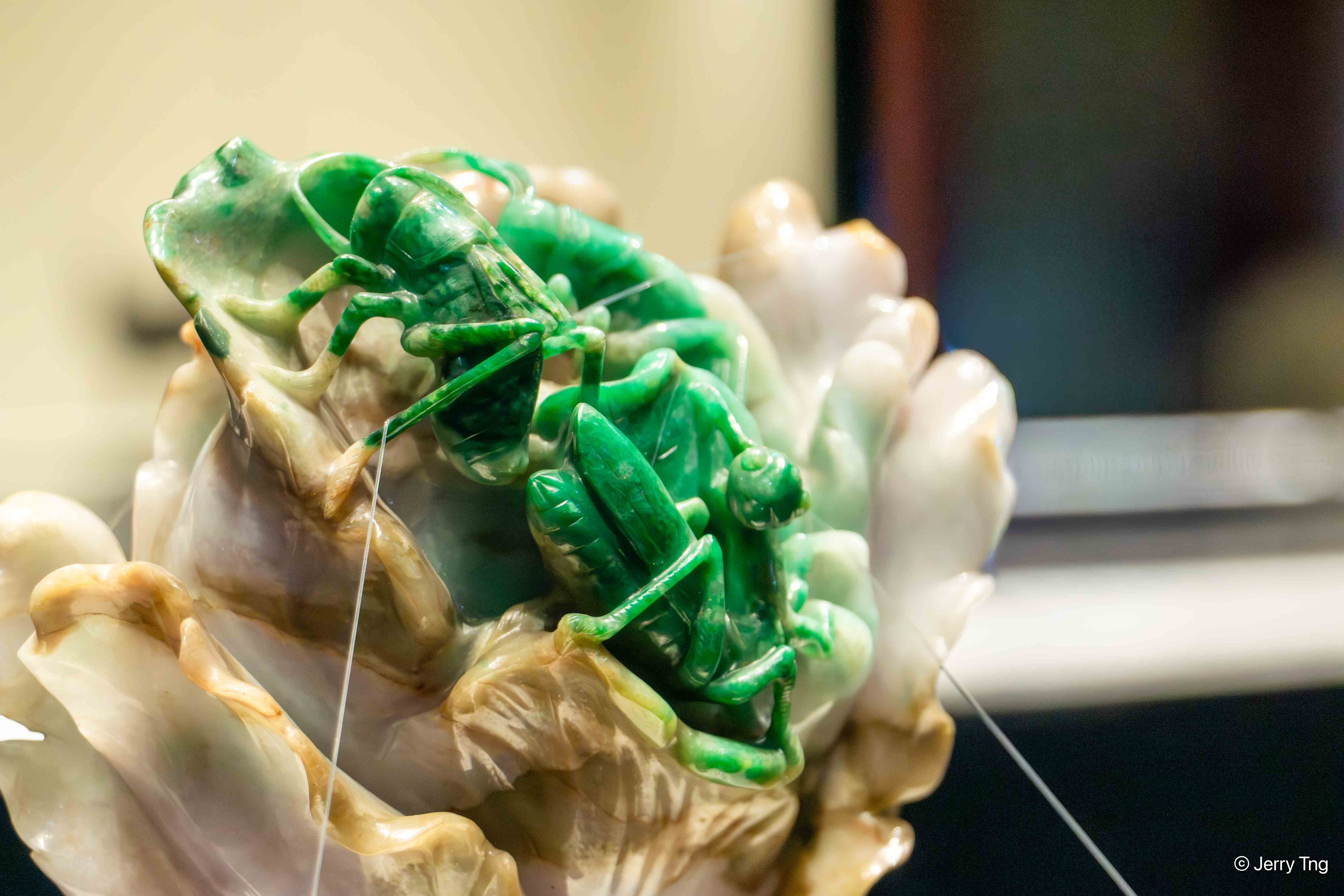
Jadeite Cabbage with Katydids 翡翠蝈蝈白菜


Jade | Qing dynasty (1644-1912) | Tianjin Museum collection.
玉器|清(公元1644年-1922年)|天津博物館藏
This Jadeite Cabbage with Katydids 翡翠蝈蝈白菜 is the biggest amongst the five Qing jade sculpture in the collection of public museums. It is skilfully carved by using the natural colour differences of the material. The lower part of the cabbage is greyish-yellow, accompanied by brown spots. The leaves on it have distinct veins and are curled. The conception is ingenious, the skills are superb, and the whole sculpture is lively, realistic, and full of interest. It is considered one of the best jade carving in the Qing Dynasty.
For more details, please follow the link >> Jadeite Cabbage with Katydids
About Tianjin Museum

Tianjin Museum is the largest museum in Tianjin, China, exhibiting a range of cultural and historical relics significant to Tianjin. The unique architectural style of the museum, whose appearance resembles that of a swan spreading its wings, has meant that it is quickly becoming one of the city’ iconic buildings. It is built to be a large modern spot for the collection, protection and research of historic relics as well as a place for education, leisure and touring.

The Tianjin Museum has an extensive collection of ancient Chinese fine arts and exhibits on Tianjin’s history. There are nearly 200,000 collections of valuable historical and cultural art and relics, including calligraphy, paintings, bronze ware, ceramics, jade, seals, ink stone, oracle bones, coins, historic documents and relics of modern times, and local folk art.
Admission is free with relevant identification document (Foreigners would need your passports for verification.)
Open Tue-Sun from 9am to 5pm, closed on Mondays (except on Public Holidays)
Tianjin Museum 天津博物馆
No. 62 Pingjiang Road, Hexi District, Tianjin 天津市河西区平江道62号
All photos taken at Tianjin Museum, Oct 2025, unless otherwise noted.
Footnotes :
- 猪首龙身形,头部高耸大耳,巨目圆睁,鼻梁有多道皱纹,双唇象闭前凸,与尾相对,头尾间留有缺口,颈部有一对钻孔。风格古朴浑厚,极具神韵。猪首龙身形的神兽可能是红山文化先民的神灵崇拜物。玉猪龙是新石器时代红山文化的代表性玉器。该器体型肥硕,玉质温润,雕琢精细,是同类型器物中较大且最为精美的一件。 ↩︎
- 平底,薄壁,长流短尾,下部假腹有镂孔,通体合范铸成。形制原始,风格粗朴,是目前国内最早的青铜容器之一。20世纪60年代,文物工作者从天津电解铜厂废旧杂铜中拣选 ↩︎
- 这片甲骨所刻的一条卜辞结构相当完整,叙辞、命辞、占辞、验辞俱全,其验辞记录了妇姘在某年二月辛日生育一名男婴的情况。“(女力)”,一释为“嘉”。以生男孩为嘉,显露出当时商王室重男轻女的倾向。 ↩︎
- 说明:据考证,商王武丁前后有三位王后,分别为妇姘(即妣戊)、妇好(即妣辛)和妣癸,合称为“武丁三配”。妇姘在殷商王室的地位十分崇高。她可能是祖己、祖庚、祖甲的生母,著名的司母戊大方鼎(一作后母戊鼎,现藏中国国家博物馆)就是为祭祀她而铸的。 ↩︎
- 唐, 際根 & 牛, 海茹. (2013). 殷墟王陵區人祭坑與卜辭所見“羌祭”及“殺牲法”研究: A Study to the Human Sacrificial Pits at the Yinxu Royal Cemetery and the Qiang People Recorded in the Oracle Bone Inscriptions Concerning the Victim Killing in Ritual Performance. 人文中國學報. 411-431. 10.24112/sinohumanitas.192192. ↩︎
- 说明:此卜甲所刻卜辞记录了用三百名羌奴祭祀商先王丁,以及贞问是否要用三十名羌奴、对剖十只专供祭祀的羊来祭祀先王大甲和丁等事。王襄旧藏。 ↩︎
- 兽骨制成,通体土沁。前流后尾,口沿外撇,近流处有对称的立柱,圆腹略深,一旁有柄,下承三条锥形足。腹部三面出脊,两侧刻兽面纹,眼部镶绿松石。Museum information card, Oct 2025 ↩︎
- 双立耳,平唇,颈部有六个短扉棱,腹略鼓而垂,下承三条兽蹄形足。耳上饰夔龙纹,颈部饰窃曲纹,腹部饰环带纹,蹄足上部有短扉棱,饰兽面纹,腹壁内铸铭文八行七十二字,记述周厉王二十三年九月,王命兼管军事的近臣膳夫克去巡视厉王驻屯在成周的军队并进行整饬。徐世昌孙媳张秉慧捐献。 ↩︎
- 该器物属周代文物,通体素面,圆柱形立式直柄中空可纳木把,勺腹浅而两侧出肩微翘,口沿平直呈铲形,造型独特别致。直柄外壁铸有“工盘野(野)秦口为之”七字铭文,属物勒工名制度实物,体现战国时期青铜器铸造工艺特征与工匠管理制度。器物形体较大,兼具实用功能与艺术价值,为研究战国时期度量器具及铭文制度提供重要实物资料。 ↩︎
- 星十二面棱柱形,中心有一从下到上顶端尚未穿透的圆形孔。器表阴线刻篆书四十五字“行气,深则蓄,蓄则伸,伸则下,下则定,定则固,固则萌,萌则长,长则退,退则天,天几春在上,地几春在下。
顺则生,逆则死。”论述了呼吸和行气的全过程,是我国古代关于气
功修炼的最早记录,有极高的科学价值和文字学价值。 ↩︎ - 上部边缘出廓缕滕对称双螭,螭眉眼上挑,螭身饰小圆圈纹及游丝毛雕,璧身浮雕乳钉形谷纹。造型奇特,滕琢细致巧妙,工艺卓绝,镂雕、浅浮雕等多种技法井用,在汉代玉璧中极少见,十分珍贵,是东汉时期同类器物中的精品。 ↩︎
- 古代白瓷的制作,并不是在釉料中加入一种白色呈色剂,而是选择含铁量较少的瓷土,釉料经过加工,使含铁量降低到最少的程度。在洁白的瓷胎上,施以纯净的透明釉,就能烧制出白度很高的白瓷来。
明代的甜白釉是中国白釉品种的佼佼者。甜白釉是指釉质洁白,温润似玉,肥厚无脂,釉面光洁无棕眼,简称“奶白”或“甜白”。釉层有薄厚之分:薄釉常施于薄胎及脱胎圆器上,釉面平整晶莹,器物的口、足边沿及带系的棱角处微显胎骨,足边沿的釉面截削整齐,施釉不淌,有光素与刻、印纹样两种装饰。厚釉则釉质凝厚,较薄胎器的釉面更加肥腴,多施于厚胎琢器,以光素器为多。少数器皿上线条流畅的暗刻花纹,有时须认真仔细看才可看出纹饰或款识来。
这件瓶高34.5厘米,口径5.5厘米,足径12厘米。
瓶小口短颈,丰肩平底,通体为甜白釉色,胎质细腻,釉面洁净。外壁压印暗花,因釉子凝厚肥腴,纹饰不清,是永乐厚胎甜白釉瓷中的罕见作品。
不论薄釉厚釉,永乐白釉器都有一个特点,即迎光透视,胎釉呈现肉红或粉红色,而清代仿品则显现青色。另外一个特点是:在器物足边和折角积釉处,常闪烁着灰青色的光泽,釉面偶然显现如同青、白、灰三色交织在一起的极淡的虾青色,甚为奇特。 ↩︎ - 十六瓣菱花口,内底绘折枝枇杷与绶带鸟,内外壁绘折枝桃、石榴、枇杷纹。此盘大而规整,胎质细腻洁白,釉层肥厚品亮,外底无釉,青花色泽艳雅,纹饰精美,别有寓意。同类纹样的永乐青花盘传世少见,堪称珍品。 ↩︎
- 口外卷,短颈,丰肩,鼓腹,平底,近足处外撇。器里施绿釉,外壁茄皮紫釉地堆塑花鸟紋。颈部黄绿色浮云,肩部如意纹,腹部山石、花鸟,腹下端上昂蕉叶纹。器身凸起的线条勾勒有致,立体图案效果极佳。此罐为明代景德鎮窑仿珐华器物中的佳品。 ↩︎
- 正面彩绘佛教宝轮图案,背面描金模印各种乐器,寓意美妙的歌舞,其样式见于《方氏墨谱》法宝类。侧面有阳文楷书“方于鲁制”款。清《四家藏墨录》著录,工艺精良,艺术水平极高,是传世明代彩墨珍品。方于鲁,明代万历时期制墨名家。所制墨,质地坚细,晶莹如玉。
其墨模雕刻皆出自高手,尤其注重墨的装饰效果。首创为墨赋彩,彩绘图案的画稿为著名画家丁云鹏所绘。其墨肆约歇业于明天启年间。清初方于鲁墨已极珍稀,现今其传世彩墨不足十锭。杨石先捐献。 ↩︎ - 观音半跏跌坐,头戴风帽,黑发高髻,眼帘下垂,眉目疏朗,形象端庄,衣纹线条流畅。袒胸,胸前佩璎珞。身上交补襟披袈,内穿僧祗,为汉式装饰,塑像神情娴静端庄、肃穆安详,艺术水平极高。底部中心有脐形底门,内可装经卷、佛珠、杂宝等佛教宝物,可见观音像原被供奉于皇室佛堂,是内宫礼拜的圣物。景德镇御窑厂督陶官唐英秉承乾隆皇帝旨意烧造,背部阴文暗刻篆书竖行“唐英敬制”四字款。目前已知传世仅两件,弥足珍贵。 ↩︎
- 小撇口,长颈,腹部下端丰满,圈足。胎质细腻洁白,胎体轻薄,釉面莹润如玉,上用珐琅彩绘画。颈部用蓝料彩绘上下两组蕉叶纹,腹部珐琅彩绘芍药雉鸡图。空白处墨彩题诗:“青扶承露蕊,红妥出阑枝。”引首朱文“春和”印,向尾白文“翠铺”、朱文“霞映”二方印。瓶底赭彩书“乾隆年制”四字方款。构图精美,画工秀润典雅。绘画图案取自清代著名宫廷画家蒋廷锡的手稿。此瓶是集诗、书、画、印于一身的艺术珍品。珐琅彩瓷始烧于康熙晚期,盛于雍正、乾隆之时,多由宫廷如意馆画师所绘,精美之极,是宫廷御用瓷,为皇帝所垄断,极为稀少,珍贵异常。 ↩︎
- 盖有桃形纽,盖身及瓶两侧镂雕缠枝菊花纹。颈肩镂空花耳上各套一活环,瓶身光素,梯圆图足,足下附座,上阴线刻兽面纹。此瓶为一块需翠料剖开制成一对,材质精良,色洋璀璨莹润,滕琢精淋,抛光匀细,工艺高超,具有西方艺术风格的纹饰与翡翠的品莹质感交相辉映,是难得一见的科美工精的大型翡翠品。 ↩︎
- 仿商代铜卤造型,附双龙首提梁,器身饰兽面纹。玉质温润纯净,材质优良,纹饰精美,做工精湛,是清代晚期玉雕的佳品,体大成对存世极为难得。 ↩︎
0 comments on “Tianjin Museum – Selected Rare Relics 耀世奇珍”