
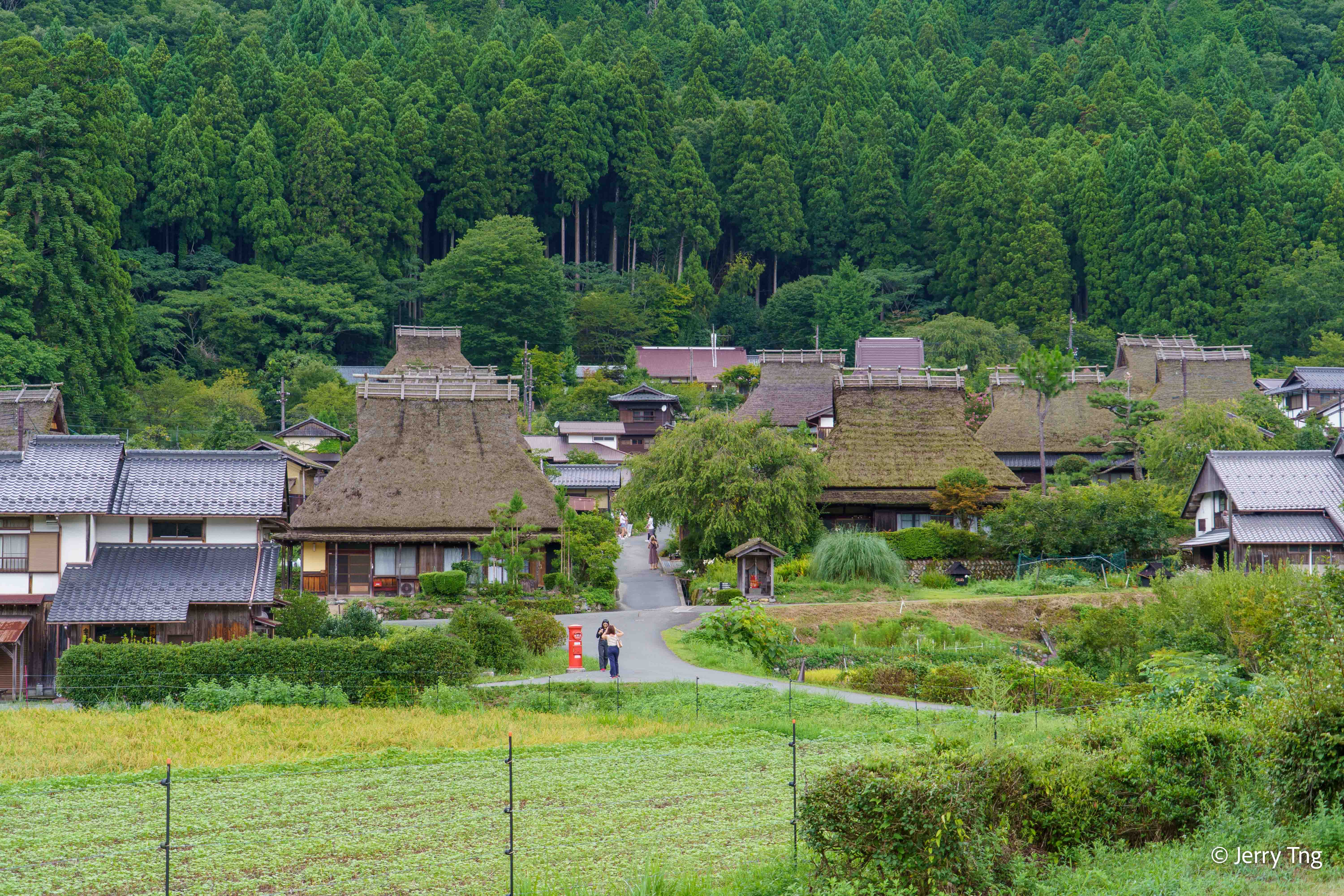
This is a village that came into existence because it was located at a junction of an ancient trading route called the Mackerel Highway, or Saba Kaido (鯖街道)1. Farmers and foresters came together to form a tightly knitted community that became what is known today as Kayabuki no Sato.

The Thatched Village or Kayabuki no Sato (かやぶきの里) is the most visited attraction in Miyama (美山). Almost the whole village is composed of old thatched houses and is carefully maintained as a cultural heritage site. You can walk around the village and enjoy the atmosphere and the breathtaking views of the thatched roofs with a mountain backdrop.

The townscape of Kayabuki-no-Sato is located on a hilly slope. While this means that the various levels of the village are more visible from afar, it also means you’ll need to hoof it up some steep inclines.

The farmhouses use traditional irimoya-style architecture with steep, durable roofs made from locally harvested susuki (pampas grass) designed to handle heavy mountain snow. Smoke from traditional sunken hearths (iori) rises into the open rafters, coating the thatch in a protective layer of tar that repels insects and dries moisture.

On December 8, 1993, the village was designated an Important Preservation District for Groups of Traditional Buildings by the Japanese government. Unlike open-air museums, Kayabuki no Sato remains an active community where residents live, farm, and manage local preservation societies and cooperatives.
Miyama Folklore Museum 美山民俗資料館

Located within Miyama’s Thatched Village, this building was originally built approximately 200 years ago. It has been used as a folklore museum since 1993, when Miyama’s Thatched Village was designated an Important Preservation District for Groups of Traditional Buildings by the Japanese government.


You enter the museum from the kitchen area where the original stoves and other cooking utensils are on display. Artefacts and other points of interest are scattered throughout the building that bring the visitor to a simpler time in this farming hamlet.

This is a regional museum that is operated by the folks of the village, so do not expect the polished exhibits and explanations on the display. Things are grouped by function and some of them are not very well-maintained, but you can still get the feel of the era when this village was bustling with activities.

The museum showcases the interior of a traditional thatched-roof house and the villagers’ way of life. You can see the guest room, bathroom, old barn and more, as they would have appeared in a typical thatched-roof farmhouse in the 19th century.


Although most of the artefacts were from the Meiji and early Showa period, the village dated back much longer when the “Mackerel Highway” was in full-swing. The original settlers were migrants from the surrounding Kansai and Chugoku regions of Japan. They were drawn deep into the mountains of Kyoto Prefecture by the abundance of natural resources.


They sought out the flat, fertile land nestled along the Yura River basin to escape more crowded areas. Over time, these families built a deeply tight-knit, multi-generational society, and many of the current residents are direct descendants of those original pioneering families.


During the Sengoku period (1470-1603), various leaders struggled for control of Japan, and a number of rampaging armies passed through Miyama. When hostile armies arrived, the villagers had to flee their homes with what provisions they could carry, and haul them up into impenetrable mountain forts. Several of the foundations of these forts can still be seen on the mountainsides, but you’ll need a guide to hike up to them.


Miyama was also on the route taken by Buddhist monks as part of their training. This involved walking from Kyoto’s Mount Hie (where monks still live and train today), up though the mountains of Miyama, and on to the coast of the Japan Sea at Wakasa.
Kayabuki no Sato かやぶきの里


If you come at different season, you will be rewarded with different views of the place. During winter, you will see a winter wonderland. This was late summer and the rice fields were getting ready for harvest in autumn. But it was so late in summer that the sunflower fields had all but withered away.


The word Satoyama “里山” – meaning village in the mountains – embodies the ancient Japanese art of living in harmony with nature, using the natural resources around you whilst taking care to manage and preserve them. The essence of Satoyama culture is gratitude and appreciation for nature and all it provides. Encircled by a ring of steep mountains, the people of Miyama have practiced and perfected the cultural tradition of Satoyama for countless generations.


The village layout was entirely designed around survival. The houses were intentionally built high enough on the lower mountain slopes to avoid the seasonal flooding of the Yura River, but low enough to maintain access to flat farming plots. To maximise natural heat and light during the harsh, snowy winters, almost all the houses were systematically built facing south, parallel to the river’s flow.

A total of 39 thatched houses still survive as local residents’ homes in Miyama’s Thatched Village. As most of these houses are private dwellings, please remember to respect the privacy of these residents. The museum is one of the few places where you can see the inside and behind the scenes of one, so I highly recommend that you leave 30 min to experience something so unique.


Before you leave Miyama, remember to buy from the vending machine or the carpark gift shop a carton of this delicious fresh milk that came from the dairy farm on the other side of the mountain. These milk cows (according to the tour guide, there were only 200 of them) produce some of the best milk I have tasted in Japan.
Miyama Folklore Museum Information

Opening hours: 10:00 – 16:00, Tue-Sun; Closedon Mondays, unless it’s a public holiday, the museum will be closed on Tuesday instead.
Exceptions: Closed on summer Obon Holiday period and New Year’s holiday period
Admission Fee: Adult – ¥300 / Child (age 15 or below) – free of charge
Visited Sep 2026
Footnotes :
- The Saba Kaido (鯖街道), translated literally as the “Mackerel Highway,” is a historic network of ancient mountain roads in Japan. For centuries, it connected the bustling seaport of Obama City (on Wakasa Bay, facing the Sea of Japan) to the inland imperial capital of Kyoto. [1, 2] Fresh mackerel (saba) spoils incredibly fast. To get it to Kyoto fresh, strong-legged carriers called toiya would pack the fish in sea salt, load it onto their backs, and run through the steep mountain passes nonstop for 18 to 24 hours. [1, 2, 3] Interestingly, the time it took to sprint the roughly 70 km mountain path was exactly the amount of time needed for the salt to cure the fish perfectly. By the time the runners arrived in Kyoto, the mackerel was perfectly seasoned and ready to eat. ↩︎
0 comments on “Miyama Folklore Museum 美山民俗資料館”