
According to their Instagram account, they are a “handmade soba shop crafting its own pottery.” But they got so good with making soba, that they were awarded Michelin Bib Gourmand recognition 3 years in a row. And they just got it renewed.

Located in Gojo, between Kyoto Station and downtown, sonoba sits amid old Kyoto streetscapes. From cooking to décor, the sensibility of the artistic spirit is displayed throughout.

The unorthodox warehouse space feels more art studio than traditional noodle shop, with an adjacent pottery workshop where owner Kento Yoshida makes his own bowls and plates. This unconventional aesthetic has drawn a younger crowd that might never have considered soba for lunch, though classics like the excellent duck nanban and herring with grated yam satisfy purists.

I arrived around 2 pm, and the lunchtime crowd had already left. I was lucky as they still had soba left for the day. I guessed this wasn’t the peak tourist season, and the crowd wasn’t that crazy. There were some locals have a late lunch. Only when I was about to finish, two more tourists walked in.

The menu is constantly evolving with monthly changes driven by specific ingredients; the meal traces the Japanese agricultural calendar rather than a fixed menu – bamboo shoots in spring, sudachi citrus in late summer (and this was available when I was there), walnuts in autumn, oysters in the colder months. You only get this kind of attention to shun (旬) in high-end kaiseki restaurants.

Bo-zushi 棒寿司 or pressed sushi is an old-school traditional style of Japanese pressed sushi from the Kansai region shaped into a long, rod-like “stick” or bar. It is most traditionally made with cured or vinegared mackerel (saba-zushi), where salted and vinegar-marinated mackerel is laid over seasoned sushi rice, sometimes wrapped in a thin layer of konbu (kelp) or bamboo skin. Unlike standard fresh nigiri that should be eaten immediately, traditional mackerel bo-zushi often tastes better after resting a bit, allowing the vinegar, fish oils, and rice to meld into a deep umami harmony.

And since bonito was in season, they replaced the saba with katsuo. It was so delicious that I was tempted to order two more pieces. However I didn’t as the star soba was coming, and I didn’t want to stuff myself before the main attraction.

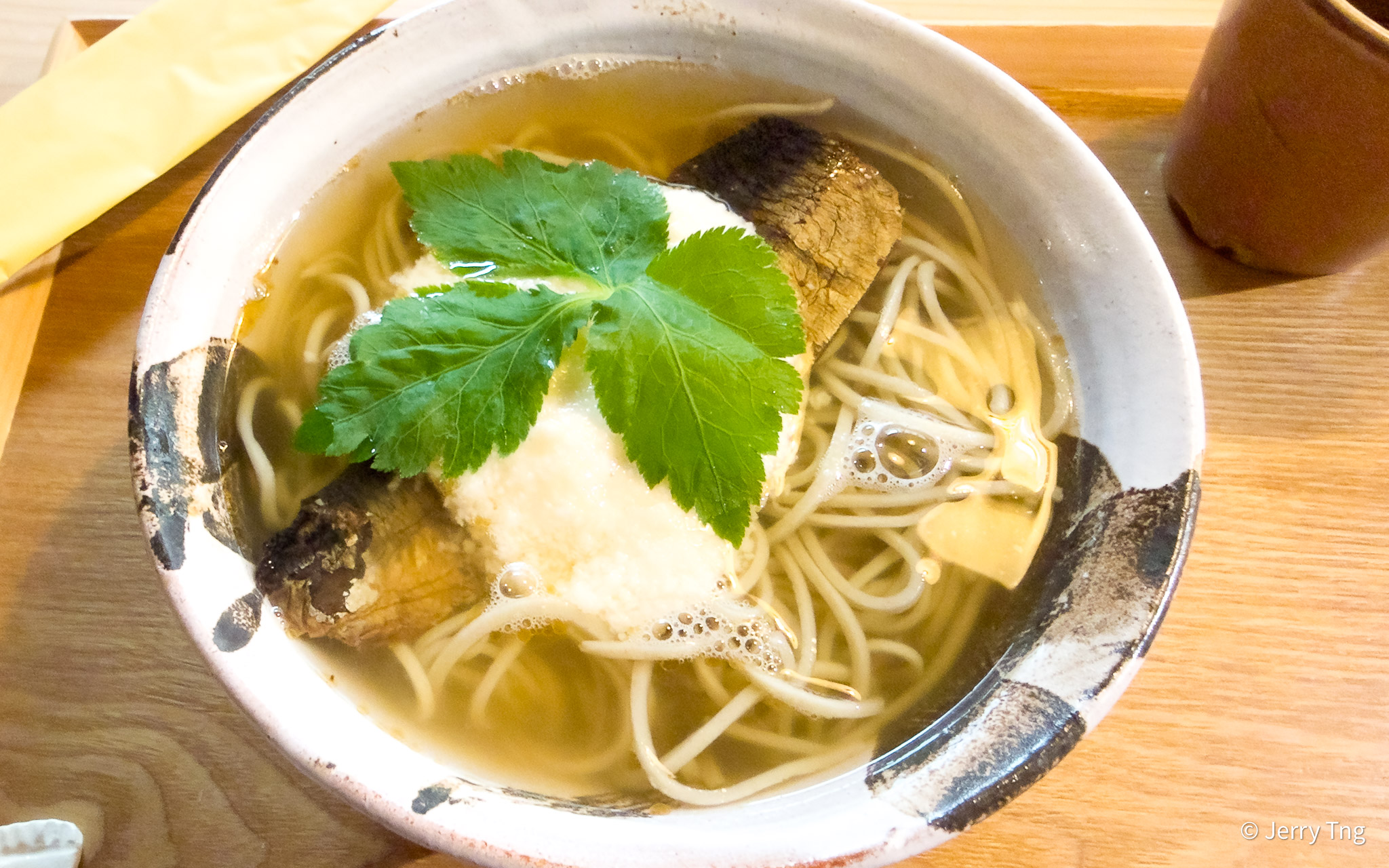
While their signature soba for the summer season is cold sudachi lime soba, I couldn’t resist but order the hot soba because it had two ingredients that I love – herring and Yamato yam.

Yamato yam 大和芋 is a type of yamaimo, aka 山药 in Chinese. The slimy substance, made of mucin and fiber like mannan, protects the digestive tract and slows sugar absorption. Regular consumption can help regulate blood pressure and lower cholesterol levels, which is very important for me 🙂

Yoshida’s hand-cut noodles show a distinctive green hue and deeply nutty flavour that sets them apart. Their 100% buckwheat soba (known as juwari soba in Japanese) is freshly handmade every day, and each bowl is carefully prepared with great attention. Unlike the dried version, these fresh soba is more chewy and survives better soaked in hot broth.

Nishin soba was created by the 2nd generation owner at Matsuba (also in Kyoto) in 1882. Kyoto is an inland city, and so the nobility in the past would get their fish from nearby ports, and before the invention of refrigeration, these fish were usually dried or salted for transportation. The nishin in hot broth made it tender and lose some of the strong taste, which is good.

And then there’s the broth that binds everything together. Crystal-clear, light, yet intensely flavourful and gentle, the dashi demonstrated the amount of thought that was put in to layer those flavours together.

It was a really nice bowl of soba, very robust broth and an excellent balance of umami. And to top it all, the pottery used in the meal were all handmade by the owner himself.

Sonoba’s integration of craft across disciplines at the ¥ tier positions it differently from nearly everything around it. The 2024 and 2025 Bib Gourmand designations confirm this assessment across consecutive guides. And after this visit, they got the 2026 recognition as well. Well worth the detour.
Sonoba そのば
533-3 Motoshiogamacho, Shimogyo Ward, Kyoto, 600-8119, Japan
京都市下京区本塩竈町 533-3, 京都, 600-8119, 日本
Visited Sep 2026
Michelin Kyoto Guide Bib Gourmand 2024-2026
0 comments on “Sonoba そのば @ Kyoto”