
‘You are what you eat.’ Owner/Chef Song Jung-eun walks the talk with this farm-to-table restaurant where everything you eat is not produced at commercial volume.


As you walk through Insadong Alley, which is crammed with teahouses and Korean eateries, you will find a low-rise Korean style house – a restaurant called ‘A Flower Blossom on the Rice’. Various flowers, vegetables, and herbs are carefully planted in small pots in front of the restaurant.

A Flower Blossom On the Rice 꽃,밥에피다 is an organic fusion Korean restaurant that uses ingredients grown with eco-friendly farming methods. Over 95 percent of the restaurant’s dishes are made with pesticide-free, organic, and eco-friendly ingredients.
The ingredients of A Flower Blossom On the Rice
The restaurant greatly supports the sustainable environment system and the people who consume eco-friendly agricultural and livestock products.
- Organic White Rice – Cherwon, Gangwon-do Province
- Organic Brown Rice- Jangseong-gun, Jeollanam-do Province
- Pesticide-Free & Organic Vegetables- Consumer Cooperative & Regional directive transaction
- Organic Korean Beef – Asan-si, Chungcheongnam-do Province
- Non Antibiotic Korean Pork- Cial Stockbreeding Company
- Non Antibiotic Viable Egg – Natural Near Company
- Pesticide-Free Wheat – Natural Near Company
- Tofu Made with Pesticide- Free beans – Natural Near Company
- Sesame Oil and Perilla Oil made with Korean Sesame – Jeongsun-gun, Gangwon-do Province
- Organic Red Pepper Powder – Jeongan, Chungcheongnam-do Province
- Traditional Soy Sauce with Korean Beans – Geochang-gun, Gyeongsangnam-do Province
- Traditional Doenjang(Korean Fermented Soybean Paste) with Korean Beans – Boeun-gun, Chungcheongbuk-do Province
- Traditional Gochujang(Korean Red Pepper Paste) – Gimcheon-si, Gyeongsangbuk-do Province
- Rockfish from Heuksando Island, John Dory from Jeju Island, and Sea Pineapple from Tongyeong-si, Gyeongsangnam-do Province
- Cold-Pressed Raps Oil- Natural Near Company, Imported


The restaurant opened in late Dec 2015 and ran a deficit for about two and a half years, so around the fall of 2017, the owners were contemplating closing the place when the tyre manufacturer recognised them with a Bib Gourmand listing. That’s when everything turned around.
Organic Korean Beef Grilled Tteokgalbi Course (Spring Special)
The items in the set menu are adjusted to reflect the seasonal changes as the ingredients of the season are available. And when we were there, they were serving the Spring menu.
Starter

I ordered an IPA from Mungyeong Ganadara Brewery, a Korean craft brewery founded by Kim Eok-Jong. Very refreshing on a hot day like this one. It was the last bits of Spring and we were proceeding to the beginning of summer and so there were alternation of the ingredients because of the seasonal change.
Deep Fried Seaweed and King Oyster Mushroom
Natural farming method seaweed (1 percent production rate in Korea) and King Oyster Mushroom coated with organic glutinous rice

The first starter to come out was a Jeju-style seaweed salted using natural sea salt, which is the traditional method of making these seaweed sheets. The surprise was the deep fried king oyster mushroom which tasted like keropok.
감자 스프 제철 Seasonal Potato Soup
Boiled with seasonal vegetables

The soup was made from organic potato and onions blended together for that creaminess that did not come from adding diary. Everything tasted light and yet delicious, no burden to the body.
Spring Salad
Seasonal Organic Vegetables and home made Special Dressing

The salad is a mix of pesticide free vegetables from Korea with Western herbs like arugula. Instead of cheese, tofu is crumbled and added for texture (and I thought it was cheese).

The dressing is made from organic pine nut, giving the nutty, creamy taste. It is thickened using tofu instead of heavy cream.
Palate Cleanser

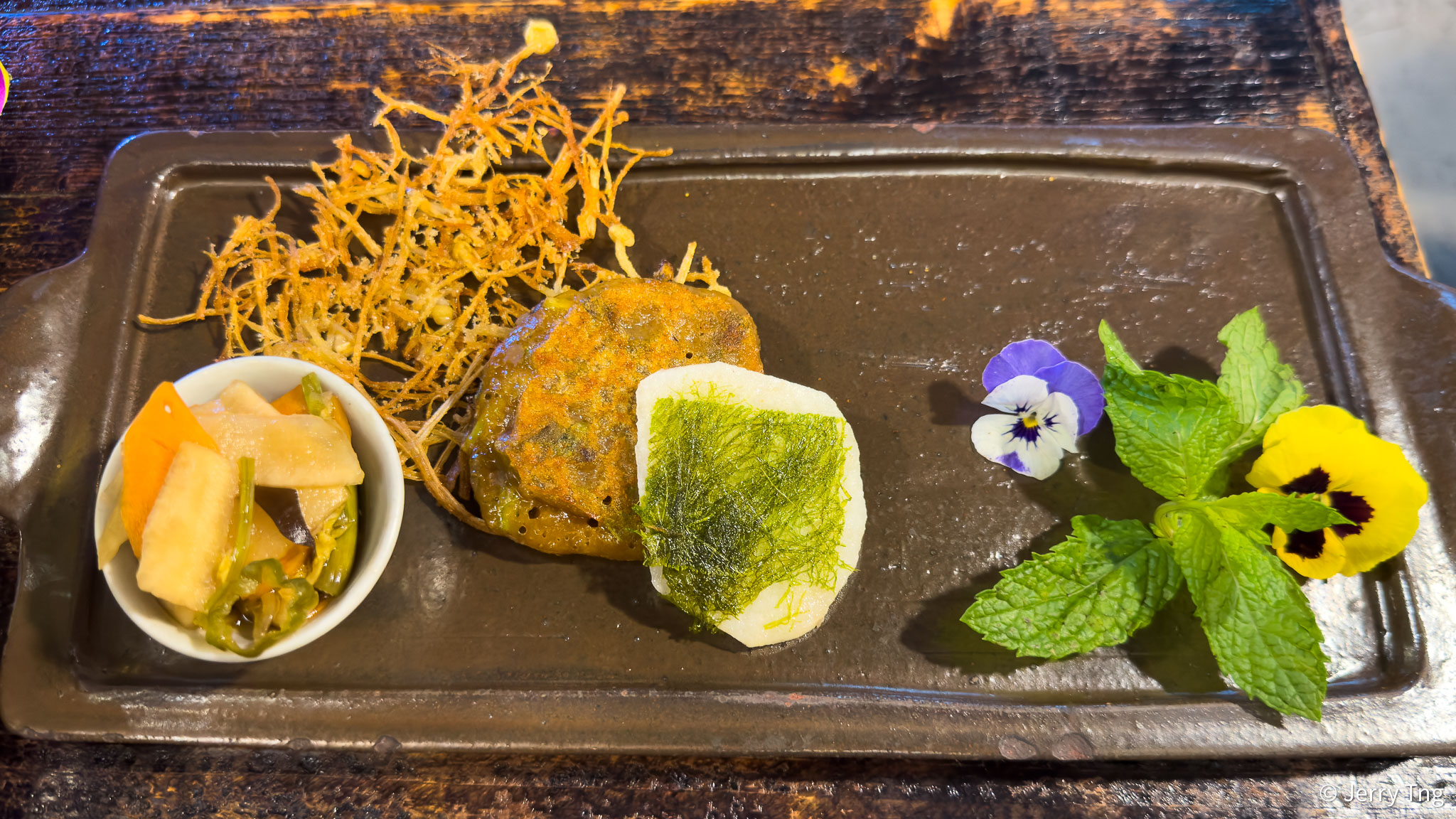
Next to come out in the course are some “palate cleanser”, but not in the conventional French cuisine sense. The waiter reminded us that the flowers are edible too.
세 가지 얌전과 장김치 Three types of Jeon (Korean pancake) with Soy sauce Kimchi
Mushroom, organic vegetables, organic flour, and soy sauce Kimchi

Jeon 전 (in Hanja, 煎) is a fritter in Korean cuisine made by seasoning whole, sliced, or minced fish, meat, vegetables, etc., and coating them with wheat flour and egg wash before frying them in oil. Three types of vegetables were used for the jeons – enoki mushrooms, lotus root and radish. I really enjoyed the radish jeon with the dried seaweed that looked like fine hair called gamtae gim 감태김, gim referring to dried seaweed sheets. The kimchi, which looked like Noynya achar, is fermented in-house using organic soy sauce instead of the usual pepper flakes.
Korean Cold Salad with Spring Vegetables
Organic spring vegetables, organic Tempeh, mustard, traditional Korean soy sauce, organic pine nut, and organic brown nice vinegar

Potato is lightly cooked and julienned together with Korean pear, wood fungus mushroom, jicama, dried dates and picked radish. The mix is dressed with a pine nut and sesame sauce. Very refreshing with all the texture and flavours going in the naengchae 냉채.

I was surprised to find tempeh (Indonesia fermented soy bean) in the mix. Tempeh like natto is an acquired taste, but is a great natural source of probiotics.
Stir-fried vegetables
Eggplant mushroom, organic fried tofu, green chilli, chilli oil, Chinese pepper, and flower buns made with pesticide-free wheat

This Sichuan-flavoured japchae is made from pesticide-free golden pine mushroom, mangadak mushroom (aka shimeji or beech mushroom), and milk powder made from Korean beans and stir-fry it with sancho powder and ginger pepper oil. Golden pine mushroom is a Korean variety and has great umami. Flower bun made with pesticide-free wheat flour is similar to the Dongbei mantou and goes perfectly with the spicy japchae.
Main Dish

The main course came in three parts – a bibimbap, a vegetable dish and a protein dish, with some pickles to go with the rice.
멍게 비빔밥 Raw Sea Pineapple Bibimbap with Thistle Doenjang Soup

The special bibimbap is meongge bibimbap 멍게 비빔밥 with raw sea pineapple seasoned with organic brown rice vinegar. I would say I am a fan of sea pineapple, but I couldn’t resist paying the extra to try it every time I see it in the menu. Perhaps I am trying to get accustomed to this acquired taste.

Meongge 멍게 (the yellow looking pieces) is also called ‘Sea Pineapple’ 바다의 파인애플 because of its hard body that resembled the tropical fruit. The raw version is quite acceptable in terms of taste, even though the gasoline taste lingers. These days they are farmed in Tongyeong in South Gyeongsang Province; more than 70 percent of meongge in Korea originate here.

Just like all bibimbap, you mix everything together before eating. I find the flavour a bit bland and asked for some of their special gochujang. And the pepper sauce was not spicy but packed a lot of flavours.

The main dish comes out with a side dish of vegan radish kimchi marinated with ripe persimmon and millet porridge, so it much more refreshing than the usual manufactured . Doenjang-jjigae 된장찌개 or soybean paste stew is a Korean traditional jjigae (stew-type dish) made from doenjang (soybean paste), and in this case, thistle.
Organic Korean Beef Ttekgalbi with Sprout Ginseng (100g per person)
Organic Grass Fed Beef patties, Korean Traditional Soy Sauce, organic vegetable, organic sprout ginseng

Organic Korean beef is precious as there are not very many in Korea that raise cattle that happily grazes in organic grass or eats organic feed. Here, only organic Korean beef is served every day. Tteokgalbi or grilled short rib patties is made with minced beef short ribs marinated with traditional soy sauce, and served with sautéed mushroom and vegetables as a side dish with a slice of pine mushroom, sliced to preserve their shape and grilled. But the highlight was the sprout ginseng.

We all know the wonderful healing properties of ginseng, Chinese and Koreans have sworn by it for centuries. Ginseng sprouts have been recently cultivated as a medicinal vegetable in Korea due to their relatively short period of growth. Supposedly, they contain still have a high content of bioactive compounds, including ginsenosides and amino acids, compared to full grown ginsengs. It tasted like burdock with a slight ginseng aroma.
죽순들깨찜 Steamed Bamboo Shoots
A summer delicacy in organic bamboo shoots seasoned with perilla seeds

Bamboo shoots are rich in potassium and vitamins B1 and B2, which help restore the tired body, lower the cholesterol and control blood pressure. Deulkkae 들깨 or Korean perilla is a nutty condiment that has that basil property and goes very well with the bamboo shoots.
Steamed Rockfish from Heuksando Island (Ala carte)
Semi-dried Rockfish from Heuksando Island and Spring Herb

I could not resist not to order another main course to share. Rockfish from Heuksando Island is lightly pickled and dried in salt, resulting in a lean meat that becomes chewy when cooked, improving the texture. Rockfish treating this way can be cooked in a variety of ways, and we tried the steamed fish today. I wouldn’t say I enjoyed it, but it would be better grilled I reckon.
Dessert and Beverage
And to round out a fabulous meal was some Korean desserts (more like a petit fours), and a shot of beverage in the tradition of the cinnamon-date-pine nut drink (Sujeonggwa 수정과) that is traditionally served at the end of the meal.
Beverage – Organic Tangerine and Carrot Juice
100% squeezed Organic Tangerine Carrot Juice from Jeju Island

Dessert
- Yugwa (Korean puffed rice snack) is made with organic rice and organic grain syrup;
- Bam yang gaeng (Hommage a’ BiBi) made from Korean chestnut and organic agar;
- Gaeseong Honey Cookie is a Korean honey cookie made in the Gaeseong region style.

The Spring course menu was very generous and substantial for its price (~SGD 85 per set). This very affordable restaurant has received the Bib Gourmand awards 7 years in a row and is popular among locals and tourists alike, so it’s advisable to make a reservation ahead of time. Highly recommended and leave at least 1.5 hour to enjoy the meal properly.
A Flower Blossom On the Rice 꽃,밥에피다
3-6 Insadong 16-gil, Jongno-gu, Seoul 서울특별시 종로구 인사동16길 3-6
Tel : +82-2-732-0276 (Reservations)
Visited Jul 2024
Michelin Seoul Guide Bib Gourmand 2018-2024, Green Star 2021-2024
PS: Here’s Chef/Owner Song Jeong Eun talking about the Summer Menu 2024, looking forward to the return visit.
Pingback: A Flower Blossom On the Rice @ Seoul (2025) – live2makan