

By popular vote (and expert opinion), this inkstone was voted one of Top 10 Treasures of the Guangdong Museum and was also classified as a National Treasure 1st Class. The Duan inkstone has a natural image of the Monkey King in the stone face.
Inkstone with Natural Mark of Monkey King 清端石千金猴王砚
Duan stone | 18th year of Qing Guangxu reign (1892) | Dimensions – L: 25.5cm, W: 17.6 cm, H: 2.7cm | Guangdong Museum Collection. 端石|清光绪十八年(1892年)|长25.5、宽17.6、厚2.7厘米|广东省博物馆藏

The stone was mined from an ancient quarry that produced the special Duan stone called “Old Pit Stone” 老坑大西洞石, something that is sought after by collectors. The surface of the inkstone has some impurities known as “fish brain jelly” 鱼脑冻, hence called because it resembles the clear and ivory colour of fish brain. I can attest to that as I have eaten that before. And what made this particular piece of inkstone special is that the jelly looked like a monkey.
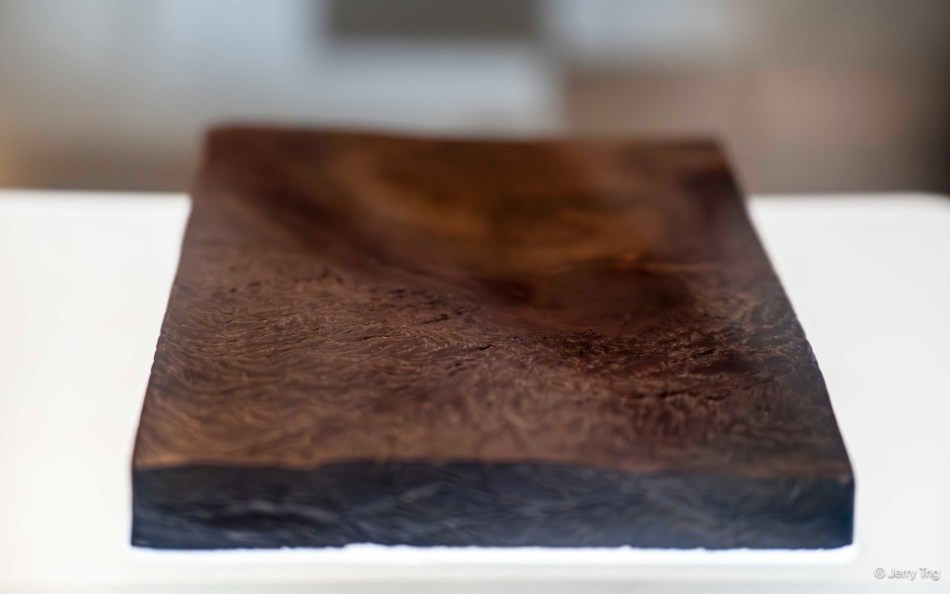
Duanzhou 端州 was the Tang dynasty name for Zhaoqing 肇庆 in Guangdong. Using vivid imagination, image of the monkey was thought to be the Monkey King 美猴王. The carver made the rest of the surface of the stone to look liked Huaguo Mountain 花果山, the fabled abode of the Monkey King.

On the left side of the inkstone were carved the name given to the inkstone (“Golden Monkey King Inkstone” 千金猴王砚), the date of the production (Renchen year of Qing Guangxu reign 光绪壬辰, which is 1892), and the name of the collector (“Collected by He Xian of Guangzhou” 禺山何氏闲叟珍藏). On the right was the name of the carver (Xiang Xinnan 项信南, famous carver from Guangzhou) and the inkstone maker (Guo Lanxiang 郭兰祥, who came of a famous line of inkstone makers from Zhaoqing 肇庆).
The Development of the Duan Inkstone

Four Treasures of the Study 文房四宝 is an expression used to denote the brush 笔, ink 墨, paper 纸 and inkstone 砚 used in the Chinese study. The name appears to originate in the time of the Southern and Northern Dynasties (420–589 AD). Classical scholars had more than just the Four treasures in their studies. The other “Treasures” include the brush-holder 笔架, brush-hanger 笔挂 or brush canister 笔筒, paperweights 镇纸, the brush-rinsing pot/basin 笔洗, and the seal 圖章 and seal-ink 印泥.

Inkstone 砚/研 has a long history. It can date back to the Neolithic Period as a polishing tool called grind 研磨器, which developed from grinding vessel in daily life. After the Han Dynasty, inkstone materials became various, such as stone, tile, porcelain, jade, metal, lacquer, etc.
Duan Inkstone in the Form of Dustpan 端石箕形砚
Duan stone | Tang dynasty (618-907) | Dimensions – L: 18.9cm, W: 12/6cm, H: 3.3cm | Guangdong Museum Collection, Excavated in Tang Tomb in Guojiatan, the eastern suburb of Xi’an in 1964. 端砚|唐代(公元618-907年)|长18.9厘米,宽12.6厘米,高3.3厘米| 广东省博物馆藏,1964年西安市东郊郭家滩唐墓

The Duan inkstone 端砚 was first produced in the Tang Dynasty (618-907). Inkstone in form of dustpan (like the one in the Museum’s collection) was popular. Having further developed in the Song and Yuan Dynasties, the production matured in the Ming and Qing Dynasties and declined in the Late Qing Dynasty/early Republic of China. Due to renewed demand, the craftsmanship of the Duan inkstone has resumed and developed since 1960s.
Inkstone Collection


As writing tools, the Duan inkstone was simple and practical in the early Tang Dynasty. Since the mid-Tang Dynasty, inkstone gradually changed from besides practical use into a work of art for collection, forming unique appreciation standards for its texture, marks and crafts.

Duan inkstone 端砚 had been loved by scholars for centuries. They wrote poems or books about it, made inscriptions on it as well as spent an unreal amount of wealth collecting it. Nature offers the Duan inkstone beauty of stone. Craftsman provides the Duan inkstone with artistic beauty. Scholars through dynasties endued the Duan inkstone a profound culture connotation.
“温、润、柔、嫩、细、腻、洁、美” – 端砚八德
端砚老坑石的“八德”
“一曰历寒不冰,质之温也;二曰贮水不耗,质之润也;三曰研墨无泡,质之柔也;四曰发墨无声,质之嫩也;五曰停墨浮艳,质之细也;六曰护毫加秀,质之腻也;七曰起墨不滞,质之洁也;八曰经久不乏,质之美也。具此八德,质已迈常,信为古今之瑰宝,可遇而不可求者也。”
清代书法家陈龄《说砚》
Inkstone with Inscription 端石王震写经砚
Duan stone | Qing Daoguang reign (1821-1850) | Guangdong Museum Collection 端石|清道光(公元1821年-1850年)|广东省博物馆藏

Take this piece of Duan inkstone from the late Qing dynasty. The collector (卢氏珍藏(印)) and the place it was kept (芸叶庵) were inscribed on the left edge. The cover of the inkstone was carved with the origin (it was the inkstone of Wang Zheng 王震 (1867–1938), aka Man from Bailongshan 白龙山人, from Zhejiang Wuxing, who resided in Shanghai) by the artist/calligrapher (Wu Changsuo 吴昌碩 (1844–1927), master in the arts) in 1921. Such was the passion of the collector.
Family Reunion


Among the collection of Duan inkstones in the Museum are three slabs from the same piece of stone material “一石三砚”. The Governor-General of Guangdong and Guangxi cum Governor of Guangdong 两广总督兼广东巡抚 at that time, Zhang Zhidong 张之洞 (1837–1909), restarted the mining of the Old Pit and opened a new pit called “Daxi Pit” 大西洞, and the Duan stones mined from the pit were known as “Zhang’s Stone” “张坑石”
Inkstone with Inscription “Crane Inkstone” 端石嵒华四象砚 “松鹤砚”
Duan stone | 19th year of Qing Guangxu reign (1893) | Dimensions – L: 23.8cm, W:15.7cm, H: 2.3cm | Guangdong Museum Collection. 端砚|清光绪十九年(1893年)|长23.8、宽15.7、厚2.3厘米|广东省博物馆藏

He got hold of this special piece of material with excellent “fish brain jelly” and other unique attributes, and asked the most famous inkstone maker of that time Guo Lanxiang 郭兰祥 to make inkstones out of the material. And from that one piece of material, Guo made three inkstones. In the Museum collection were the Monkey King inkstone “千金猴王砚” and the Crane inkstone “嵒华四象砚”. The third piece was purported to be sold to a private collector , while some believed that the third piece never existed.
Inkstone with Natural Mark of Tai Chi 水归洞鱼脑冻九晕太极砚
Duan stone | 19th year of Qing Guangxu reign (1893) | Dimensions – L: 22.5cm, W: 15.8cm, H: 2.7cm | Guangdong Museum Collection, Donated by Mr He Chonggan in 2019. 端砚|清光绪十九年(1893年)|长22.5、宽15.8、厚2.7厘米|广东省博物馆藏,2019年何崇甘先生捐赠

Then in 2019, the grandson of the original owner of the Monkey and Crane inkstones, Mr He Chonggan 何崇甘 decided to donate the last piece of the trilogy to the Museum. The family of inkstones is finally reunited!

Footnote: the Old Pit and the Daxi Pit were all closed since 1990s as there were no more economical mining possible. These inkstones are even more valuable for that matter.
About Chinese Treasure Series


中華國寶系列 Chinese Treasure series feature specific artefacts and relics from museums all around the world that are historically significant to be considered a National Treasure. The series covers the 5,000 years of Chinese civilisation from Neolithic periods before the Xia dynasty (c. 2070-1600 BC) to modern day.

0 comments on “Treasures – Inkstone With Natural Mark Of Monkey King (Qing Dynasty)”