
I have walked past it many times without knowing what cuisine it serves. I would now put it as one of best Kaiseki I have had in Tokyo.

Kioicho Ransen 紀尾井町 藍泉 is located in the basement arcade of New Otani Hotel in Tokyo. You would almost missed it as it is tucked away in the corner with a nondescript entrance.

I did not have any reservation, so they had to check with the kitchen if they can cater to one walk-in kaiseki course. They usually have to prepare beforehand for kaiseki and do not have extra ingredients to cater for walk-in. That’s the main difference between a proper kaiseki restaurant and a washoku restaurant trying to serve kaiseki.

It was my lucky day as they had one more set of the seasonal kaiseki, but it was the smallest set on the menu. As I have smaller appetite these days, I said yes; the menu featured the seasonal ingredients, kegani 毛蟹, or horsehair crab, and what attracted me in the first place, ayu 香魚, or sweetfish.
毛蟹と季節の味覚 Hokkaido horsehair crabs and seasonal flavours (Jul 2025)
Tonight’s meal was all about the kegani 毛蟹 that is in season. Kegani, or horsehair crab from Hokkaido, is a well-known delicacy and known for its sweet and firm meat, as well as for the flavourful kani miso (crab roe).
Appetiser 【先付】
Kegani crab, white daikon radish, crab broth jelly, shiso flowers 毛蟹 白だい 蟹出汁ゼリー 花穂

And for the Sakizuke 先付 course, which is an appetiser, shredded kegani has been topped with a jelly made from the broth that was collected from boiling the crabs, and for flavours and texture, a boiled okra and shiso flowers, a peppery edible herb. Delicious, well executed, wonderful start to the dinner.
Shinogi 【志のぎ】
Kegani Dock, Homemade Karasumi 毛蟹ドック 自家製唐墨

In kaiseki, Shinogi 凌ぎ is a small, interim dish served between courses to stave off hunger. It’s a chance for the chef to showcase a creative and often visually appealing dish, typically featuring seasonal ingredients. Kegani “dock” 毛蟹ドックis a specialty that looked like a pre-assembled gunkan, taking literally the meaning of a 軍艦 (warship) in the dry dock. The two main ingredients, shredded kegani and shaved karasumi (salted and dried mullet roe, homemade by the restaurant), sat silently on a ball of shari.

Karasumi 唐墨, aka 烏魚子 in Chinese, is a Japanese delicacy and a high-priced item often enjoyed with sake. The name is said to resemble blocks of ink used in calligraphy. It’s known for its salty, sea-like flavour and umami taste. It complimented the sweet kegani perfectly. Although the kegani “dock” was a messy thing to eat.
Sashimi【造り】
Today’s Selection of Fish 本日のお魚

Tsukuri 造り course in a kaseiki meal is the sashimi course. Kombujime 昆布じめ (lit. kelp pickle) is a method where the fish is sandwiched between pieces of kelp, which helps transfer flavour and umami to it (kelp is not eaten), and kakushi bocho 隠し包丁 is a method of lightly scoring the fish in places it can’t be seen, so it is easier to eat.

With the lighter fish in the front, you eat from front to back. The fishes for today were tachiuo タチウオ (largehead hairtail or beltfish), tsubugai つぶ貝 (whelk) and katsuo カツオ (bonito). The tachiuo has a pleasant texture, mild taste and is considered a summer treat. The tsubugai has sweet flavour, soft yet crunchy texture, and clean ocean taste.


The katsuo was served with myoga 茗荷 pickled in sashimi soy sauce. Bonito is usually not served as is because of its mild taste and lean texture, so it is usually tataki, warayaki or paired with myoga. It was one of the best bonito I had anywhere. The sashimi course was small, but packed with very high quality and tasty ingredients.
Snack【進肴】
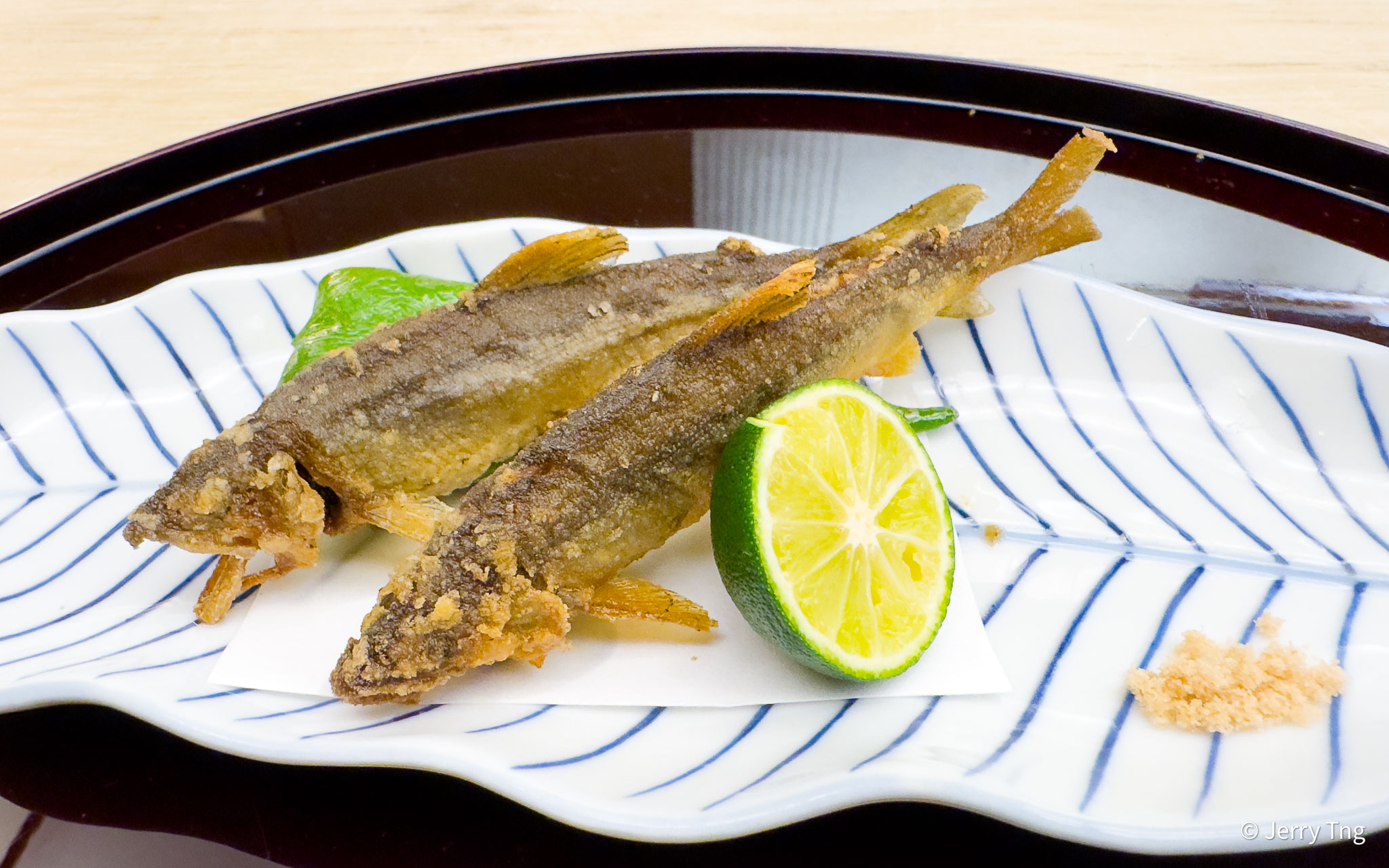
Deep Fried Sweetfish 鮎唐揚げ

This fish is one of my favourite and why I chose this meal tonight. Ayu 鮎 (sweetfish) are a popular seasonal delicacy, especially in Japan, where they are enjoyed grilled, sashimi-style, or in various other culinary preparations. Depending on the time of the ayu season, you will be able to get ayu, salt-grilled to perfection. But I was missing the timing, the ayu was too small for grilling, instead they were served deep fried.

I didn’t enjoy this fish prepared this way, but the technique was flawless, the fish was not overcooked. Except I didn’t enjoy this fish prepared this way. Such was the disappointment that I have to repeat it twice.
Fried Course 【揚物】
Kegani Croquette with Tomato Sauce 毛蟹コロッケ トマトソース

After the ayu, another deep fried item as part of the next course, known as the Agemono 揚物. This is not to be confused with tempura, which is also deep fried. Tempura is a type of agemono, but agemono can include croquettes, karaage, etc. This dish is typically a highlight of the meal, offering a textural and flavour contrast to the other courses.

The main ingredient for tonight’s kaiseki was introduced one more time. Crab meat was combined with mashed potato and deep fried as a croquette. The creamy inside with sweet umami from the crab was accompanied by a tomato sauce made in-house. Not your Heinz out of a bottle, but a nice rendering of Japanese tomatoes in a tangy, sweet sauce.
Main Course 【食事】
Yamagata Prefecture’s “Yukiwakamaru” Sweetfish Rice Cooked In A Claypot 山形県産『雪若丸』鮎の土鍋炊き御飯

Finally freshly cooked white rice or rice cooked with ingredients, red miso soup, and three to five kinds of pickles are served on small plates as part of the main course called Shokuji 食事. Pickles, which is usually described as part of the main course but with its own elegant name Konomono 香の物 (lit. fragrant food), signal the end of the meal. This is where the food ends.

Tonight’s main attraction was Yamagata Prefecture’s “Yukiwakamaru” rice with sweetfish cooked in a claypot 山形県産『雪若丸』鮎の土鍋炊き御飯. 雪若丸 Yukiwakamaru is a relatively new, high-quality rice variety from 山形県 Yamagata Prefecture, introduced in 2018 as the “younger brother” of the popular Tsuyahime rice. It’s known for its large, firm, and glossy grains, with a satisfying chewiness and a subtle sweetness. Its delicious taste is determined by the seasoning which draws out the flavour of the ayu and the method of boiling.
Pickles and Miso Soup 香の物 味噌汁


And with rice, there’s always konomono (pickles) and misoshiru (miso soup), or else it would not be considered as washoku 和食.

The whole pot was for me, as I was dining alone, I was afraid that it would be wasted because it was really delicious. I thought the bones of the sweetfish would be a problem, but it was not so. I had two bowls of these wonderfully stewed rice, and could not eat no more. I reluctantly sent it away.
Sweets 【甘味】
Today’s dessert 本日のデザート

The after-dinner dessert is mostly wagashi 和菓子 (Japanese sweets), but sometimes fruits or sorbets are served. Many of them have a clean flavour to refresh the palate. Japanese sweets sometimes come with a small toothpick like stick called kuromoji 黒文字 instead of a metal spoon or fork.

Yōkan 羊羹 is a wagashi made of red bean paste, agar & sugar. It comes in 2 main types: neri yōkan 煉羊羹 and mizu yōkan 水羊羹, which the one served today. “Mizu” means “water”, indicates that it is made with more water than usual. Often chilled and eaten in summer, yōkan is usually sold in block form and cut into slices. And served with a hot cup of ocha to cut some slack on its sweetness.

And a second dessert, a yogashi 洋菓子 was served instead of fresh fruits (which is normally served with wagashi). Mango mousse with fresh mango and chantilly cream was so good that I finished it despite feeling extremely full. The mango is locally sourced; Miyazaki mango, also known as Taiyo no Tamago 太陽のたまご (lit. Egg of the Sun) is a premium, highly sought-after variety known for their exceptional taste, rich sweetness, and vibrant colour.

These came as a surprise. I was just feeling guilty that they would dispose of all the rice I could not finish. Instead, they made them into onigiris (rice balls) for my breakfast tomorrow. PS: they tasted really good even though I did not reheat them.

The meal was short, only seven courses, and each course was just a small bite. Although I had three onigiri to bring back to the hotel, I was disappointed that I was not served the grilled ayu. But the rest of the meal was ample and delightful. I had the counter to myself, and everything except for the sashimi was prepped in the kitchen at the back, so I was really the lone diner. But the service was not compromised as they came running the moment I said, “すみません.” Will come back for sure.
Kioicho Ransen 紀尾井町 藍泉
Arcade Flr., The Main building, Hotel New Otani
4-1 Kioi-Cho, Chiyoda-Ku, Tokyo, 102-8578, Japan
Tel : +81 (03) 3514 1751 (Reservations)
Visited Jul 2025
0 comments on “Ransen 藍泉 @ Tokyo (2025)”