
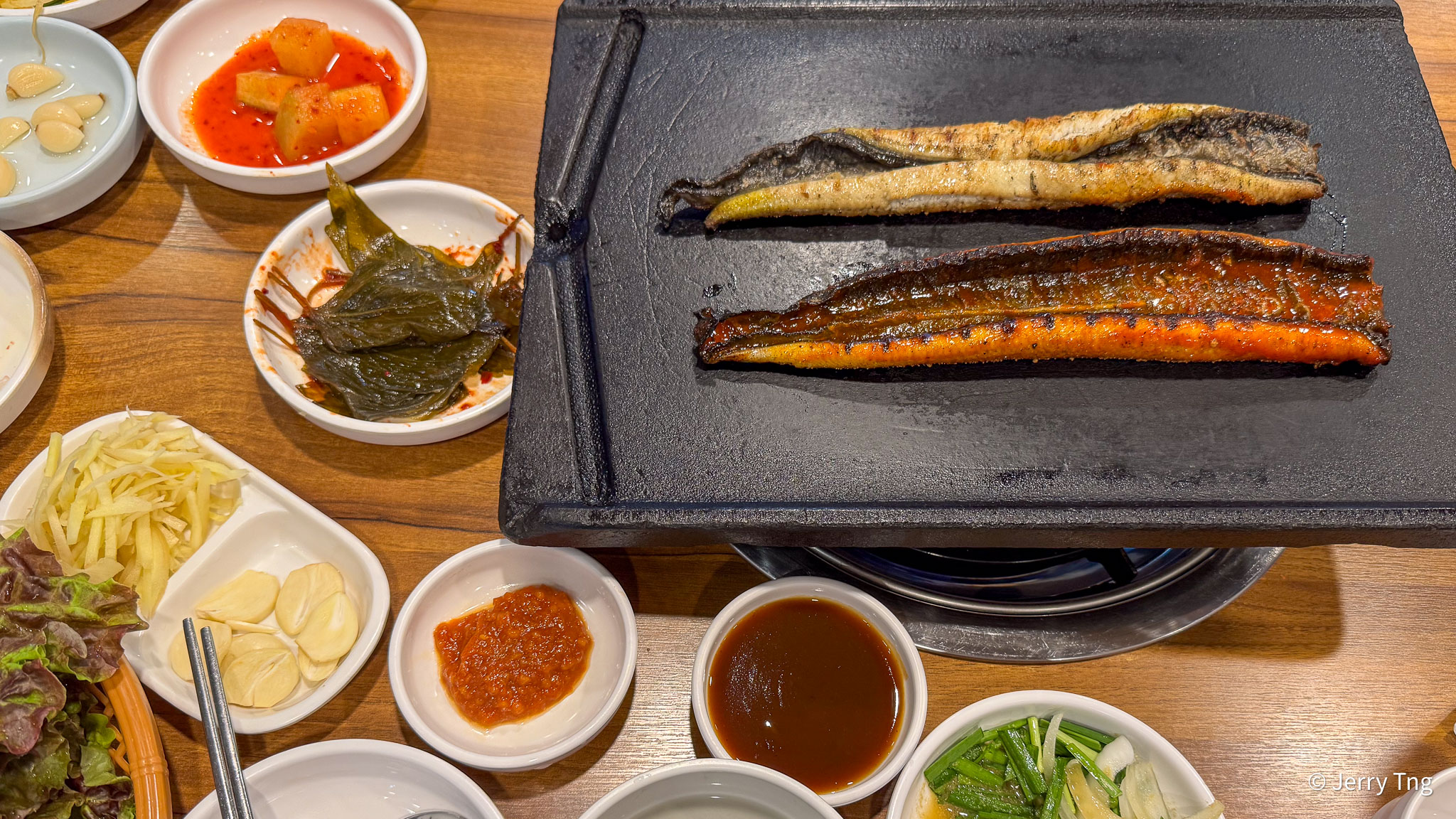
Freshwater eel is a very popular dish in Korea, and many restaurants focus on this. I was walking around my usual place of abode looking for a popular one around Bukchangdong.

Dongwon Freshwater Eel 동원 민물장어 has been serving the same thing for more than 30 years. Jangeo gui 장어구이 (grilled freshwater eel, aka unagi in Japanese) is believed to give one strength during the summer heat, and eaten during the summer months.

Minmul jangeo 민물장어 refers to freshwater eel in Korean cuisine. The eel served are all brought to the restaurant live in the morning, and slaughtered upon ordering. The side dishes called banchan 반찬 are also made fresh each day.

After I had placed the order, a cast iron hot plate was placed on the stove on my table and heated up. At this point nothing else was on the table and it was a summer night, the place got hot very quickly.


And then the banchan were brought to the table, and like all Korean restaurants, these are refillable. Together with the banchan were a cold seaweed (kelp) soup and freshly mixed chopped chives and yellow onions.

Snake-like and nocturnal, eels are mysterious creatures. Contrary to salmon, eels live in rivers and go to the sea to lay eggs. The eggs are laid in a place with high water pressure so the reality is that the environment cannot be reproduced, so farming is done by catching what comes over from the sea to the river.


You must order at least one piece of eel per person, which costs 38,000 won per eel. And it comes in three flavours – original, spicy and sweet soy sauce. The service staff will help grill it in the kitchen and then served them on the hot plate. Then the eels are cut into slices and left on the plate to keep warm. Cold eels are horrible, just ask the English.

When comes to eels, Koreans like to grill them and wrap the grilled eel with lettuce or perilla leaves and add some ginger or garlic. It has been used as a tonic food since ancient times, as well as for medicinal purposes due to its nutritional value. Wild freshwater eels cost between 100,000 and 200,000 won per kilo. Considering the price compared to the quantity, it surpasses even Korean beef.

The ajummas were excellent and they were not shy to “instruct” you how to eat the eels. They didn’t speak any English, and I had to depend on a translation app to order. However they took my hand and assembled a ssam, did the universal hand sign to wrap it up and put it in my mouth.

For unknown reason, they refused to let me put the kimchi or the pickled perilla leaves onto the wrap. But the accompanying brown sticky sauce that tasted like a cross between hoisin and sweet rojak prawn paste was really satisfying.

Eel is a powerful food ingredient that symbolises power. In general, tails have been known to be good for men’s stamina and have been commonly used, and even now the myth is spreading a lot. All power is concentrated in the tail of the eel, so it is said that eating the tail is like eating an entire eel.

It was a traditional grilled eel restaurant where you can enjoy delicious eel. I think the various side dishes went well with the eel. But it was the service and cute, friendly ajummas that stole my heart. Highly recommended!
Dongwon Minmul Jangeo (Freshwater Eel) 동원 민물장어
1st,2nd,3rd floor, 22-6, Sejong-daero 14-gil, Jung-gu, Seoul
Tel : +82 2 734 9776
Visited Jul 2025
0 comments on “Dongwon 동원 @ Seoul”