
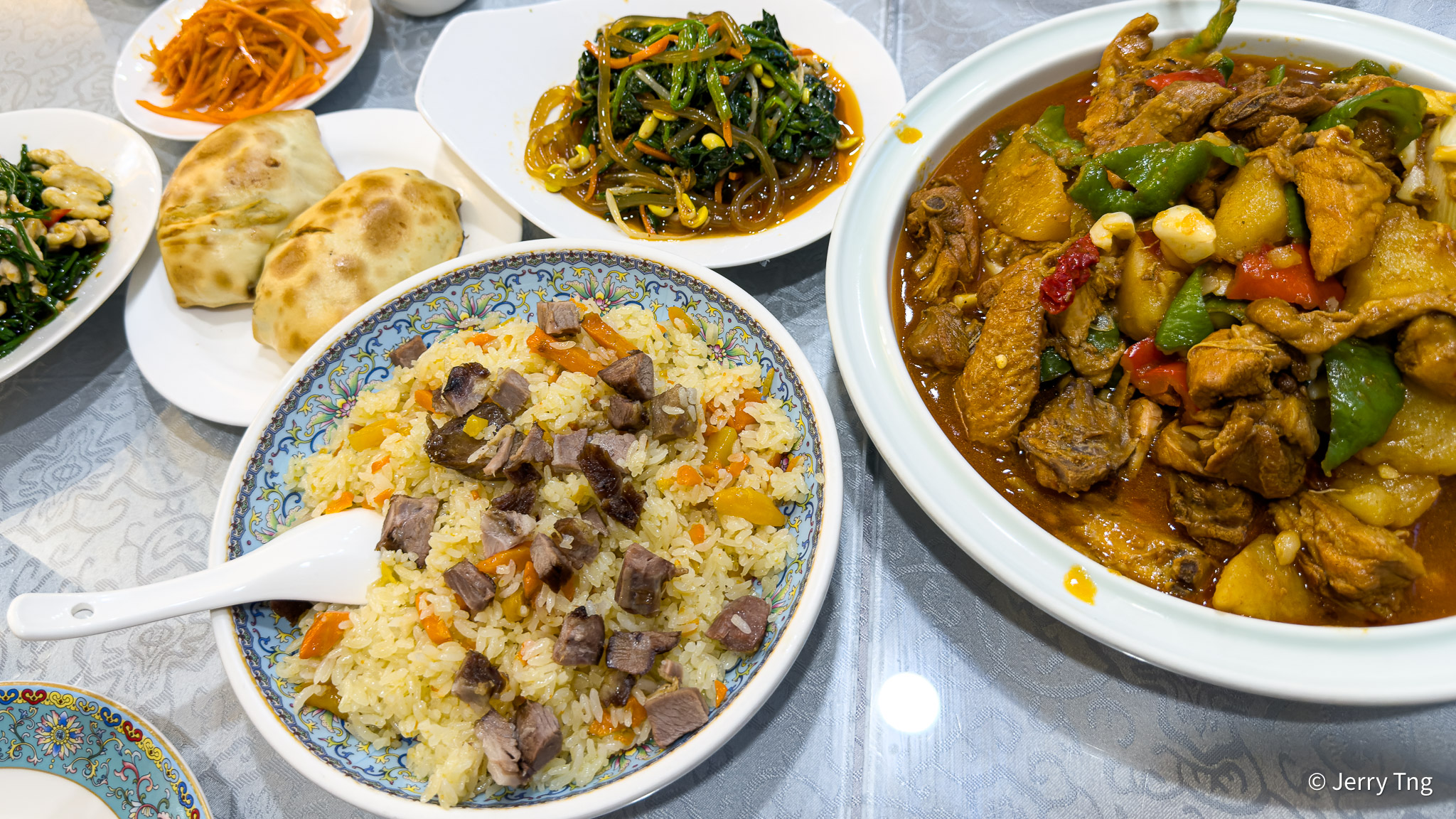
We had lots of fun memories of dining in this restaurant in Xinjiang Liaison Office in Beijing. Not only the food is authentic with ingredients and chefs all coming from Xinjiang, the hospitality was uniquely Xinjiang.

Khan Tengri is a majestic 7,010-meter (22,999-foot) pyramidal marble peak in the Central Tian Shan range, located on the tripoint border of Kazakhstan, Kyrgyzstan, and China. Meaning “Ruler of the Skies,” it is the world’s most northerly 7,000-meter peak.

Khan Tengri Restaurant is the most famous part of the Xinjiang Liaison Office in Beijing. Almost everyone that goes there goes to the restaurant. Opened in 2010, it has become the beacon of Xinjiang cuisine in Beijing, attracting Beijingers and tourists alike curious about the cuisine.

Located in the new wing where they operate a hotel, the lobby transports you to an exotic place, with Islamic art decorating the marble walls.

Since my first visit in 2012, this place has not changed much. The kitchen has glass windows for everyone dining in the main hall to see the busy activities inside. There used to be a stage where they will perform belly dancing and other Uyghur cultural shows during dinner time. I guessed that has stopped since the Covid years.
Our Dinner Menu
Xinjiang Big Plate Chicken 新疆大盘鸡

The “curry chicken” of Xinjiang. It is a spicy hot chicken stew served on a big plate and gained popularity in the mid-to-late 1990s, and is said to have been invented in Shawan, northern Xinjiang by a migrant from Sichuan, who mixed hot chilli peppers with chicken and potatoes in an attempt to reproduce a Sichuan taste. The chicken is not the highlight, the sauce is. And homemade noodles (like a pasta) is added underneath the heap of chicken to soak up all the sauces. Yummy, but I prefer to add the noodles after we finished the chicken then for them to get soggy in the sauce.
Xinjiang Mixed Salad 新疆凉拌菜

I don’t think this salad has Xinjiang origin, more like an appetiser with Chinese tastes.
Hand-grabbed Rice 手抓饭

It is like our Nasi Lamb Briyani and eaten in the same traditional way, using our bare hands if you dare! Hence it has the moniker, “hand-grabbed” rice. There’s no turmeric; instead saffron is added to create that familiar yellowish tint. The taste is totally different from Nasi Briyani.
Lamb Baked Buns “Samsa” 羊肉烤包

“Samsa” is the Uyghur name for baked buns, a traditional specialty snack of the Uyghur and other Central Asian ethnic groups in Xinjiang. It is made by rolling out unleavened dough into thin sheets, wrapping it with a rich filling, folding it into a square or triangle, and then baking it in a special tandoor oven. When you break open one, the overwhelming fragrance of the lamb fills the room. Be careful as you bite into one – they are deceivingly hot inside.
In case you are wondering how is it related to our curry puffs or samosa. While samsa and samosa share the same linguistic roots and trace their origins to the same ancient Central Asian pastry, they evolved into two distinct treats. Samsa is typically baked and meat-heavy, whereas samosa is deep-fried and often vegetarian.
Mongolian Chives with Walnut 沙葱拌桃仁

This salad I tried the first time in a Mongolian restaurant. Mongolian chives is an Asian species of wild onion native to Mongolia, Inner Mongolia, Tuva, Kazakhstan, and parts of China. It is not as pungent as Chinese chives, often compared with scallions but sweeter.
Lamb Kebabs 铁钎烤肉

This is not the more expensive lamb kebabs with willow sticks. I don’t see how the cedar sticks add to the flavour of the kebabs. The flavours come from the spices – cumin, paprika, rosemary, thyme, etc – that are sprinkled liberally on the lambs. And it comes from the fats burning in charcoal fire in the pits in the restaurant. So I don’t mind the metal skewers, even though the skeptics will squeal from such a technique.
BBQ Lamb on Willow Branch 红柳羊肉串

Salt cedar or Tamarix (or more commonly called in China as Rose Willow 红柳) is a native plant species in Xinjiang. I ordered just two sticks as it costs 4x more than the kebabs on metal skewers as a comparison. No difference between the two in terms of taste.
Grilled Lamb Kidneys 烤羊腰

Not to be outdone, the lamb kidneys were a class act on their own. If you are not game for the strong smell of a urinary organ, then you will not like this in any way. However the spices used to grill the kidney helped in reducing the muskiness, it did cover every bit of the unique taste.

The restaurant has seen a better time. Xinjiang cuisine is now much more popular and accessible than before so many other restaurants have popped up closer to the centre of town making this location less attractive. The food quality has remained pretty much the same, so I wasn’t surprised that the picky diners would want something more exciting and instagrammable. But I guess they wouldn’t go away as they are state-owned and so the employees are actually civil servants, which explains the poor service level. Nevertheless, it is also the most value-for-money eat for Xinjiang food in Beijing as you need to pay for rent and other incidents that the commercial restaurants have to bear.
Khan Tengri Restaurant 汗腾格里风味餐厅
北京市海淀區甘家口街道三里河路7號新疆嘉宾楼
Visited Apr 2026
0 comments on “Khan Tengri 汗腾格里 @ Beijing”