
Suddenly the weather changed in Kyoto – it was so hot for the first few days, and then it rained continuously for two days, and today the temperature dropped to the low 20s (˚C). And with such “cold” weather, a nabe (hotpot) meal was in order. I was looking for a shabu-shabu place or a kaniya (crab house), and this place popped up.

Sapporo Kaniya is one of the largest crab specialty restaurants in Hokkaido. Their sukiya-style interiors are inspired by the refined aesthetics of traditional tea-ceremony architecture, and recreates a serene and tranquil ambiance through meticulous attention to detail. Every dining party is seated in a semi-private cubicle (private rooms are for party of 8 or bigger) where you cannot see your neighbours.

But the interior did not help when your next cubicle was seated with uncouth and noisy Taiwanese diners. How I know they are not Chinese? They were taking at the top of their voice in Taiwanese dialect. However bad manners are not the exclusivity of one country. Kyoto is full of tourists behaving badly these days.

Hokkaido is famous for four major types of crab, with the hairy crab (kegani, not to be confused with the Chinese mitten crabs) being the signature local favourite prized for its sweet, delicate meat and exceptionally rich, creamy kanimiso (crab brain/paste); snow crab (zuwaigani, usually served in hotpot); hanasaki crab (hanasakigani, spiny and rare); and, the red king crab (tarabagani) being the most iconic and luxurious.
【かにと鰻祭り】かにと鰻会席 夏彩(なついろ)Crab & Eel Kaiseki “Natsuiro” (Colors of Summer)
お通し Appetizer

I ordered a course meal which cost ¥6,050 including tax. But let me warn you that the photos usually depict a meal for two persons. So when dining alone, the portion would be smaller than the photo, and when I took the photo for this post, the overall effect was not as dramatic. Also, those that you see on YouTube with the thick and big chunks of crab are usually the king crab. What I was having was the zuwaigani which is known for long, slender legs and a delicate, sweet flavour, and again, less dramatic.
ズワイかにお造り Snow crab sashimi

First course, snow crab sashimi (ズワイかにお造り); I am not a fan of crab served as sashimi because the texture of raw crab wasn’t very appealing to me. But the taste of the crab was magnificent. The sweetness of the crab was to die for. A metal crab picker was provided to help you pulled every morsel of flesh from the crevices.
かにグラタン Crab gratin

Next, a crab gratin filled with the rich, savoury kani-miso (crab tomalley) of horsehair crab. The word comes from the French verb gratiner (to broil or form a crust); a gooey, cheesy crust was formed over the carb tomalley mixed with bits of potato and cream. It was a good eat, and very satisfying as I particular enjoy kani-miso for what it is.
かにシューマイ Crab shumai dumpling

The gratin was followed by a small snack of crab shumai (Japanese steamed dumplings) with a dashi glaze. Unfortunately it was cold when served and I wasn’t used to eating cold shumai. However< I was still amazed by the knife work of the chef, just look at the tiny bits of onions and bell peppers floating on the glaze.
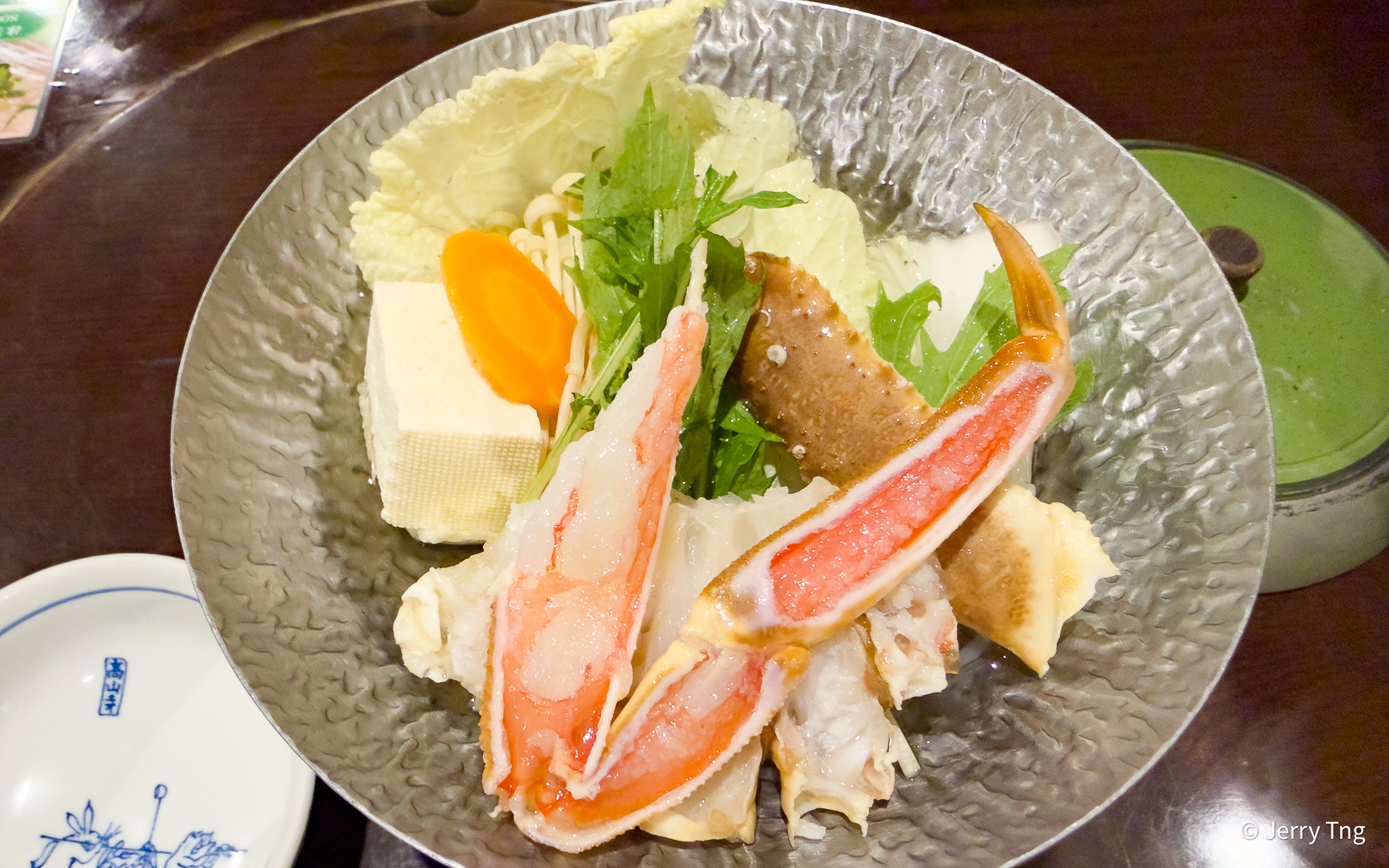
ズワイかに小鍋 Snow crab small hot pot


Next, the main attraction for the meal – snow crab hot pot, or kani-suki. It was served on a single portion with everything in it on a metal pot over a small chemical fire source. It was like the type of hot pot served in the kaiseki meal after an onsen bath in a ryokan.

They carefully select only “hard-shell” crabs (katakani)—prized for being packed full of meat. The hot pot brought out the delicate, refined sweetness of snow crab. I was tempted to order more crab, but then there’s the unadon that’s coming at the end. I shall resist the temptation.
茶碗蒸し Steamed egg custard (chawanmushi)

The crab chawanmushi came really late in the meal. In fact I had to remind the waitress before she sent me one immediately. It had a tiny piece of crab craw meat, ginkgo nut and that’s it.
かに天ぷら Crab tempura

And just before the unadon course, the crab tempura. It was really small serving of three pieces of vegetable (sweet potato, lotus root, okra) and a single piece of snow crab leg.
ニうな丼、香の物、汁物 Mini eel bowl, Pickles, Soup

These days, they are all operated by a F&B group and for Kaniya, they have a sister restaurant that specialises in charcoal-grilled freshwater eel with a special sweet and savoury sauce (unagi kabayaki), sliced served on rice, known as hitsumabushi (ひつまぶし). A single serve portion of unadon (eel on a bowl of rice), with miso soup (汁物) and pickles (香の物) round up the savoury part of the dinner. Of course it’s delicious, as the unadon was authentically Nagoya-style hitsumabushi.
デザート Dessert

And for dessert, it was simply a ball of matcha ice cream. And it wasn’t Haagen Daz.

The building itself was honored with the 1995 Kyoto City Urban Landscape Award (Architecture Category) in recognition of its exceptional design and harmonious integration with the historic cityscape of Kyoto. In addition to their crab specialties, their also offer premium Japanese Wagyu beef served as shabu-shabu or sukiyaki for people allergic to seafood or folks suffering from gout. Other than these, the meal was delicious, a great value for the amount of food served, and perfect for solitary gourmet like me.
Sapporo Kaniya 札幌 かに家 京都店
2, Tsukimicho, Higashiyama, Kyoto, Kyoto, Japan
〒605-0829 京都府京都市東山区月見町2番地
(京都府京都市東山区東大路通祇園石段下南入ル)
Tel : +81 7 55411110
Visited Sep 2026
0 comments on “Sapporo Kaniya 札幌 かに家 @ Kyoto”