
One last meal before leaving Osaka, and I didn’t wander far from my hotel, which is located to Osaka OCAT building that offer direct limousine bus connection to Kansai Airport.) There’s still one genre that I have not tried this trip – teppanyaki.

Located on the 22nd floor of Hotel Monterey Grasmere Osaka, directly connected to Namba Station, Teppanyaki “Kobe” offers a stunning panoramic view through its large windows, providing a relaxing experience.

The counter seating allows for attentive service, and the live cooking right in front of you adds to the excitement. A dedicated teppanyaki chef serves each party of diners, and as I was alone, I had the chef all by myself!

There were three choices of set lunches available, all with their signature Japanese black cattle beef. I checked, they cannot offer an alternative to the beef, so if you are not into beef this restaurant is not for you.
六甲 ROKKO Lunch Menu (Sep 2026)

Once the order was placed, all the ingredients were prepped and placed along the counter space behind the specially built stainless steel grill.

And I was also surprised how good this zero alcohol beer tasted, almost like real beer without the burden. Unfortunately it is currently unavailable in Singapore, and the Heineken version did not come close.
Small Appetizer 食前のお愉しみ

First up, a small espresso cup of cold corn soup with a dash of olive oil and sprinkling of dried parsley flakes.
Today’s Hors d’oeuvres 本日のオードブル


The next course was a trio of appetisers that included prosciutto ham with fresh fig, hamachi ceviche with ikura, and roasted duck breast with balsamic glaze, served with dollops of nasu (eggplant) sauce and edamame sauce and some pickled vegetables. All of them delicately prepared, all of them delicious.
Scallop, Prawn 帆立貝・海老
You get to choice from two out of three seafood (the third being a daily fish option) available. I couldn’t believe that you even have to make a choice. I never had a pleasant experience with fish on teppanyaki, so I chose the other two which I always enjoy very much. To my disappointment, there was only half a scallop (but mind you the scallop was huge!)

I was surprised that so much oil was used to make this course, but then you have a corn hash brown that was actually “deep-fried” on the flat grill. I really enjoyed the prawn head that the chef took a lot of effort to flatten to form a crispy wafer.

Despite all the oil used, the course was not greasy and was delicious. The shellfish were on point, and the hash brown was crispy on the outside, fluffy inside.
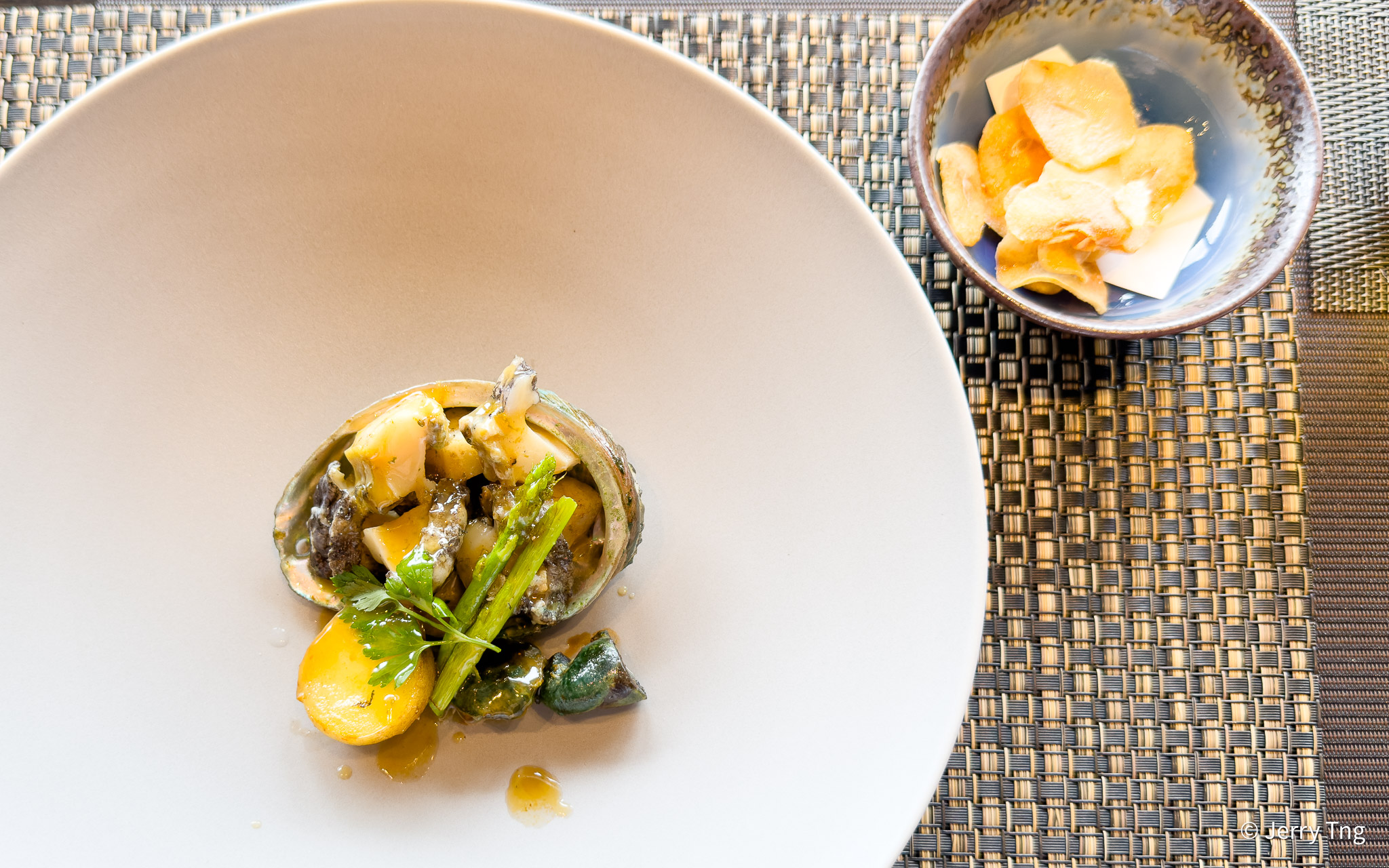
Sautéed abalone 活鮑
This is the most exciting part of every teppanyaki meal – live seafood. But I know a lot of you cannot stand the look of squirmishing mollusc on a hot plate, you should ask them to prep the abalone in the kitchen.

Unlike in Singapore, where almost all the teppanyaki restaurants will take the abalone liver to prepare a rich sauce, Japan’s version usually serves the abalone straight up, with the liver pan fried right in front of you.

Abalone is a strange ingredient, and can turn up really bad at the hands of mediocre chefs. The live abalone course is a test of the teppanyaki chef, as he would need to control the doneness of the mollusc while making sure the flavours were properly infused into the dense flesh. Here, the flesh was left uncooked so the natural sweetness of the shellfish came through nicely, while the outer crust was doused with a nice layer of butter sauce.

And to balance the taste, a side of garlic flakes was provided. The oil used to fry the garlic was then used to cook the rest of the courses.
Seasonal Vegetables 季節の焼野菜

Late summer and early autumn vegetables in Osaka feature a delicious mix of lingering summer crops and the very first harvests of the cooler autumn season (shun, or peak season); Mizunasu (Water Eggplant) is a famous Osaka (Senshu region) specialty – it has ultra-thin skin and high water content, making it so sweet and juicy that it can be eaten raw in salads or lightly pickled during late summer; Kabocha (Japanese Pumpkin) peak harvesting begins as the weather cools, offering a dense, sweet, and nutty flavour ideal for grilling or simmered dishes (nimono); Satsumaimo (Sweet Potato) early varieties start appearing in September, famous for their starchy sweetness and used in traditional roasted street food (yakiimo) or autumn rice dishes. Kyohai peppers are coming to end of season but these hot and sweet peppers remain abundant through early September, great for quick pan-frying or grilling.

You can only pick four types, and a single small portion of each was provided. I picked the shiitake mushroom, mizunasu, makomodake (Manchurian wild rice, aka water bamboo shoot) and satsumaimo.

The vegetable course was served together with the beef course, with its own two types of sauces – a garlic infused soy sauce and a ponzu sauce with mashed radish.
Special Japanese Beef Sirloin 80g 黒毛和牛フィレ

The piece de resistance for the lunch menu is the Japanese wagyu beef course. Teppanyaki is one of the best way to enjoy Japanese beef. Just before we begin, here’s a primer – all wagyu is Japanese beef, but not all Japanese beef is wagyu. Wagyu (和牛) translates to “Japanese cattle” and strictly refers to four native purebred breeds: Japanese Black, Japanese Brown, Japanese Polled, and Japanese Shorthorn.


Today’s cut is A5 Japanese Black sirloin from Kobe, an elite, world-renowned luxury steak cut sourced exclusively from the pure Tajima strain of Japanese Black cattle. It features fine, white web-like fat distributed evenly through the meat, creating a buttery texture that melts on the tongue. The beef is sizzled quickly on a hot iron griddle with minimal seasoning to let the natural sweet aroma shine.

I requested the meat to be medium rare. It came with three types of salt as its condiments, nothing else was added to the cooking process except for a dash of freshly crushed black pepper. There’s nothing that can replace true Japanese wagyu beef; despite all those wannabes around the world, nothing come close to the real thing.

The first (on the right) is fine sea salt, the second is a seaweed-infused sea salt from Awajishima and the third is Okinawa salt flakes; three different textures and tastes, I liked the Okinawa one the best because it was flakes and had a better bite.

It was so buttery and smooth, and the taste lingered for much longer than the usual Angus steaks. However it did not have the beefy taste of Angus. Thankfully, it was a small tasting portion, as the fattiness of the beef can be overwhelming if you were served the typical Western filet portion of 8 oz or ~220g or 12 oz (340g) sirloin.
Today’s Salad, Homemade Dressing ミックスサラダ 自家製ドレッシング

At this point, almost two hours have passed, and the rest of the set menu was coming up fast and furious. The daily salad mix came with the steak course, and had strips of salted konbu. Now I know what to do with my bags of salted konbu strips.
Garlic Rice, Miso Soup and Pickled Vegetables ガーリックライス 赤だし香の物

As usual, the rice course came with the standard miso soup and pickles. For a little extra, I traded the normal rice for their garlic fried rice.

It wasn’t the Cantonese-style Yangzhou fried rice – not as dry, but this one still had the pan-grilled wokhei and a nice garlicky taste. The surprise was the bits of wagyu beef in the rice.
Today’s dessert 本日のデザート

The dessert was a mango cheese tart, with mango sorbet and pieces of randomly placed fruits.

The lunch was really value-for-money, but several courses were “lunch portions”, ie smaller than usual. The service was impeccable, but as the chef did not speak much English, it was a really quiet meal with little interactions (which is what’s missing in a typical counter meal in Japan). Other than those two irrelevant lows, I really enjoyed myself and picked the perfect way to wrap up a great trip to Japan.
Teppanyaki Kobe 鉄板燒 神戶
(inside Hotel Monterey Grasmere Osaka, 22F)
1 Chome-2-3 Minatomachi, Naniwa Ward, Osaka, 556-0017, Japan
Tel : +81 6-6645-7111
Visited Sep 2026
0 comments on “Teppanyaki Kobe 鉄板燒 神戶 @ Osaka”